
One thing that always comes up when I have an in person conversation with a builder and developers is that the traditional approach of decentralized storage options seems to be a trade off expensive, inefficient, or not directly connected with modern smart contract solutions. That is exactly what my own conversations and research have indicated is the issue that @Walrus 🦭/acc has set out to address with a new take on decentralized storage architecture, to which the Sui ecosystem is no exception. 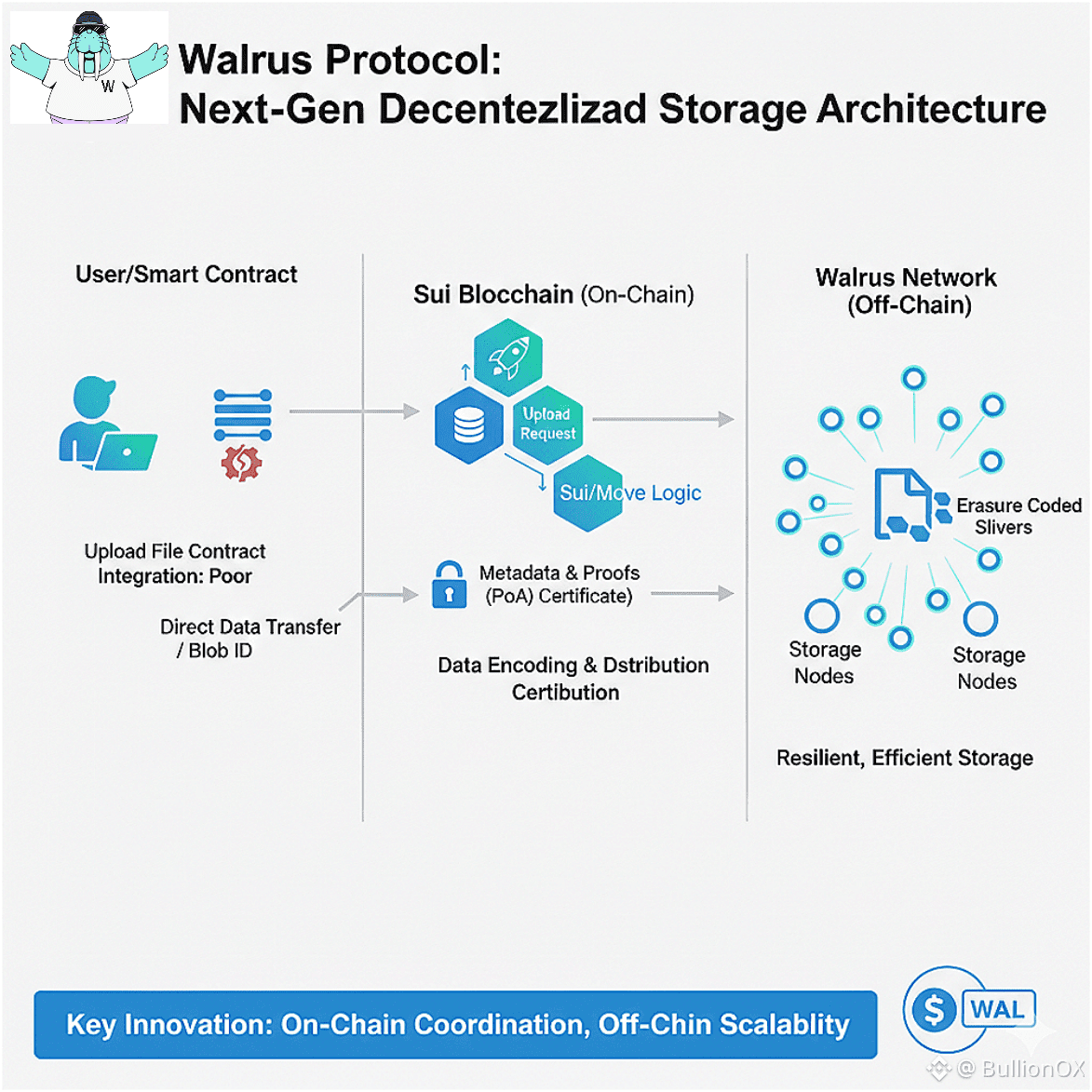
Fundamentally, Walrus is a decentralized data availability and data storage network that reinvents the management of large, unstructured data in Web3 including media files, datasets, and application artifacts. Walrus does not encode data on a blockchain as this is expensive and inefficient; instead, it relies on more efficient erasure coding to break data into encoded pieces (so called slivers) and store them at a large number of independent storage nodes. It implies that the system does not have to store full copies in all locations but information can still be reassembled even when the parts of the network fail. 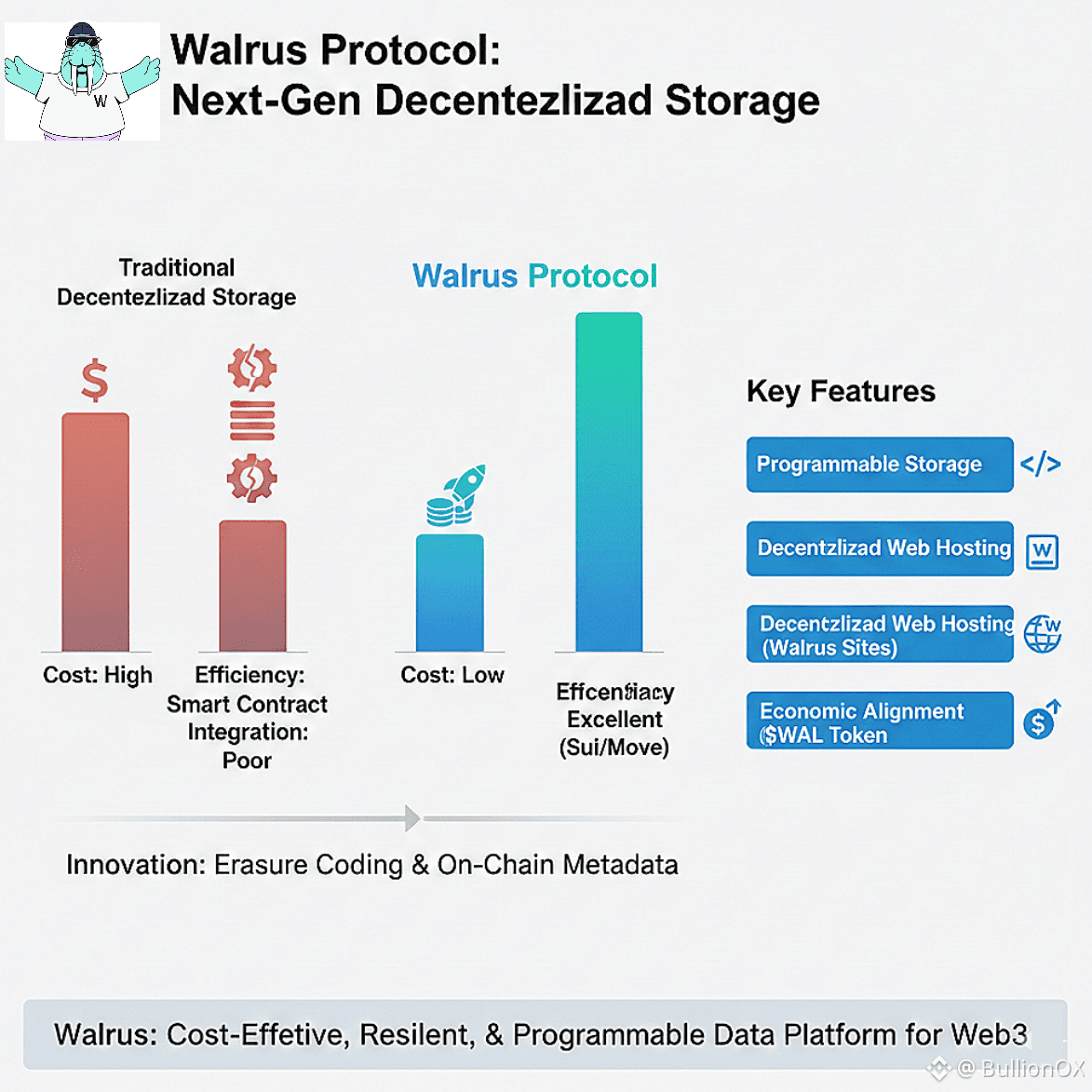
This architecture tends to find traction even in discussions with developers, as it trades off cost, availability and resilience. The encoding technique, sometimes known as Red Stuff in Walrus literature, is much more readily available than full replication, and comes at a much reduced storage cost. This renders decentralized storage not only an ideal state of matters, but feasible and usable at scale.
The way Walrus integrates into the Sui blockchain is one of the design innovations that I continue to point out. Rather than putting files on-chain, which would soon be prohibitively costly, the Walrus only stores metadata and cryptographic proofs of availability as objects on Sui. These evidences enable users and smart contracts to confirm the existence of the data and ability to retrieve them without having to store and read the entire content directly on the chain. It is this close on chain/off chain interaction that renders the architecture efficient and trustworthy.
Practically, placing a file on Walrus gives it a blob ID and is divided into fragments that are spread among a dynamic committee of storage nodes. When enough nodes have verified that they possess the assigned fragments, the system produces a certificate on chain known as a Point of Availability (PoA) that certifies that the file is available. At that stage, the network assumes the role of ensuring the access during the entire storage period. This isolation of responsibility upload responsibility/long term availability responsibility is what I explain to others as a strong assurance that many of the older storage protocols lacked.
The other feature that I have to explain repeatedly is the support of programmable storage resources by Walrus. Since storage capacity and blobs themselves are themselves on chain objects, developers can access, authenticate and expand them directly in smart contracts written in Sui in the Move language. This exposes new patterns in design where storage is no longer just passive data, it now becomes part and parcel of application logic. To name a few, there is the option of periodic renewals, transfer of storage rights, or even automated contracts based on data lifecycle.
Walrus has also been extended into more than simple storage such as Walrus Sites which allows fully decentralized static web hosting directly on the Walrus and Sui networks. They are used to store HTML, CSS, JavaScript, and media in Walrus blobs, which are connected to human readable addresses and exploit decentralized distribution and resistance to censorship. When I explain it to individuals excited about frontends in Web3, they tend to draw the line instantly: apps that appear and feel like conventional ones but exist on fully decentralized infrastructure.
The only thing that Walrus can really boast of is its ability to allow you to bridge the gap between on chain logic and off chain storage without compromises. The coordination, metadata, and prove attestation of Walrus are done with Sui blockchain; therefore, Walrus does not reinvent consensus or execution. Rather, it concentrates on what it is most efficient in efficient, resilient, and verifiable data storage at scale.
This design relies on the use of $WAL where incentives between the storage providers and users are synchronized. Storage, reward node operators and governance are paid with WAL and make the ecosystem run sustainably as time goes by. Such a matching of economic incentives and technical guarantees allows the use of decentralized storage and attract developers who are concerned with its durability and reliability.
In the more general sense of decentralized storage, Walrus is a next generation architecture, one that is constructed with cost efficiency, recoverability, and on-chain programmability in its core. It does not merely provide a location to trash files; it provides a platform on which data is a verifiable and indivisible component of decentralized applications. That was the reason why, when speaking to builders, Walrus has frequently been referred to not only as storage, but since it facilitates new Web3 application and experience designs.
With increasing developers looking to create multimedia dApps, decentralized web experiences, blockchain archives or AI data layers, Walrus provides a scalable and resilient base which fulfills real life requirements without compromising decentralization. In that regard, Walrus is transforming the design of decentralized storage to make it more cost effective and siloed rather than an expensive, coordinated, and programmable data platform of tomorrow.


