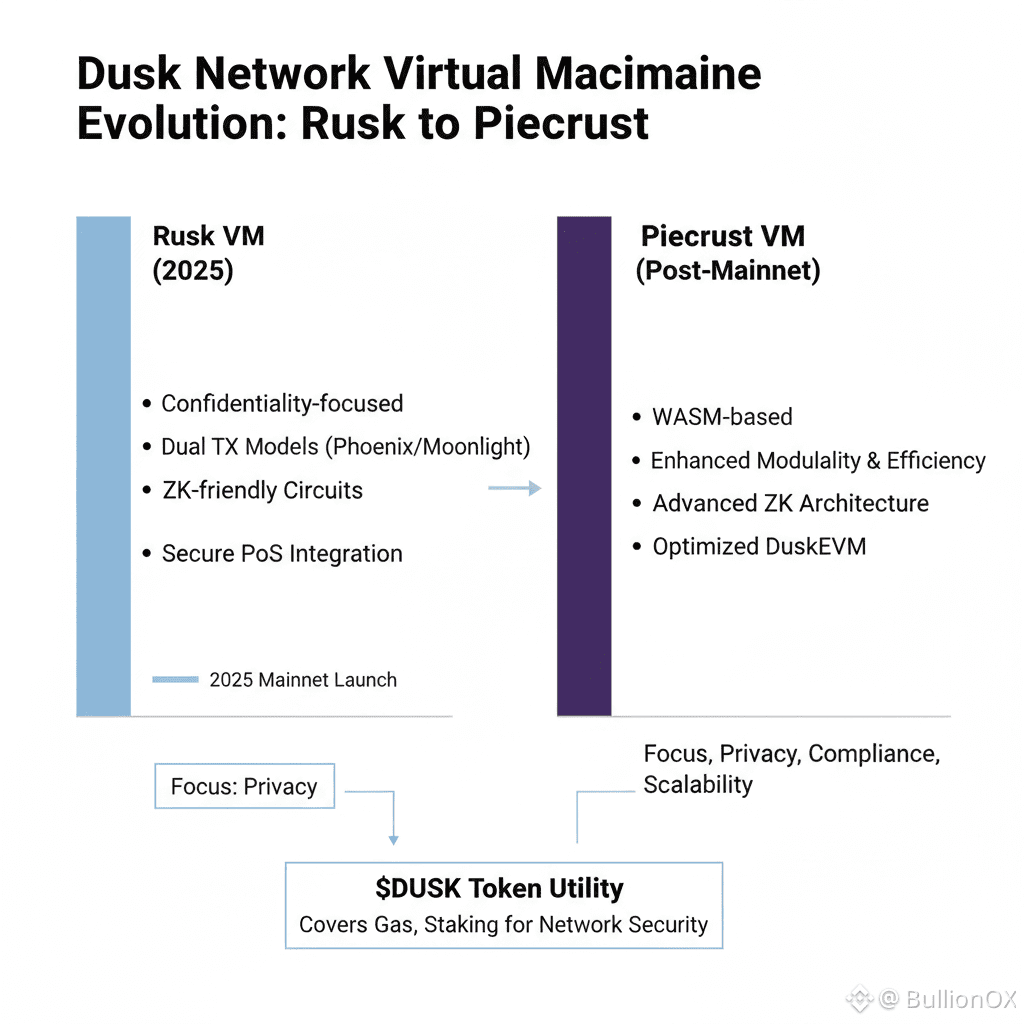
I have delved into @Dusk Network's technical evolution over the years, one aspect that really captures the project's commitment to privacy first finance is the progression of its virtual machine. Starting with the Rusk VM and moving to Piecrust, this journey reflects a deliberate design to enhance execution efficiency while maintaining strong support for zero-knowledge proofs and confidential computations. It's not about flashy changes but building reliable infrastructure for regulated use cases.
Rusk VM laid the groundwork when Dusk was developing its mainnet, which went live in early 2025. As the original runtime environment, Rusk was designed to handle smart contract execution with a focus on confidentiality. It supported Dusk's dual transaction models phoenix for shielded, private operations and Moonlight for public, compliant ones ensuring that contracts could run deterministically even with hidden states.
From my experience tracking blockchain VMs, Rusk's strength was in its integration with Dusk's consensus, allowing for secure, verifiable execution in a Proof of Stake setting. It optimized for ZK friendly circuits, enabling proofs that confirmed contract logic without revealing inputs or outputs, which is crucial for financial applications where data privacy is non negotiable.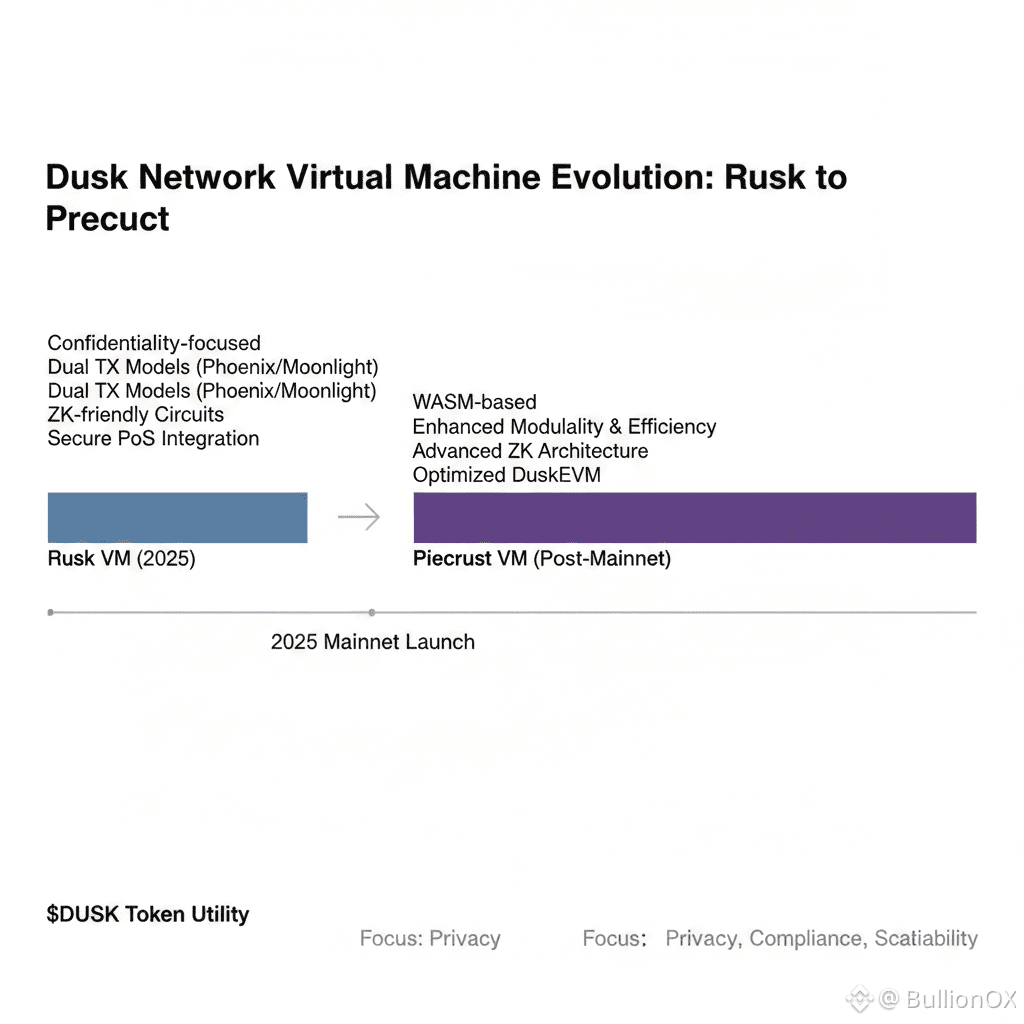
However, as Dusk aimed for greater scalability and developer accessibility, limitations in Rusk became apparent particularly in performance for complex contracts and adaptability to new standards. This set the stage for an upgrade, aligning with Dusk's vision of long term utility in compliant DeFi.
Enter Piecrust, the evolved virtual machine that represents a significant step forward. Introduced as part of Dusk's post mainnet roadmap, Piecrust is WASM based, offering better modularity and efficiency for contract execution. It builds on Rusk's foundations but improves resource management, making it more suitable for high-throughput financial operations without sacrificing privacy.
Piecrust's design intent is clear: to support advanced ZK architecture while being developer friendly . It allows for seamless upgrades without hard forks, meaning the network can adapt to new cryptographic standards or performance needs over time. This is especially relevant for regulated finance, where systems must evolve with legal frameworks like MiCA.
In practice, Piecrust enhances DuskEVM, the EVM compatible layer, by optimizing ZK proof generation for confidential smart contracts. Contracts can execute privately, with proofs attesting to their correctness, reducing computational overhead and enabling real world applicability in areas like tokenized securities.
The transition from Rusk to Piecrust wasn't abrupt; it was iterative, with testing phases ensuring backward compatibility. This careful migration preserved existing contracts while unlocking new capabilities, such as faster execution times and lower costs for private operations key for institutional adoption.
Throughout this journey, the $DUSK token plays its role in the economic layer, covering gas for VM operations and staking to secure the network, tying the VM's efficiency to overall ecosystem health.
What strikes me about this evolution is how it embodies @Dusk pragmatic approach: focusing on incremental improvements that enhance privacy and compliance without disrupting users. In Web3, where many projects chase novelty, Dusk's VM path prioritizes stability and utility for regulated environments.
Have you noticed how VM upgrades impact privacy chains? What's one change you'd like to see in blockchain execution tech?