
When I started paying closer attention to how Web3 applications actually work day to day, one thing became clear. Most chains focus on persistent storage for things like transaction history or static files, but real applications need more than that. They need quick, reliable access to data in the moment, almost like memory in a computer, to feel responsive and useful. Persistent storage alone is not enough when you're dealing with dynamic dApps, AI agents, or rich media experiences. @Walrus 🦭/acc Protocol addresses this gap by building a decentralized layer that combines durable availability with practical performance for retrieval.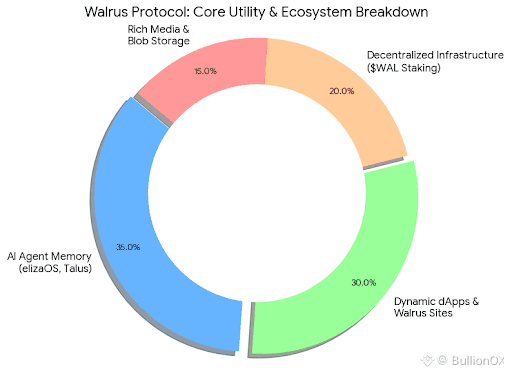
Walrus is designed as a blob storage network on Sui, where large unstructured data gets encoded and distributed efficiently. The protocol uses RedStuff, a two dimensional erasure coding system, to split blobs into slivers across independent nodes. This keeps replication low, around 4x to 5x, while ensuring data can be reconstructed even if many nodes are temporarily unavailable.
What sets it apart is the emphasis on making data not just stored forever, but accessible when needed. Uploads generate an on chain Proof of Availability certificate on Sui, which verifies retrievability without full downloads. Retrieval happens through aggregators that collect slivers and deliver the blob, often paired with caching layers or CDNs for faster access.
In conversations with developers, I've seen how this matters for agentic AI workflows. Projects like elizaOS use Walrus as a foundational memory layer for multi agent systems. Agents store context, training data, or shared knowledge as blobs, retrieving it quickly and verifiably. This creates a decentralized equivalent of working memory, where data is provenance tracked and auditably available without centralized servers.
Similarly, Talus Network leverages Walrus for on chain AI agents that handle higher data demands like context storage or model weights. The combination allows agents to recall information efficiently, supporting complex, stateful behaviors in a decentralized way.
For everyday dApps, this means hosting dynamic content or media that loads smoothly. Walrus Sites, for instance, store full website resources as blobs, enabling frontend delivery with low latency through gateways or caches, while Sui handles metadata and ownership.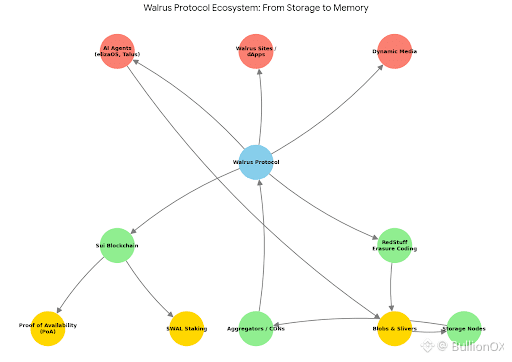
The key insight is that Web3 has plenty of ways to store data permanently, but without fast, reliable retrieval, applications stay clunky. Walrus bridges that by prioritizing both long term resilience through incentives and $WAL staking for nodes, and practical access that feels closer to memory operations.
This approach feels like a natural evolution. Persistent storage secures the past, but memory like capabilities enable the present and future of interactive Web3 experiences.


