
When I speak directly with developers and creators about Web3, one concern always comes up naturally: storing large data safely without relying on centralized services. Blockchains are excellent for transactions and logic, but they are not designed to store heavy files like NFT images, videos, AI datasets, or application assets. This is exactly where @Walrus 🦭/acc fits into the conversation in a very practical way.
Walrus is built as a decentralized storage and data availability protocol that works alongside the Sui blockchain. Instead of forcing large data onto the chain, Walrus allows applications to store data off chain while still maintaining cryptographic guarantees of availability. In simple terms, the blockchain records proofs that the data exists and can be retrieved, while the actual data lives in a decentralized network of storage nodes.
What impressed me when I first explored Walrus is how it treats storage as infrastructure rather than an afterthought. Files are broken into encoded pieces and distributed across many independent storage providers. Even if some nodes go offline, the data can still be reconstructed. This makes the system resilient by design, without relying on trust in any single operator.
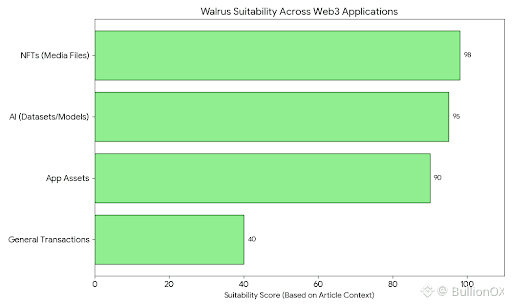
This design becomes especially valuable for NFTs. Many NFT projects depend on media files that must remain accessible for years. With Walrus, NFT content is stored in a decentralized way and referenced on chain using unique identifiers. Users can verify that the content is available without loading the full file onto the blockchain. This solves a real problem that many NFT creators face today.
AI builders I have spoken with face a similar challenge. Training data, model checkpoints, and experiment outputs are too large for on chain storage. Walrus allows these datasets to be stored securely while still being verifiable through blockchain references. This opens the door for decentralized AI workflows that require both scale and trust.
Another important aspect is economic sustainability. Storage on Walrus is paid for using $WAL which aligns incentives between users and storage providers. Providers are rewarded for maintaining data availability, encouraging long term participation instead of short term speculation. This makes the network more stable over time.
What stands out to me most is that Walrus does not try to replace blockchains. Instead, it complements them. Developers can build applications where logic lives on chain while data lives in a decentralized storage layer designed specifically for scale and reliability. This separation is what makes the system practical for real world use.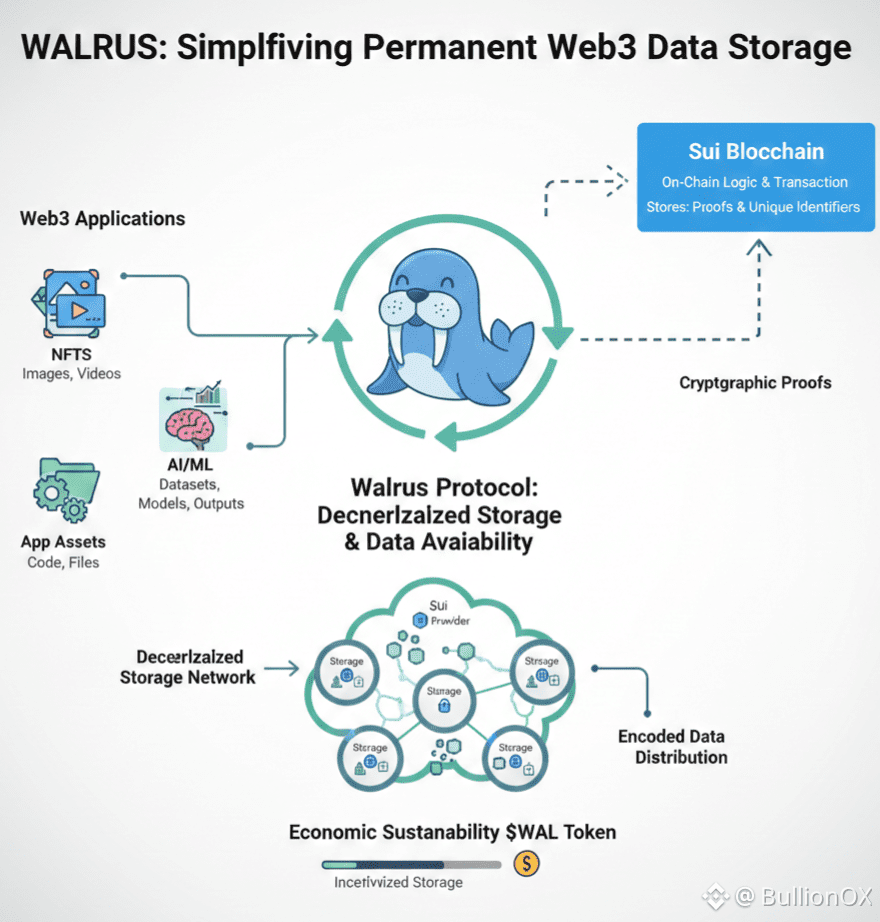
From my experience explaining this face to face, Walrus resonates because it solves a problem developers already have, rather than inventing a new one. It brings permanence, efficiency, and verifiability together in a way that feels natural for modern Web3 applications. That is why #Walrus is becoming an important part of conversations around decentralized infrastructure, especially as data heavy applications continue to grow.


