


Stablecoin payments are often described as “easy” or “instant,” but those words hide an important detail. As systems remove friction, they also remove hesitation. When a payment flow becomes simple enough, users stop treating it like a financial operation and start treating it like a reflex.
This behavioral shift is where Plasma’s design choices become interesting.
Plasma is a Layer-1 blockchain built specifically for stablecoin settlement. Instead of optimizing for general-purpose activity, it focuses on making stablecoin transfers predictable, fast, and low-friction. Features like gasless USDT transfers, stablecoin-first gas, and PlasmaBFT sub-second finality are not just technical upgrades. They reshape how users interact with payments.
When Friction Disappears, Expectations Change
 On many blockchains, stablecoin transfers carry visible friction. Users think about gas fees, confirmation times, and whether the network is congested. That friction acts as a pause, forcing people to double-check before acting.
Plasma removes much of that pause.
When sending a stablecoin does not require holding a volatile gas token, and when finality arrives quickly and consistently, the action starts to feel routine. Transfers stop being events and start becoming background operations. This is exactly what payment infrastructure aims for—but it comes with consequences.
As friction drops, expectations rise. Users assume that once a transfer is initiated, the system will behave consistently every time. Any delay or ambiguity stands out more sharply, not because it is worse than before, but because it violates a new baseline of reliability.
Stablecoin-First Design as a UX Decision
Plasma’s stablecoin-first approach is often described in technical terms, but its most immediate impact is on user behavior. Gasless transfers reduce cognitive load. Stablecoin-denominated fees align costs with the value being moved. Sub-second finality shortens the gap between action and outcome.
Together, these elements push stablecoin payments closer to how traditional digital payments feel: simple, repeatable, and predictable. For retail users in high-adoption regions, this matters because stablecoins are used as everyday money. For institutions, it matters because workflows depend on consistency more than novelty.
Reliability Over Feature Density
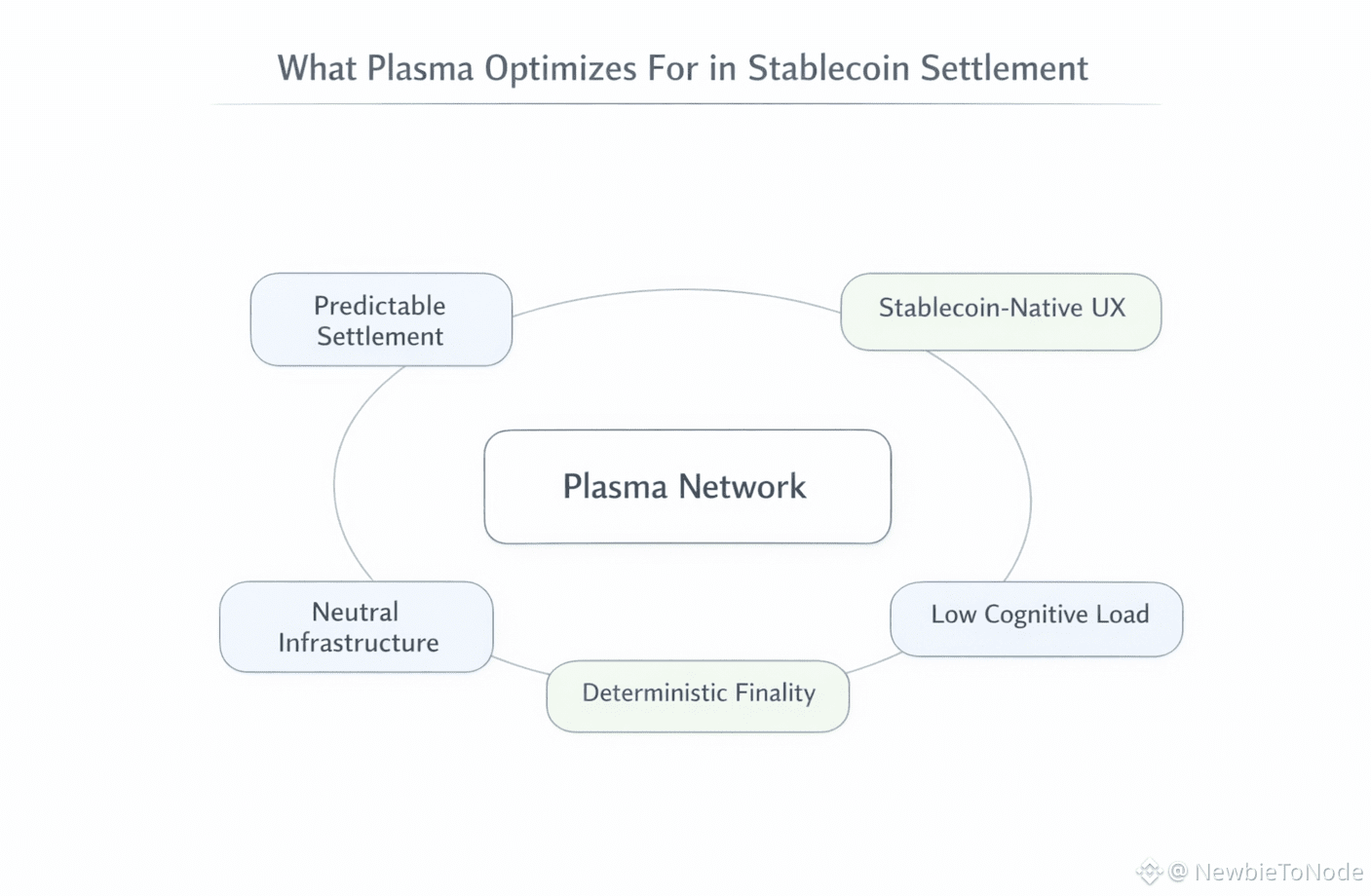 Plasma’s design reflects a broader shift in Layer-1 priorities. Instead of competing on the number of features or applications, it optimizes for a specific role: settlement. This specialization reduces complexity at the edges and concentrates effort on making one thing work well under real conditions.
Bitcoin-anchored security reinforces this focus. Neutrality and censorship resistance are not abstract ideals in payment infrastructure; they are prerequisites. Users need confidence that transactions will not be influenced by who they are, where they are, or how often they transact.
The Trade-Off Plasma Embraces
Making stablecoin payments feel simple does not eliminate responsibility—it redistributes it. As systems become faster and cleaner, teams must rely more on the consistency of the underlying network. Plasma embraces this trade-off by prioritizing deterministic behavior over flexible ambiguity.
This approach may not appeal to every use case, but it aligns well with the reality of stablecoins becoming core financial infrastructure rather than speculative instruments.
A Different Way to Think About Speed
Speed in isolation is easy to advertise. Predictability is harder to deliver.
Plasma’s value lies less in being fast and more in being consistently fast, consistently clear, and consistently aligned with stablecoin usage. As stablecoins continue to move from crypto-native tools into everyday finance, infrastructure designed around their behavior—not adapted later—may prove more durable.
Plasma represents that design philosophy: stablecoin settlement treated not as an add-on, but as the foundation.

