
Have you ever wondered what truly secures the future of your digital assets? It isn't just cryptography or code—it's a resilient, economically sound network. At the heart of the Walrus protocol, WAL staking operates on a unique principle: it transforms passive token holding into the active, load-bearing architecture of a decentralized internet. This isn't just earning yield; it's about participating in a self-reinforcing cycle of trust, security, and sustainable growth.
Forget what you know about typical DeFi staking. Walrus tackles a fundamentally different challenge: securing not just transactions, but the world's data. Its design turns stakers into essential guardians of Web3's foundation, creating a network that grows stronger and more trustworthy with every participant.
The Unseen Backbone: Staking in a World of Data
Most blockchains are designed for execution—processing transactions quickly and cheaply. Walrus is engineered for persistence. Its job is to store large, unstructured data (like NFT media, AI datasets, or social content) securely and permanently on the Sui blockchain. This mission creates a unique economic reality.
The Cost of Durability
Running a storage node isn't like running a validator. Costs are largely variable; storing more data requires significantly more hardware. If a node needs to hold two petabytes instead of one, it doesn't just add a single drive—it must scale out infrastructure to maintain security and resilience through data sharding. This makes the business model for operators delicate.
This is where WAL staking introduces genius. The protocol's pricing is intertemporal. Users pay upfront for long-term storage, but those fees are distributed to stakers and operators over time, aligning payment with the ongoing service of securing data. Stakers, by delegating to reliable nodes, don't just earn rewards—they directly influence which nodes are entrusted with the network's integrity, ensuring data remains available even if up to two-thirds of nodes fail.
The Trust Flywheel: How Staking Creates Unshakeable Confidence
Trust in blockchain is often discussed in abstract terms. In Walrus, it's a tangible, engineered outcome. Research in blockchain-enabled systems shows trust doesn't appear magically; it transfers from proven mechanisms to the platform and, ultimately, to its community. WAL staking is the core mechanism that powers this transfer.
Visualizing the Stake-Operator-User Cycle
The process creates a virtuous, self-strengthening loop. Stakers seek reliable nodes to maximize returns. Nodes compete for stake by proving performance and reliability. Users get robust, cost-effective storage. Each group's success is tied to the others', building collective confidence in the entire system.
- For Stakers: You provide economic security. By staking WAL, you're voting for the most reliable nodes. Your rewards come from a sustainable model where protocol revenue—paid by users—is distributed over time. There's no artificial inflation; rewards are tied to real, growing usage.
- For Operators (Nodes): Staking is your license to operate and your reputation. You must stake WAL to participate, aligning your incentives with the network's health. Your commission is a share of real storage fees, incentivizing you to provide robust, uptime-guaranteed service.
- For Users & Developers: You get the assurance of true data ownership. Your files aren't just off-chain links; they're verifiably stored on a resilient network. The competitive node market, fueled by staker delegation, drives efficiency and cost reduction over time.
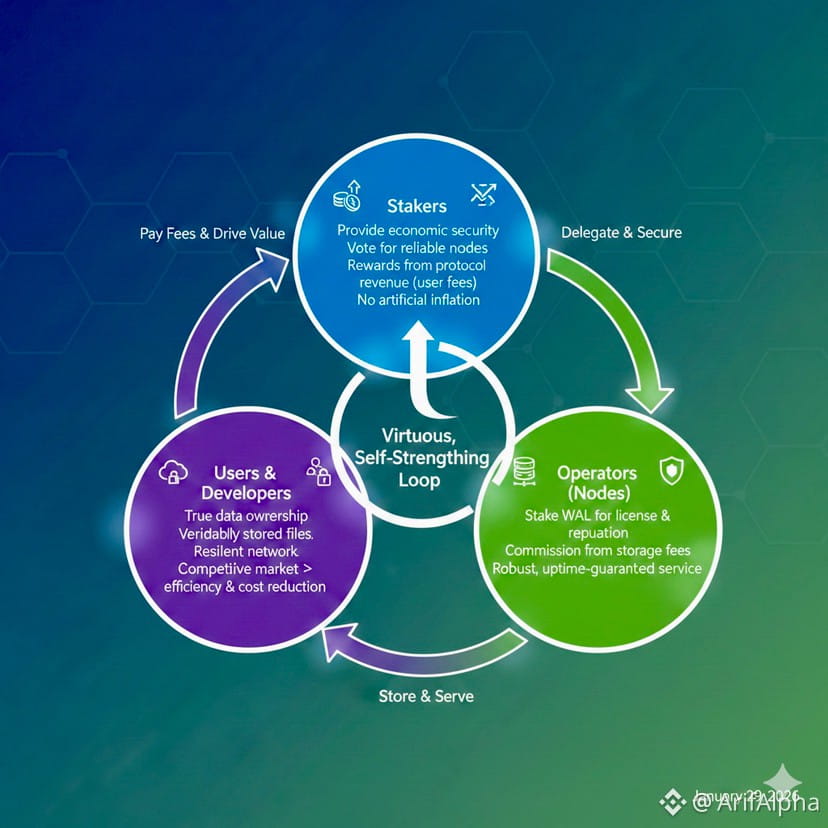
This cycle turns the WAL token from a simple asset into a credential of trust. Holding and staking it means you have skin in the game for the network's honest performance. This active participation is what academic research identifies as a key driver for "trust in platform," which directly increases adoption and usage intention.
Beyond APR: The Long-Term Economic Symphony
Many staking models bait participants with high initial yields that are unsustainable. Walrus flips the script. It's built for long-term economic viability. Initial staking rewards are modest, but they are designed to scale attractively as network adoption grows.
Why? Because the economics are tied to real value creation.
A storage operator's costs rise roughly linearly with the amount of data they manage.
A staker's rewards also increase with network usage, but without proportional rising costs.
This creates a powerful dynamic: as Walrus scales, stakers capture more value from a growing revenue base. Furthermore, the model has a built-in feedback loop for user benefit. As scale brings efficiencies, market mechanics encourage the network to pass savings to users via lower storage prices. This isn't altruism; it's smart growth. Cheaper storage attracts more users, which further increases network revenue and security—fueling the flywheel.
Becoming a Guardian: Your Role in the Ecosystem
Engaging with WAL staking is straightforward and crucial. You can stake directly through the Walrus Staking App using compatible wallets like Martian or OKX. When you stake, you're not just locking tokens. You are:
Earning Passive Income: Rewards accrue after just one epoch, with no slashing risks.
Shaping Network Resilience: Your delegation choices help select the highest-quality nodes.
Supporting a Foundational Web3 Service: You're underwriting the infrastructure for the next generation of dApps, NFTs, and AI projects.
For those seeking deeper engagement, liquid staking platforms like Winter Walrus offer derivatives (e.g., wWAL) that can be used in DeFi on exchanges like Cetus, creating additional yield opportunities.
The Bigger Picture: A Stake in the Decentralized Future
In a digital landscape riddled with central points of failure, Walrus represents a paradigm shift. It's not trying to be another DeFi farm. It's building the bedrock. WAL staking is the critical mechanism that ensures this bedrock is stable, trustworthy, and aligned with everyone who depends on it.
This is about more than price speculation. It's about participating in the economic layer that makes a decentralized internet possible. By staking WAL, you are voting for a future where data is sovereign, infrastructure is resilient, and trust is engineered into the system.
What specific aspect of Walrus's long-term, utility-backed economic model gives you the most confidence as a potential staker or user? Share your perspective below.
@Walrus 🦭/acc #Walrus #walrus $WAL

