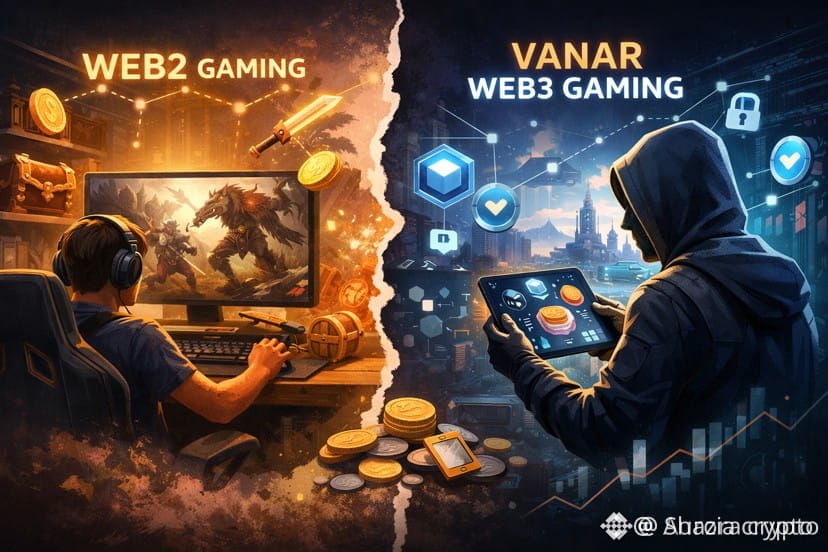
The first time I moved value inside a web3 game, it wasn’t exciting. It was a pause. A small hesitation before clicking confirm. Not fear, just that quiet “should I?” moment that never really existed for me in web2 games. @Vanarchain $VANRY #vanar
In web2, value moves invisibly. Skins, gold, progress bars — they feel owned, but only emotionally. You don’t stop to think about where they live or how they move. In Vanar, and in web3 gaming more broadly, that illusion breaks early. You feel the transfer. Even when it’s fast. Even when it’s cheap. And that alone changes how you behave.
Games are supposed to be frictionless. Stable loops you fall into without awareness. So it’s strange that the moment games start handling real value, the experience becomes heavier. You stop clicking automatically. You slow down. Sometimes you hesitate longer than the action deserves.
That shift isn’t really about wallets or chains. It’s psychological. Web2 trained us to treat progress as temporary, resettable, revocable. If something breaks, it’s someone else’s problem. Web3 doesn’t promise that. And Vanar doesn’t seem interested in pretending otherwise.
What stood out to me wasn’t ownership rhetoric. It was predictability. When actions carry value, you start wanting boring infrastructure underneath. Systems that behave the same way every time, especially when usage spikes or sentiment changes. Most general-purpose chains don’t feel built for that. Games end up competing with everything else — launches, drops, noise. Latency starts to feel emotional. Fees feel personal. You don’t blame the chain. You blame the game.
Vanar feels narrower by design. Less flexible, more constrained. And that limitation feels intentional. Fewer surprises. Fewer edge cases. Not perfect, but calmer. Gasless interactions matter here, not as a feature to advertise, but as psychological relief. The moment players have to think about mechanics outside the game loop, immersion cracks.
The token layer is quieter than I expected. It doesn’t pull attention. It just sits there, coordinating validators, keeping the system alive. Not an object to dream about, more like plumbing you only notice when it fails.
None of this guarantees adoption. High on-chain activity doesn’t mean players stay. Habits take time. Validators leave when incentives thin. Stress shows up when markets move fast and assumptions get tested.
Compared to web2, this feels fragile. Compared to other web3 ecosystems, it feels restrained. Neither is clearly better. Maybe this is what the transition actually looks like. Not fun versus finance, but lightness versus responsibility. And the open question remains: will this kind of infrastructure become something players don’t have to think about at all, or will it stay a thoughtful experiment that quietly asks more from users than they’re willing to give?