
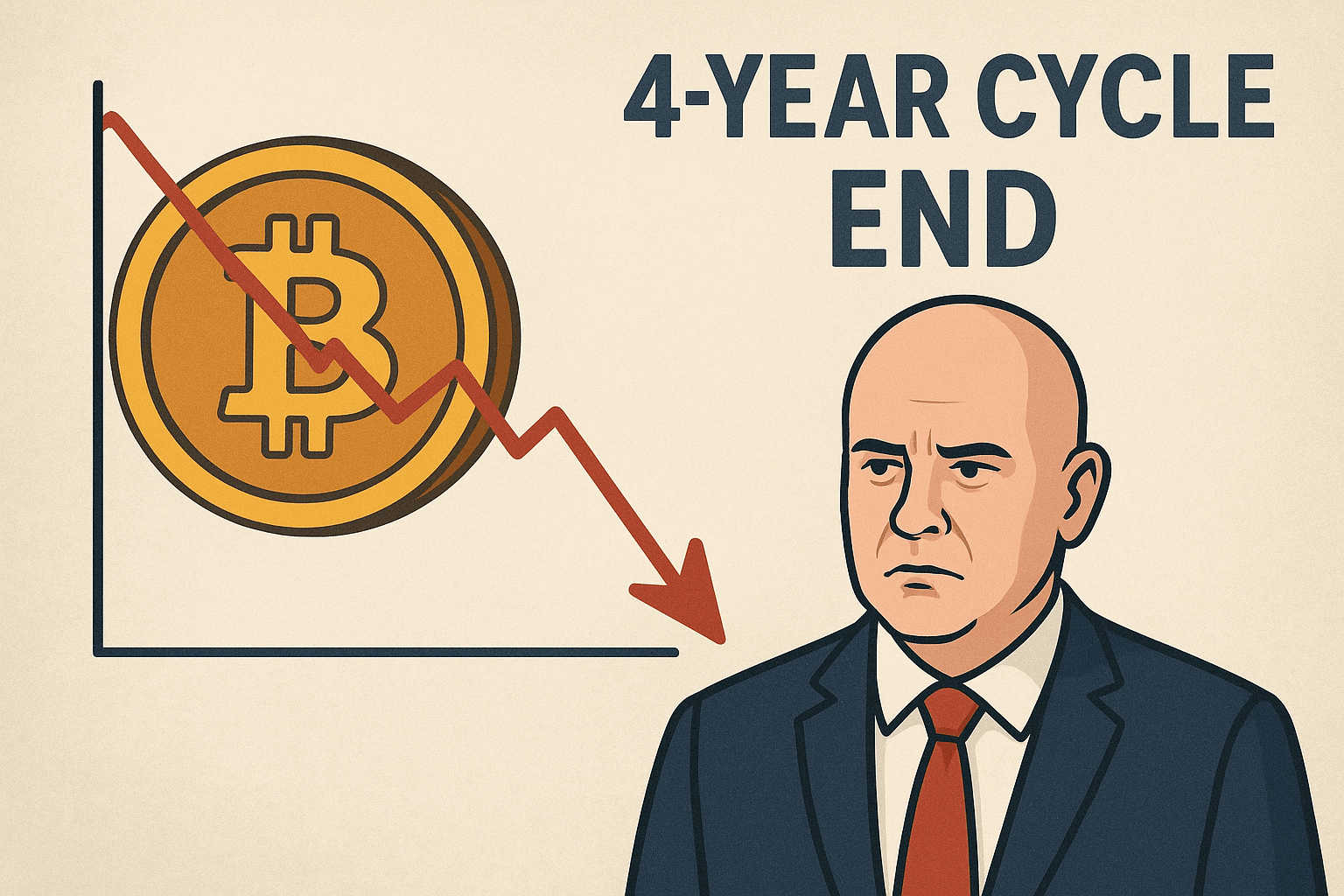
Charles Edwards, founder of Capriole, believes that Bitcoin's 4-year cycle model – which is linked to halving events – has officially ended. However, the reason is not that the market has stabilized, but because the 'motivation' that previously caused 80–90% drops has disappeared, destroyed by Bitcoin's own scarcity design.
Bitcoin – The 'Hardest' Asset in History
In the Capriole Update #66 (August 15, 2025), Edwards emphasized: after the halving in April 2024, the growth rate of Bitcoin supply has dropped to 0.8% per year, less than half of the 1.5–3% rate of gold. This makes Bitcoin the most scarce asset humanity has ever known, with new supply issued almost being just 'rounding errors' compared to total demand.
The consequence is: deep drops from selling pressure from miners in previous cycles are increasingly becoming 'artifacts of the past'.
The Cycle Still Exists, But the Dynamics Have Changed
Edwards does not deny Bitcoin's cycle, but he asserts that the reasons have changed. Now, volatility is determined by:
Macroeconomic liquidity
Investor reflex behavior
Extreme pricing on chain
Excitement in the derivatives market
Importantly: the halving schedule is no longer a 'guideline' for turning points. Instead, investors need to focus on global liquidity and institutional cash flow.
Liquidity – The Deciding Factor of Trends
According to Edwards, the 'Net liquidity' index – global money supply growth minus debt costs (10-year US Treasury yield) – is the core measure:
All bear markets of Bitcoin in history have occurred when this index is negative.
In contrast, major bull markets appear when net liquidity is positive.
Currently, he assesses the liquidity environment as positive, with expectations that the Fed will cut interest rates 3 times in the second half of 2025.
On-chain Data – No 'Bubble' Yet
Indicators such as MVRV, NVT, Energy Value often signal the peak cycle when they turn red. But by mid-2025, they are still far from the extreme zone. According to Edwards, Bitcoin is growing steadily, much more sustainably than in previous cycles.
However, the aggregate derivatives indicator 'Heater' has begun to heat up, approaching historical highs. This signals a need for short-term caution, although it is not enough to form a major peak.
Strength From Institutional Cash Flow
A dominant factor in the 2025–2026 period is the absorption of supply by institutions. Currently, more than 150 listed companies and ETFs are buying Bitcoin at a rate 5 times the newly mined supply each day.
Historically, whenever demand surpasses supply at this level, Bitcoin prices have averaged a 135% increase in the following months. However, Edwards warns: institutional demand could quickly turn into supply when they change strategies.
Capriole has thus built an early warning system, monitoring:
The buy/sell ratio of treasury companies
CVD treasury (Cumulative Volume Delta)
Net buying on Coinbase
The number of companies ramping up sales
Long-term Risks: Quantum Computers
Edwards concludes by discussing the most significant potential threat: quantum computing (QC). He believes that in the next 5–10 years, QC could grow faster than Bitcoin by 50% per year, becoming a market over $2 trillion.
While it does not pose an immediate threat in this cycle, quantum computing (QC) could break Bitcoin's security code in the next 3–6 years if no preventive measures are taken. With rapid development (China spending 5 times more than the US, announcing a QC machine a million times stronger than Google), Bitcoin needs to prepare for a quantum-resistant upgrade before it is too late.
Edwards estimates that transitioning the entire network to QC-safe standards could take 3–6 months of transaction processing, due to blockchain limitations. He calls on the community to urgently act through BIPs (Bitcoin Improvement Proposal) related to QC.
Conclusion
Bitcoin's 4-year cycle linked to halving has ended.
The two most important factors in the new era: Net liquidity and institutional cash flow.
The biggest risk: Bitcoin fund management companies – they can amplify both upward and downward trends.
The long-term threat: quantum computing – if unprepared, it will be the 'grim reaper' in the next cycle.
According to Edwards, if institutional capital remains strong, Bitcoin still has a significant price increase phase ahead. But vigilance is essential: instead of believing in the 'outdated 4-year cycle', investors need to learn how to read the new rhythm of the market.