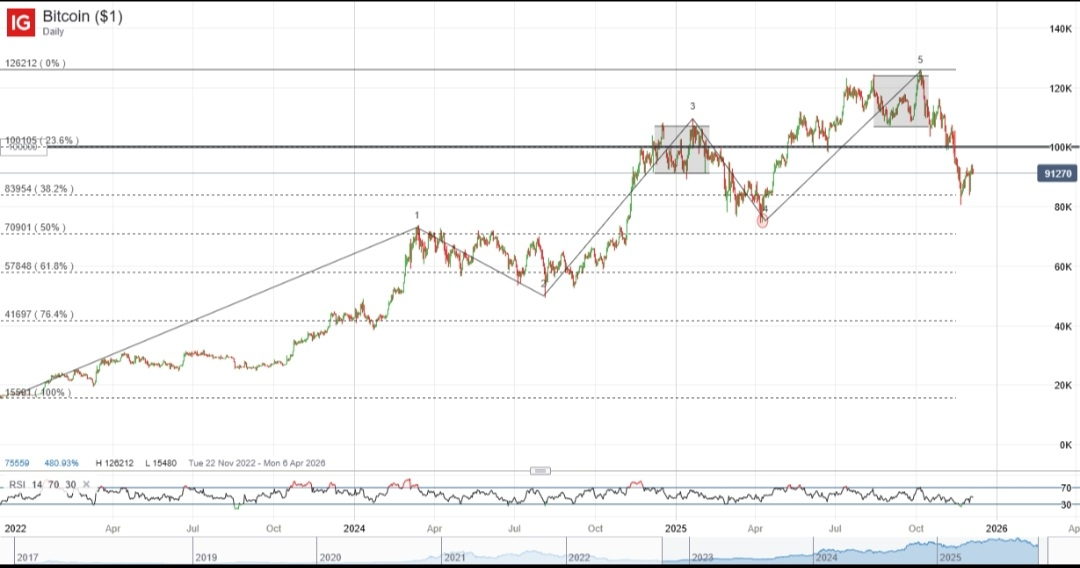
Bitcoin’s price has been under significant pressure in early 2026. After reaching a record high above $126,000 in October 2025, $BTC has seen sharp declines, trading near the $60,000-$75,000 range recently according to multiple market reports.
Key recent developments:
Price slump: Bitcoin has lost nearly half its peak value, falling to levels around $63,000–$76,000 — its weakest in over a year.
Market downturn: Broader crypto markets are also down heavily, wiping out over $500 billion in global value.
Institutional selling: Some Bitcoin ETFs have seen outflows, tightening immediate demand.
Corporate losses: Major corporate holders like Strategy (formerly MicroStrategy) reported huge losses tied to the slump.
Veteran investor Michael Burry has warned of deeper potential sell-offs and “sickening” effects on institutions if Bitcoin continues downward.
Analysts and models highlight risks, with worst-case scenarios suggesting further drops — even below $60,000 or down toward $50,000 levels — depending on market sentiment and macro factors.
📊 What’s Driving the Current Bitcoin Phase?
🔹 Institutional Flows & ETF Dynamics
While institutional flows initially supported Bitcoin’s rise (with over $100 billion flowing into spot ETFs over time), recent outflows and slower ETF momentum have weighed on price growth.
Some research shows that total Bitcoin ETF inflows could still exceed $100 billion by the end of 2026, suggesting structural demand remains — even amid short-term weakness.
🔹 Macro & Liquidity Environment
Macroeconomic factors — especially U.S. Federal Reserve policy, interest rates, and dollar strength — strongly influence Bitcoin’s trajectory. A hawkish rate environment tends to dampen risk assets like Bitcoin, while future rate cuts could rekindle demand.
🔹 On-Chain Supply Forces
Bitcoin’s fixed supply and accumulation by long-term holders continue to support scarcity narratives. Exchange reserves are historically low, meaning less BTC is available for active trading — a factor that could underpin future rallies if demand returns.
🔮 Price Outlook — Wide Range of Scenarios
Unlike traditional assets, Bitcoin’s outlook is highly polarized. Analysts and institutions offer a broad range of predictions for 2026:
📈 Bullish Views
Base-case optimism: Many banks and analysts forecast BTC finishing 2026 in the $120,000–$170,000 range.
Some scenarios even project $180,000–$250,000 toward year-end under strong demand.
⚖️ Moderate / Institutional-Driven
Major institutions like Standard Chartered have revised forecasts to around $150,000 for 2026, reflecting slower but steady growth driven by ETF and institutional demand.
📉 Bearish Scenarios
Continued macro pressure or institutional outflows could keep BTC between $55,000 and $85,000 or even push toward lower support around $50,000–$60,000.
What this means: The forecast isn’t a single number — it’s a range that captures different market forces and macro conditions.
🧠 What Experts & Analysts Are Watching
🔎 Key Indicators
Institutional ETF flows: Continued inflows could flip sentiment bullish.
Macro liquidity: Fed rate decisions and dollar strength matter.
Exchange reserves: Lower trading supply may fuel rallies.
Technical patterns: On-chain and chart signals suggest possible trend shifts.
🗓 Catalysts on the Horizon
Analysts suggest watching events like:
CPI and inflation data
Fed rate announcements
ETF rebalancing flows
Large institutional allocations
These catalysts can trigger short-term volatility but also long-term direction.
🧩 Summing Up the Latest Bitcoin Scenario
Bitcoin’s 2026 narrative is one of transition:
✔️ Short-term weakness and volatility amid macro headwinds and outflows
✔️ Structural demand remains via ETFs, institutional interest, and scarcity
✔️ Wide price forecast range reflects uncertainty and diverse market forces
In many ways, Bitcoin today isn’t just a speculative play — it’s increasingly tied to institutional capital, global liquidity cycles, and macro sentiment. This makes its path less predictable in the short term, but potentially more resilient in the long run.