
 Most blockchain debates obsess over speed, features, and upgrades.
Rarely do they ask a more uncomfortable question:
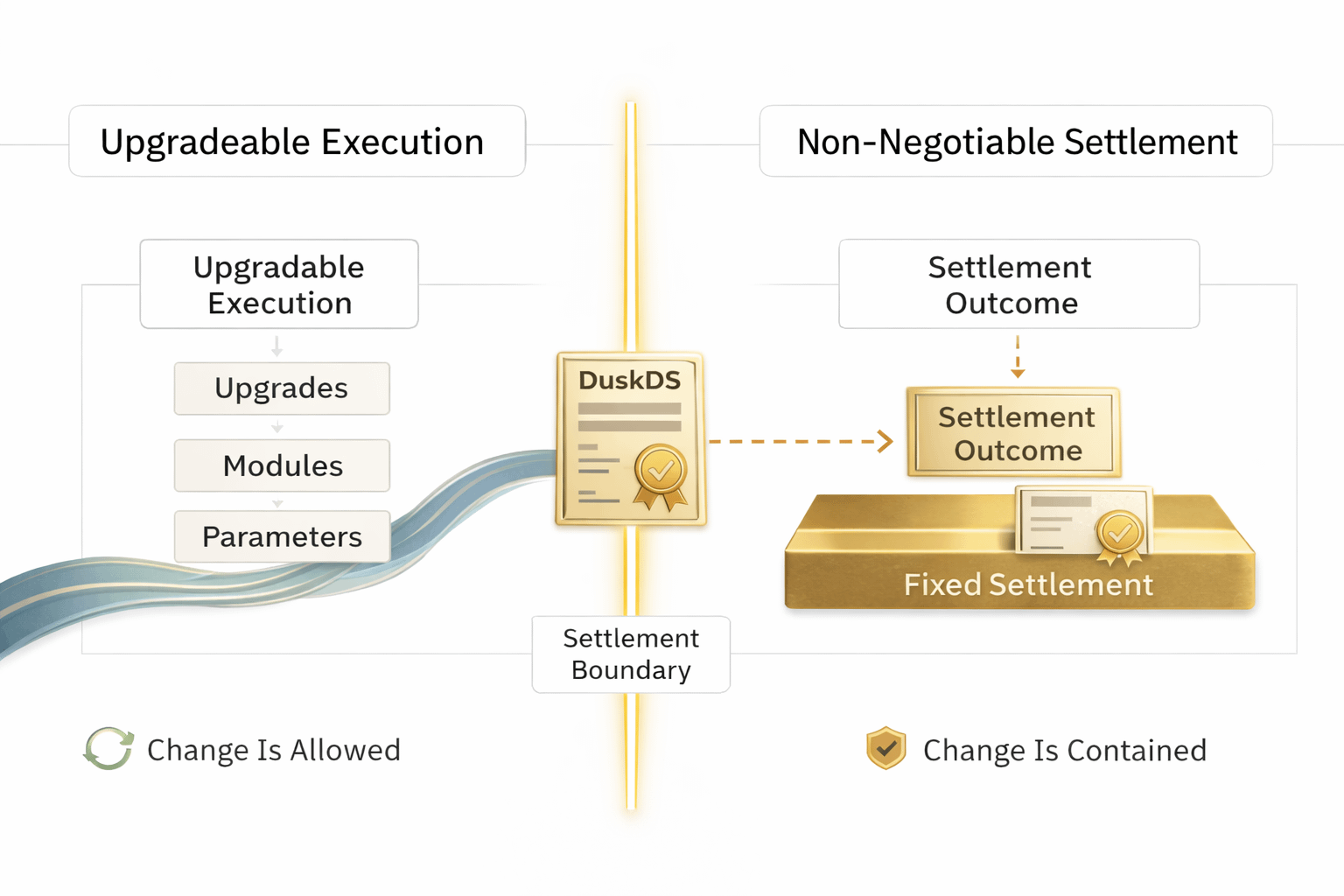
What, exactly, is allowed to change and what must never change at all?
Dusk design starts from that boundary.
Execution Is Where Change Belongs
Execution is the living part of a system.
It’s where applications evolve, bugs are fixed, and performance improves.
In Dusk, execution is intentionally upgradeable:
Smart contract logic can evolve
Execution environments can be refined
Parameters can be tuned as real-world usage reveals edge cases
This flexibility isn’t a weakness it’s realism.
Financial systems don’t survive by freezing execution forever. They survive by allowing controlled evolution where mistakes can be corrected without rewriting history.
Settlement Is Where Change Must Stop
Settlement is different.
Settlement is not about what happened, but about what is now irrevocably true.
Once a transaction crosses the settlement boundary on Dusk:
The state is ratified
Obligations become final
Downstream accounting can safely proceed
No patches.
No reinterpretation.
No “we’ll fix it later.”
This is the line institutions care about most, because this is where legal and financial responsibility begins.
Upgradeable execution without fixed settlement is chaos.
Fixed settlement without flexible execution is stagnation.
Dusk separates the two.
Why This Separation Matters
Most systems blur execution and settlement.
They rely on dashboards, heuristics, and post-processing checks to infer safety.
Dusk doesn’t infer. It certifies.
Execution may look healthy:
Blocks flowing
Validators online
Latency normal
But none of that is settlement.
Settlement requires explicit confirmation that:
Rules were followed
State transitions are valid
Assumptions did not drift
If certification doesn’t happen, the system doesn’t pretend otherwise.
The transaction simply does not settle.
That honesty is the philosophy.
Late Settlement Is a Signal, Not a Bug
In many systems, delays are hidden.
In Dusk, they’re exposed.
A late certificate isn’t treated as noise-it’s treated as stress information.
It tells operators and institutions:
Something changed upstream
Risk assumptions may be shifting
Confidence should be recalibrated
The system stays explainable even when it slows down.
And explainability is more valuable than speed when money, compliance, and trust are involved.
Institutions Don’t Need Excitement
They need guarantees.
They need to know:
When a trade becomes final
When exposure is real
When accounting entries are safe to record
Upgradeable execution lets innovation continue.
Non-negotiable settlement ensures obligations don’t move underneath you.
That’s not a technical choice-it’s a financial one.
The Quiet Strength of Dusk
Dusk doesn’t optimize for headlines.
It optimizes for clear boundaries.
Execution can change.
Settlement cannot.
And once you understand that distinction, you realize why Dusk feels “boring” to some and essential to institutions.
Because the most important part of a financial system is not how fast it moves.
It’s where it refuses to move at all.