

I remember standing in a crowded side event, holding a coffee I didn’t really want, nodding through conversations that all sounded strangely interchangeable. Everyone was building something “important.” Every token had a purpose. Every system promised alignment.
And yet, nothing felt anchored.
It wasn’t that people were dishonest. It was that everything moved too easily, value, attention, conviction. Tokens flowed, narratives shifted, and participation felt less like commitment and more like motion.
I couldn’t quite explain why that bothered me. But it stayed with me.
Over time, I began to notice a pattern.
Most systems in crypto ask a single token to do too much. The same asset is expected to secure the network, govern decisions, incentivize users, and act as the medium of interaction. It becomes a kind of economic multitool.
But when one thing tries to carry everything, behavior starts to blur.
Using the network feels like investing. Governance feels like signaling. Participation starts to inherit the psychology of speculation even when that’s not the intention.
Nothing breaks immediately. It just distorts.
I didn’t fully question this until I came across @MidnightNetwork dual token model,NIGHT and DUST.
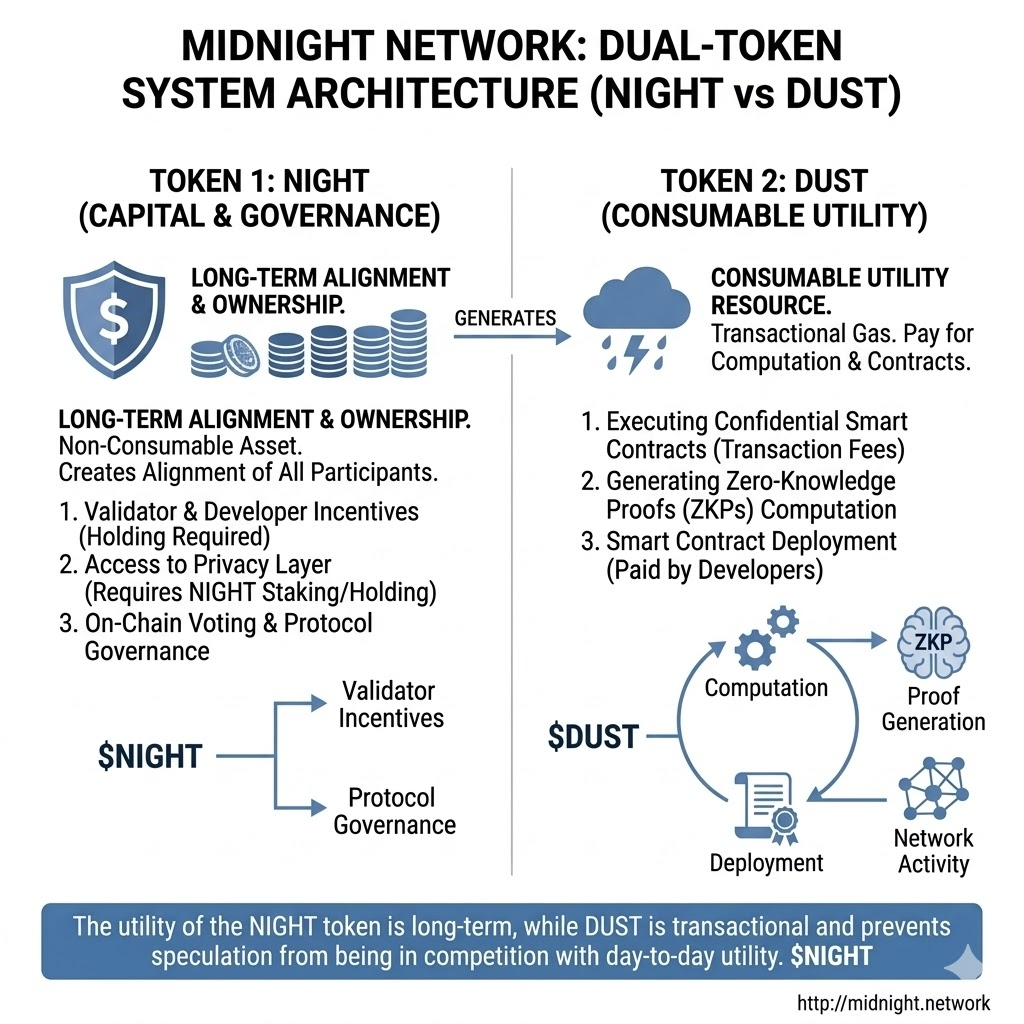
At first, it felt like unnecessary complexity. Another abstraction layered onto a system that already demands too much cognitive overhead.
Two tokens instead of one? It seemed inefficient.
But upon reflection, that reaction came from habit. I was used to compression, assuming everything should live inside a single economic loop.
Midnight does the opposite. It separates what most systems merge.
At a basic level, the roles are clear.
$NIGHT is the economic backbone of the network, powering staking, enabling validator participation, and securing the system through consensus. It also governs how the network evolves over time, anchoring long term alignment.
DUST is different. It is the unit used to pay for executing private smart contracts, fuel for computation within Midnight’s programmable privacy environment. It is consumed when used, not held for appreciation.
That distinction sounds simple. But its implications aren’t.
At first, this felt counterintuitive.
We’re conditioned to believe that value should accumulate. That holding is winning, and spending is losing. Most systems reinforce that instinct by tying every interaction back to an appreciating asset.
But #night introduces a subtle boundary.
You can use the network without turning that usage into a financial decision.
And that changes behavior more than it changes mechanics.
What stood out to me wasn’t just the separation but the clarity it creates.
When usage (DUST) is decoupled from ownership and governance (NIGHT), participation becomes less loaded. You’re not constantly calculating opportunity cost. You’re not hesitating because interaction might mean giving up exposure.
You just use the system.
At the same time, NIGHT still anchors commitment. It ties security and governance to those willing to take long term positions, without forcing every user into that role.
Two different actions. Two different incentives. No unnecessary overlap.
But what makes this design more interesting is that the separation isn’t absolute.
DUST doesn’t exist in isolation, it is economically anchored to the system through NIGHT. Access to DUST is governed by the network’s underlying economic stake, tying usage back to the same layer that secures the protocol.
At first, this felt like a contradiction. If the goal is separation, why keep a connection?
But this is where the design becomes more precise.
The system separates behavior, not responsibility.
Usage is lightweight, but not free floating. It remains grounded in the economic layer that secures the network. That prevents abuse, preserves scarcity, and ensures that even low-friction participation doesn’t come at the cost of integrity.
It’s not just separation, it’s controlled independence.
The privacy layer adds another dimension to this.
Midnight isn’t just optimizing token design,it’s enabling confidential computation and selective disclosure through programmable privacy. Executing private smart contracts is inherently more complex than running transparent ones. It requires different cost structures, different assumptions, different trade offs.
DUST exists within that context.
By isolating the cost of private execution into its own unit, the system avoids forcing those complexities into the primary economic asset. It keeps privacy functional, instead of turning it into a speculative premium.
And that distinction matters more than it seems.
From a builder’s perspective, this changes how systems can be designed.
If every interaction depends on a volatile asset, user experience becomes unstable. Costs fluctuate. Behavior becomes unpredictable. Even simple actions start to carry financial weight.
But with a usage specific token like DUST, interaction becomes more predictable. Builders can design for participation without forcing users to think about markets.
It shifts the focus from price to experience.
And that’s a rare shift in crypto.
Zooming out, this approach feels aligned with something broader.
We’re entering a phase where trust online is more fragile. People are more aware of incentives, more sensitive to hidden trade-offs. Participation is no longer automatiic,it’s conditional.
At the same time, new users especially from emerging markets aren’t necessarily entering crypto to speculate first. They’re looking for systems that work, that coordinate, that provide utility without requiring constant financial positioning.
In that environment, collapsing everything into one token starts to feel outdated.
Separation begins to feel necessary.
Midnight doesn’t remove incentives. It reorganizes them.
It allows usage to feel like usage.
It allows commitment to feel like commitment.
And it avoids forcing both into the same behavioral channel.
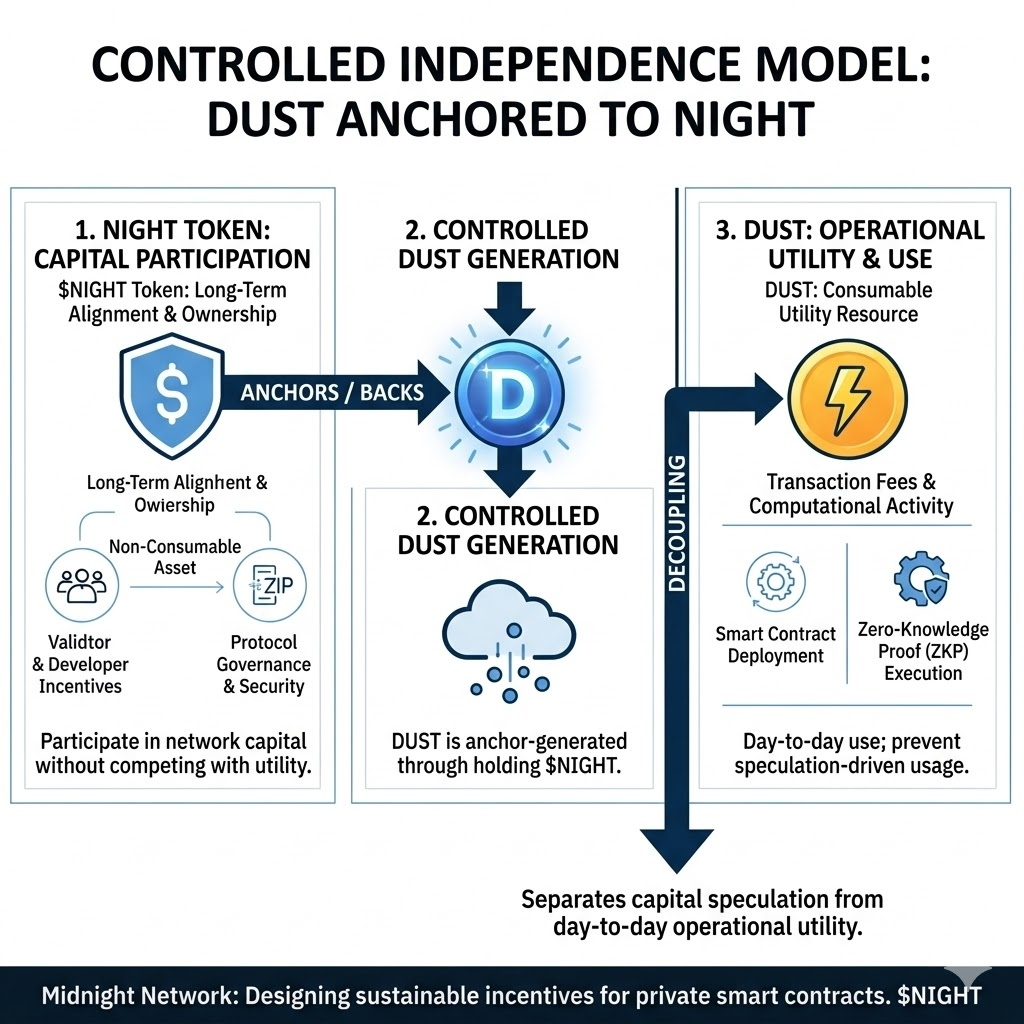
That might seem like a small design choice. But it addresses a tension that shows up everywhere between interacting with a system and investing in it.
I still think about that conference sometimes the ease with which everything was presented as valuable, the speed at which attention moved, the lack of anything that felt grounded.
What I was reacting to wasn’t just culture. It was structure.
Systems that blurred too many lines.
Between use and speculation. Between participation and positioning. Between value and narrative.
What Midnight suggests, quietly, is that those lines can be redrawn.
Not by simplifying everything but by deciding what should never be merged in the first place.
And maybe that’s the shift that matters.
Not better tokens. Not bigger ecosystems.
Just systems that respect the difference between acting and investing,
because when those two begin to look the same, you’re no longer participating in a network, you’re just positioning around it.