

I remember standing at a side event, nodding through introductions I knew wouldn’t last. Names blurred into handles. Promises echoed with a kind of rehearsed optimism. “Let’s connect” had quietly lost its meaning.
What unsettled me wasn’t the lack of sincerity, it was the absence of continuity. Every interaction felt real in the moment, yet strangely disposable afterward. By the next day, it was as if none of it had happened. No memory. No accumulation. Just fragments.
What felt off wasn’t the people. It was the system around them.
In crypto, we’ve engineered permanence at the financial layer, transactions are immutable, histories are traceable. But socially, everything resets. Contribution doesn’t compound. Reputation doesn’t travel.
You can spend months building, helping, contributing and still be treated like a stranger in the next room.
So people adapt. They optimize for visibility. They signal harder, speak louder, attach themselves to momentum. Trust becomes something you simulate in short bursts, instead of something you build patiently over time.
I didn’t expect much when I first came across wallet based identity in the @SignOfficial ecosystem.
At first, it felt reductive, almost too structured for something as fluid as human identity. Another protocol attempting to define trust with code.
But upon reflection, it wasn’t trying to define trust. It was trying to record it properly.
What stood out wasn’t verification.
It was structure.
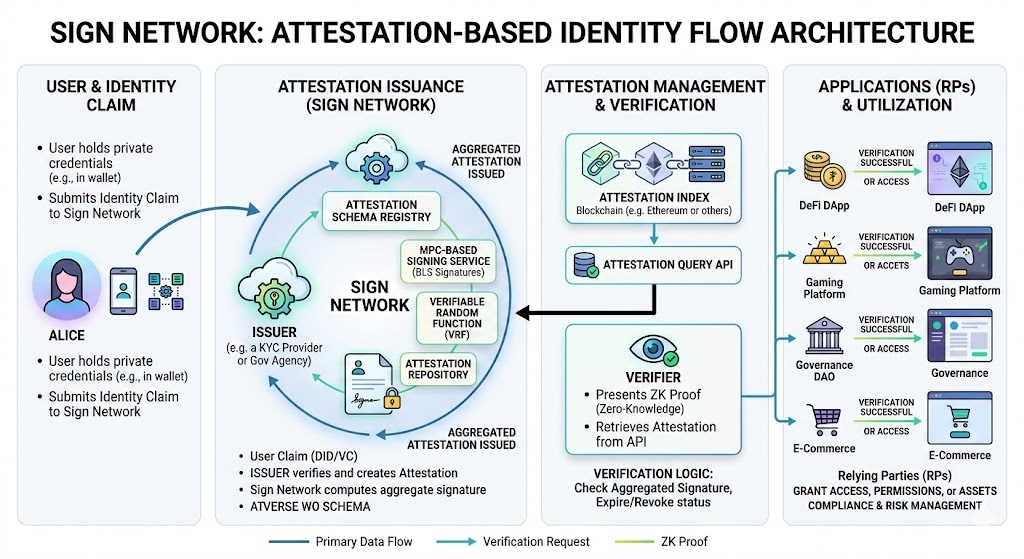
In #SignDigitalSovereignInfra , identity isn’t a profile, it’s a collection of schema-based attestations. Not vague signals or social claims, but structured, machine-readable records of participation, credentials, and relationships.
Each attestation follows a defined schema. It has meaning not just to people, but to systems. It can be queried, interpreted, and reused across applications.
Quietly, identity shifts from something you say, to something that can be understood programmatically.
And these attestations don’t exist in a single rigid layer.
Some live on chain,expensive, immutable, reserved for high trust moments. Others exist off chain,flexible, scalable, allowing identity to grow without friction.
Together, they form a layered memory system.
More importantly, they are permissionless to issue. No central authority defines what counts as identity. Anyone can create an attestation.
But meaning doesn’t come from issuance,it emerges from patterns over time.
This is where the shift becomes behavioral.
Right now, most systems reward presence. You show up, you speak, you get noticed. But attention is volatile. It fades quickly.
In a wallet based identity system, what matters isn’t that you appeared, it’s that you persisted.
You’re no longer just expressing yourself in moments. You’re accumulating a trail of verifiable actions.
And accumulation favors a different kind of participant. The one who contributes quietly. The one who shows up repeatedly. The one who builds without needing constant recognition.
Because now, their work doesn’t disappear, it compounds.
What makes this powerful is not just storage, but lifecycle.
An attestation is issued. It’s stored on chain or off chain. Then it’s verified and consumed by applications that depend on it.
This is where things change.
Applications don’t just display identity, they begin to use it as infrastructure.
Access can be granted based on past contributions. Rewards can be distributed based on verified participation. Airdrops no longer rely on guesswork. Communities don’t depend solely on intuition.
Participation becomes legible, not assumed.
There’s also a quiet redistribution of trust.
In traditional systems, credibility is often platform bound. Your reputation belongs to where you built it. Leave the platform, and you start over.
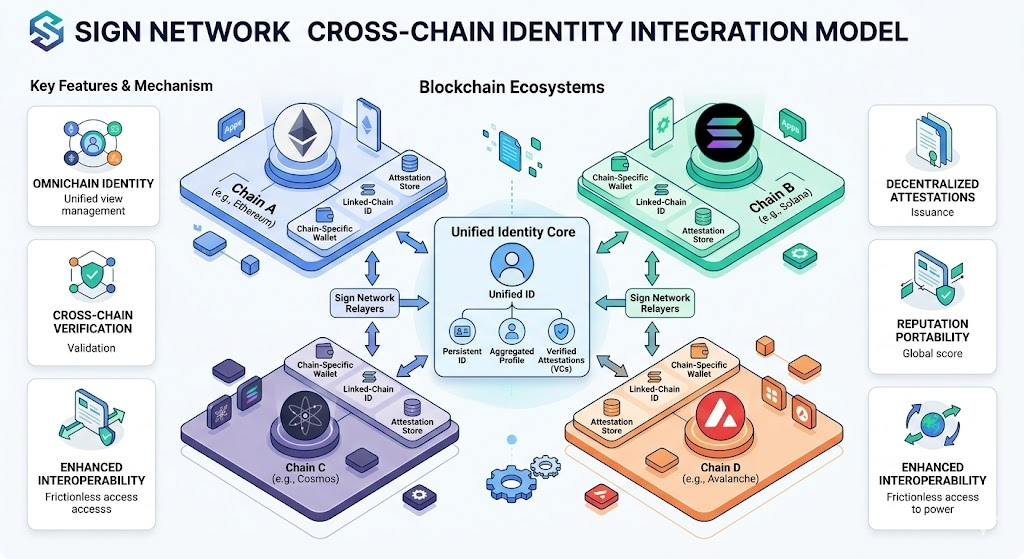
But here, identity is anchored to your wallet.
Your attestations travel with you. They form a portable, composable identity graph, one that different applications can interpret in their own context.
Not perfectly. Not uniformly. But meaningfully.
And over time, trust stops being dictated and starts being assembled.
Zooming out, this feels like a response to something deeper.
Online trust hasn’t disappeared, it’s fragmented. We scroll more, believe less, and rely on surface level heuristics to make decisions.
In many parts of the world, especially emerging markets, crypto isn’t ideological, it’s practical. People care less about narratives and more about reliability.
But reliability requires memory.
And until now, we haven’t had a proper way to preserve participation across contexts.
$SIGN doesn’t force trust. It structures it, through attestations that are persistent, queryable, and portable.
Of course, this doesn’t eliminate noise.
Anyone can issue an attestation. Not all signals are meaningful.
But that’s not a flaw, it’s a design choice.
Because meaning isn’t assigned at the point of creation. It emerges through aggregation, context, and repetition.
We move from asking, “Who said this?”
To asking, “What patterns does this identity reveal over time?”
I keep thinking back to that event.
All those conversations that faded, not because they lacked value, but because there was no system to carry them forward. No shared memory. No continuity layer.
What wallet based identity offers isn’t a replacement for human connection.
It’s a memory layer for participation.
A way to ensure that what you do doesn’t dissolve into timelines—but accumulates into something others and even systems can understand.
There’s something slightly uncomfortable about that.
Because it means identity becomes harder to reset. You can’t rely on reinvention as easily. Your actions begin to form a visible pattern over time.
But maybe that’s the point.
Maybe trust was never meant to be easily restarted. Maybe identity was never supposed to be this forgettable.
I used to think the problem was that people didn’t remember me.
But now it feels like something else entirely.
The system never gave them anything to remember me with.