
I used to think the biggest problem with privacy chains was cryptography. Wrong from the start. What made me quit on ZK dApps before wasn't the circuits or proofs. It was the transaction fees. Not because they were expensive. Because they were visible.
You can hide data inside a transaction. But look at the fee, the time, the pattern. You can trace the behavior. Privacy is broken from the outside, not the inside logic.
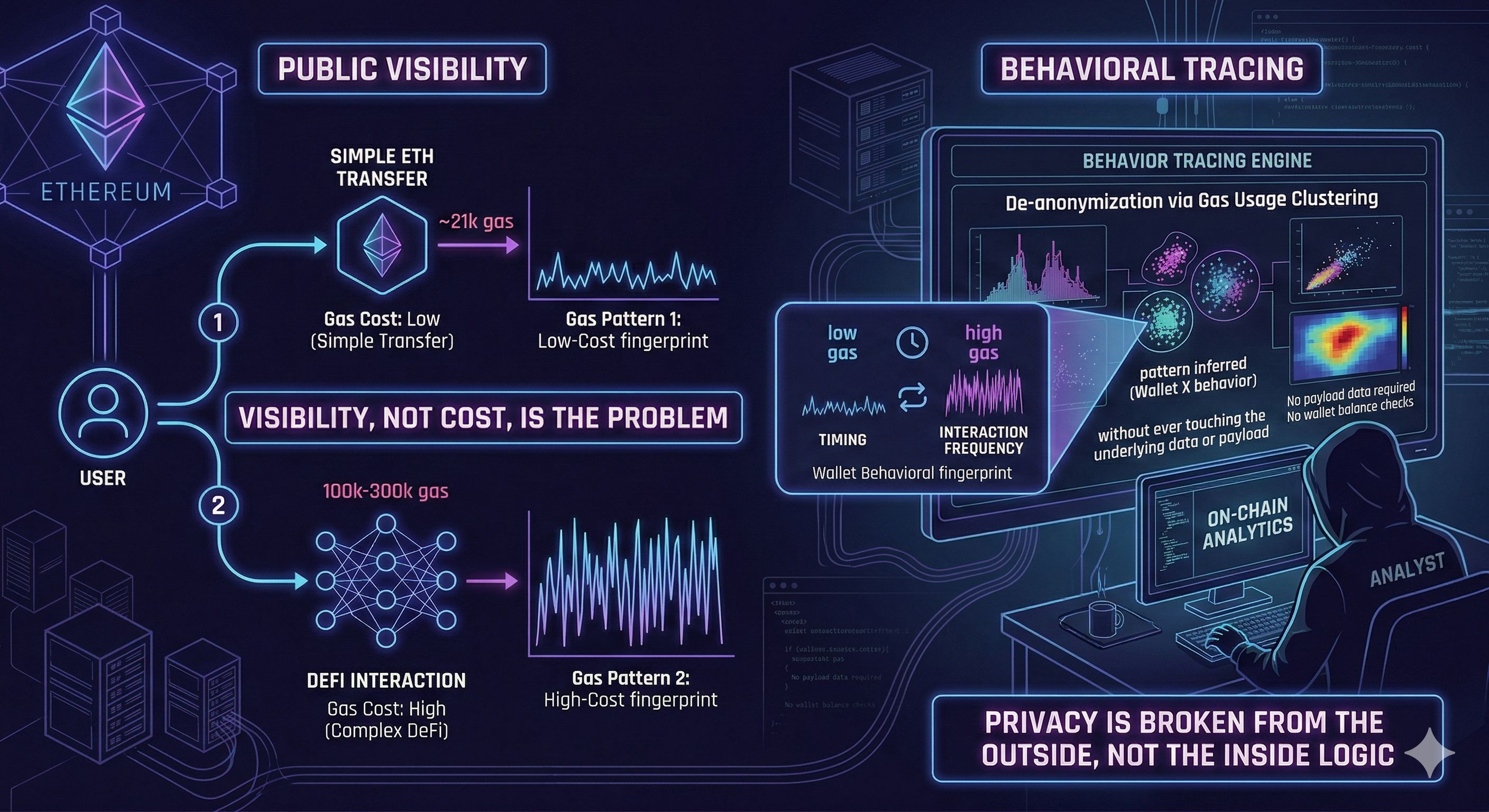
On Ethereum, a basic ETH transfer costs 21,000 gas. A typical DeFi interaction can range from 100,000 to 300,000 gas depending on complexity. That difference alone creates consistent fingerprints. Combined with timing and interaction frequency, these signals are commonly used by on-chain analytics to cluster wallets and infer behavior. No underlying data needed.
That’s when I started to understand why Midnight separates NIGHT and DUST.
At first glance, dual tokens just make it messy. Another token. Another step. Another thing for users to learn. But with one token, every private transaction pays a public fee. That’s enough to create a "shadow" of the whole system. DUST exists to erase that shadow.
Midnight’s own documentation frames this clearly. Instead of putting all state on-chain, it separates public verification from private data, with zero-knowledge proofs acting as the bridge. Fees tied to visible tokens create observable patterns. This is exactly what a privacy-first system tries to avoid. Splitting NIGHT and DUST is not just a token design choice. It’s a direct response to that leakage problem.
Other privacy-focused systems run into the same constraint with different trade-offs. Aztec uses relayers to abstract fees away from users. This reduces visible metadata but adds infrastructure assumptions. Aleo separates execution and proof generation. Still, transaction submission and timing can leak interaction patterns at the edges. Even general-purpose zk-rollups like zkSync or Starknet expose fee and timing data publicly. This makes behavioral tracing feasible. Midnight isn’t solving a new problem. It’s choosing to address it directly at the token design layer.
Problem is, adding DUST creates a new mess. UX breaks instantly. Users don't want to think about what they hold, what they pay with, or where to swap. Crypto is hard enough. Adding a layer makes it worse.
And here is where it gets interesting. Midnight is solving a problem no one says out loud. How to keep something mandatory at the protocol level, but forbidden at the user experience level.
DUST can't disappear. But it’s not allowed to "show up."
Only way is to push it down. One possibility is relayers. User signs, backend pays DUST. Web2 experience. No gas, no extra tokens. Sounds beautiful.
But the question hits immediately. Who is paying for you? If it’s a middleman, you just added trust to a system designed to kill trust.
Another way is auto-swap. Wallet swaps NIGHT for DUST when needed. User knows nothing. But swaps are public. Traceable. Privacy broken in a subtler way. Hidden here. Exposed there.
Some designs fold fees into the app logic. Pay with stables, backend handles the rest. No DUST visible. You aren't paying "gas" anymore. You’re paying a "service fee." Sound familiar?. This is where the line between Web3 and Web2 blurs.
The better you hide DUST, the more it feels like Web2. The more trustless you stay, the worse the experience becomes. No perfect balance.
If only 10 to 20 percent of transactions on Midnight go private, demand for DUST isn't theory. It becomes mandatory fuel. Then every abstraction leads back to one question. Who is creating real demand for $NIGHT?.
If private usage reaches a meaningful share, fee demand stops being optional. It starts behaving like base-layer consumption. This is where value begins to anchor. Not speculate.
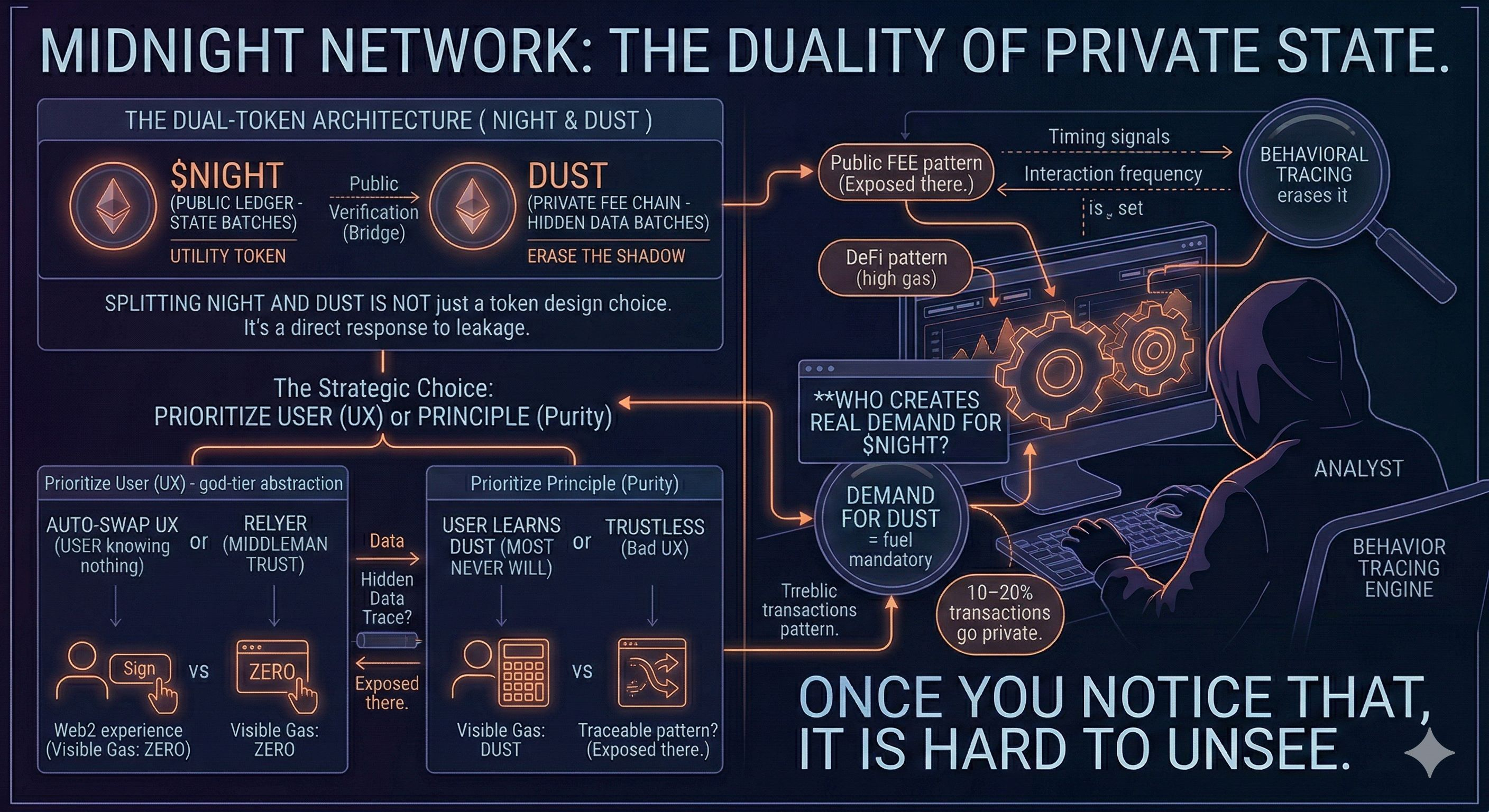
Midnight isn't just building a privacy chain. It’s being forced to choose. Prioritize the user. Or prioritize the principle.
If they pick UX, they need a god-tier abstraction layer. If they pick purity, users have to learn DUST. Most never will.
Maybe a harder truth. If it only works with a backend handling fees, is it still a blockchain? Or just a privacy system wrapped in one?. Not a tech problem. A product problem.
Mainnet drops later this month. DUST becomes invisible infrastructure. Or the first reason users walk away.
Once you notice that, it is hard to unsee.
#night $NIGHT @MidnightNetwork
