
The more I look at SIGN, the more I feel like I’m not really looking at a “crypto project” in the usual sense. It doesn’t try very hard to impress at first glance. There’s no immediate dopamine hit, no clean one-liner narrative you can tweet. It feels… heavier than that. Almost administrative. And oddly enough, that’s what makes me keep reading.
If you follow how the market talks about infrastructure today, the story is still quite predictable. Faster chains, cheaper transactions, better UX, more “decentralization.” Every new system is framed as a leap forward in performance or scale. And to be fair, that’s what gets attention. Numbers like TPS, latency, finality. Things that look good in benchmarks and dashboards.
But there’s always a slightly awkward moment when those narratives meet reality.
Because the moment real users, real institutions, or worse, governments, step in, the problem shifts. It’s no longer just about how fast a transaction can be processed. It becomes about who is allowed to do what, under which rules, and who has the authority to intervene when something goes wrong. Suddenly, the system isn’t just executing code. It’s enforcing decisions.
And most blockchains aren’t really designed for that.
They assume a kind of neutral environment where rules are static and enforcement is automatic. But in the real world, rules change. Exceptions happen. Authority exists. Coordination is messy. That’s usually where things break, not at the level of throughput, but at the level of control.
That’s the part I think the market tends to underestimate.
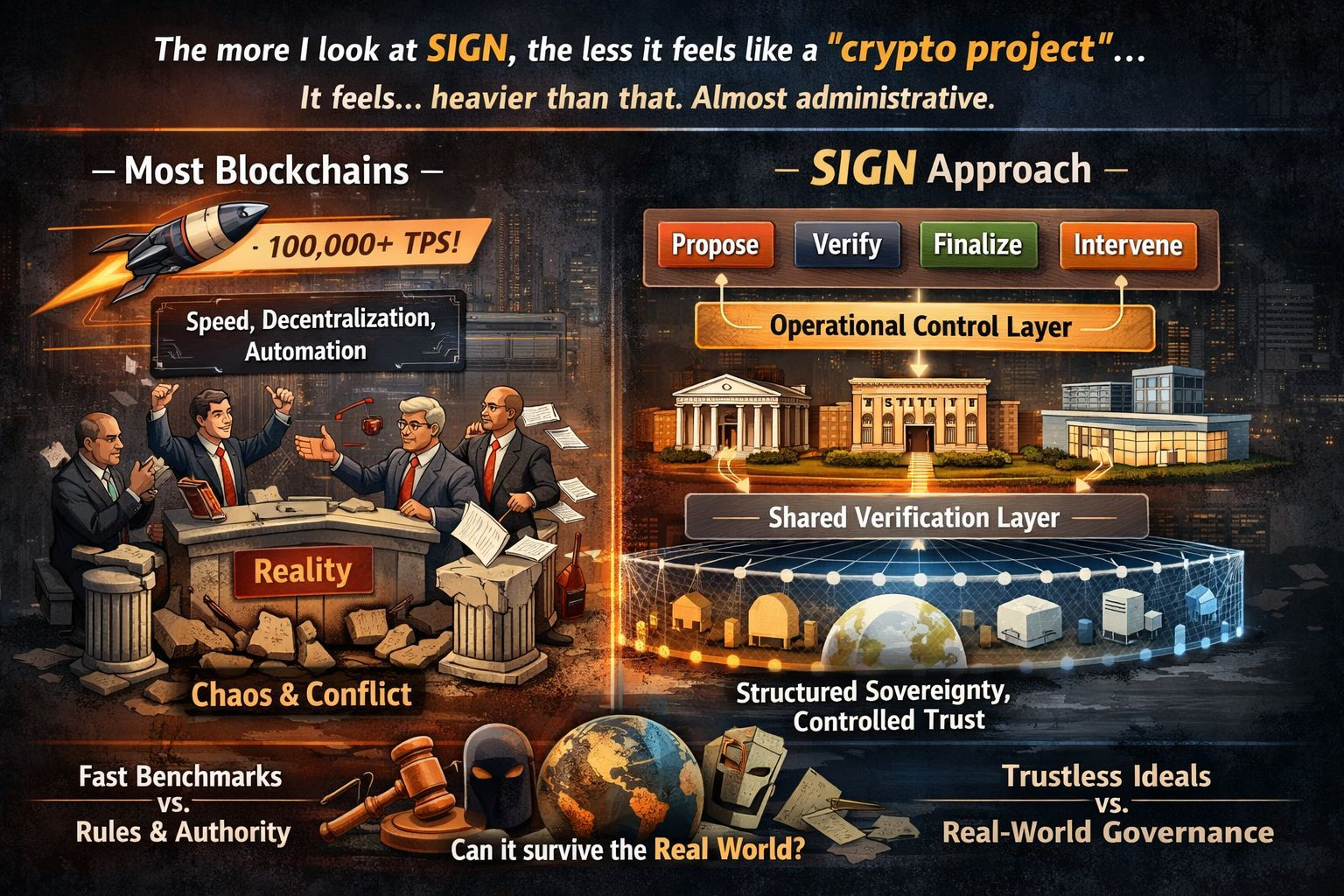
We don’t actually lack infrastructure. We lack systems that can encode control without collapsing into centralization, and distribute trust without losing the ability to act. It’s less a scaling problem, and more an administrative one.
This is where SIGN starts to feel different.
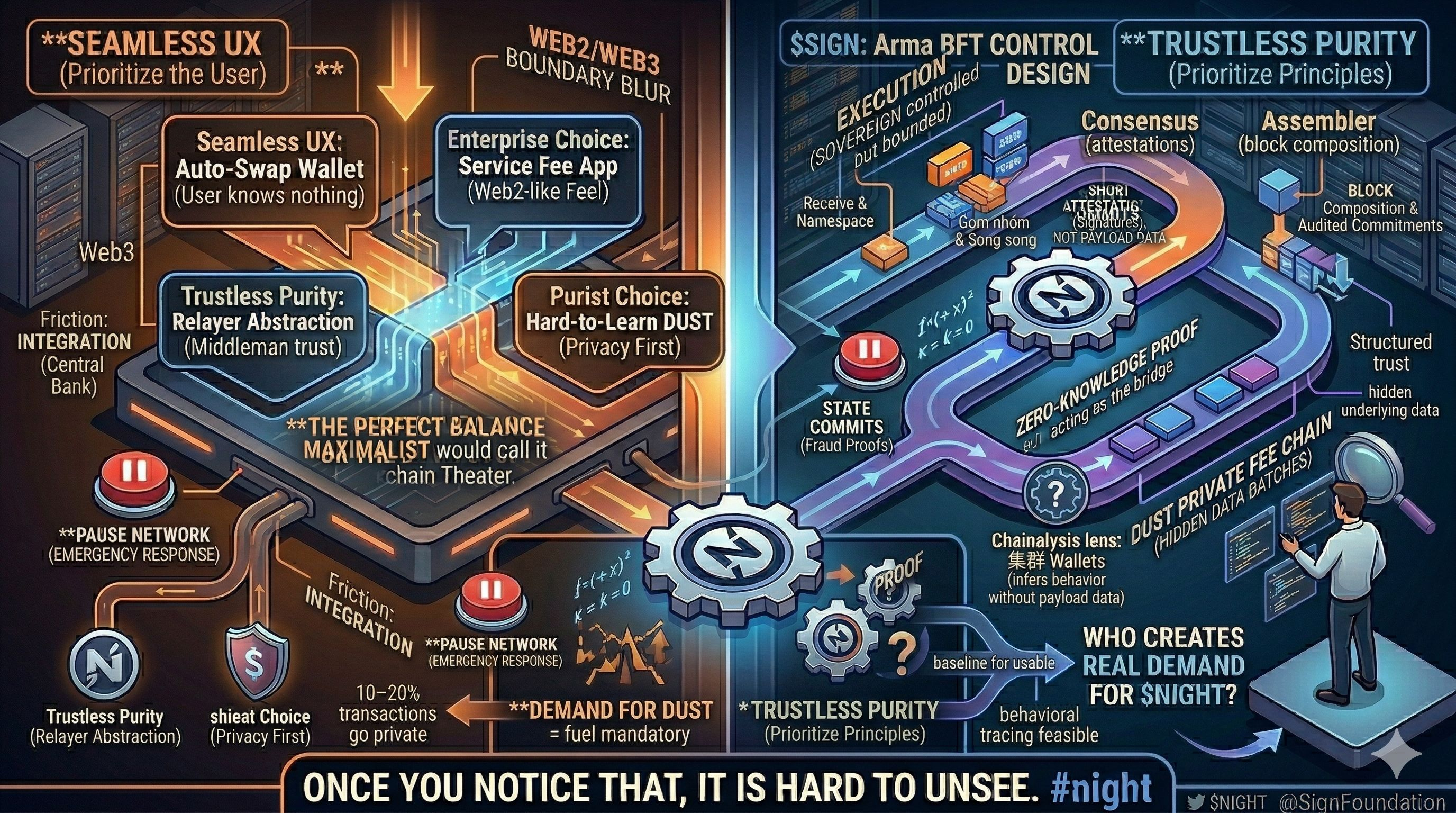
At first, something like Arma BFT just looks like another consensus mechanism trying to push performance. A four-component structure, parallel responsibilities, claims of high throughput, even numbers like 200,000 TPS. On paper, it fits neatly into the same category as every other “high-performance chain.”
But the more I sit with it, the less it feels like a performance story.
The separation into components starts to look less like optimization and more like control design. Instead of forcing one layer to handle everything, it distributes responsibility across different roles. Not just to go faster, but to make the system easier to reason about when something goes wrong. Who proposes. Who verifies. Who finalizes. Who can challenge.
It’s subtle, but it shifts the question from “how fast can this run” to “how does this system behave under pressure.”
And that’s where the idea of sovereignty comes in.
Most chains treat sovereignty as a philosophical concept. SIGN treats it more like an operational constraint. If a government or institution is going to use this, they need control over execution, policy, and intervention. Not total control, but enough to function. At the same time, the system still anchors itself to a public layer, where state commitments are visible and verifiable.
That tension is the design.
And suddenly, something like 200k TPS stops being the main story. It becomes a requirement. Because if you’re building for real-world systems, especially at a national level, you don’t get to be slow. Throughput isn’t a feature. It’s the baseline for being usable at all.
So instead of asking whether the performance is impressive, the more relevant question becomes whether the architecture can sustain that performance without breaking its own trust assumptions.
This is where SIGN, at least conceptually, starts to make sense.
It’s not trying to be the most decentralized system in the abstract. It’s trying to build a system where controlled environments can still plug into a shared layer of verification. Where authority exists, but is bounded. Where actions can be taken, but still audited.
That’s a very different goal from most chains, even if the surface metrics look similar.
But this is also where I start to hesitate.
Because everything I’ve just described works cleanly in theory. Clear roles. Defined responsibilities. High throughput. Structured control. It all sounds coherent.
Reality is rarely that cooperative.
A decentralization maximalist would look at this and call it 'Blockchain Theater.' They’d argue that if you need an administrative layer to hit a pause button, you might as well use a SQL database. They aren't entirely wrong. But they’re likely missing the point. SIGN isn't an attempt to replace trust with code; it’s an attempt to structure trust where code alone isn't enough. It’s a bridge for the entities that currently run the world, not an escape hatch from it.
What happens when incentives get messy? When one component has more power than expected? When coordination between roles breaks down under stress? When upgrades or governance decisions become political rather than technical?
And more importantly, what happens when real users interact with it?
Can it handle edge cases, disputes, manipulation attempts? Can it survive actors who are actively trying to game eligibility, authority, or execution paths? Can it operate across jurisdictions where “sovereignty” means very different things?
These aren’t edge scenarios. They are the default conditions of any system that touches real-world value.
That’s why I find SIGN interesting, but not in the usual way.
Not because of the TPS number. Not because of the consensus design in isolation. But because it is trying to formalize something most of crypto still avoids: the layer where control, rules, and verification intersect.
It’s not a glamorous layer.
But it’s probably the one where systems either hold up, or quietly fall apart.
So the question isn’t really whether Arma BFT can reach 200k TPS, or whether the four-component model is elegant on paper.
It’s whether this kind of structured sovereignty can survive contact with real incentives, real institutions, and real conflict.
And that’s not something any whitepaper can fully answer.
#SignDigitalSovereignInfra @SignOfficial $SIGN
