

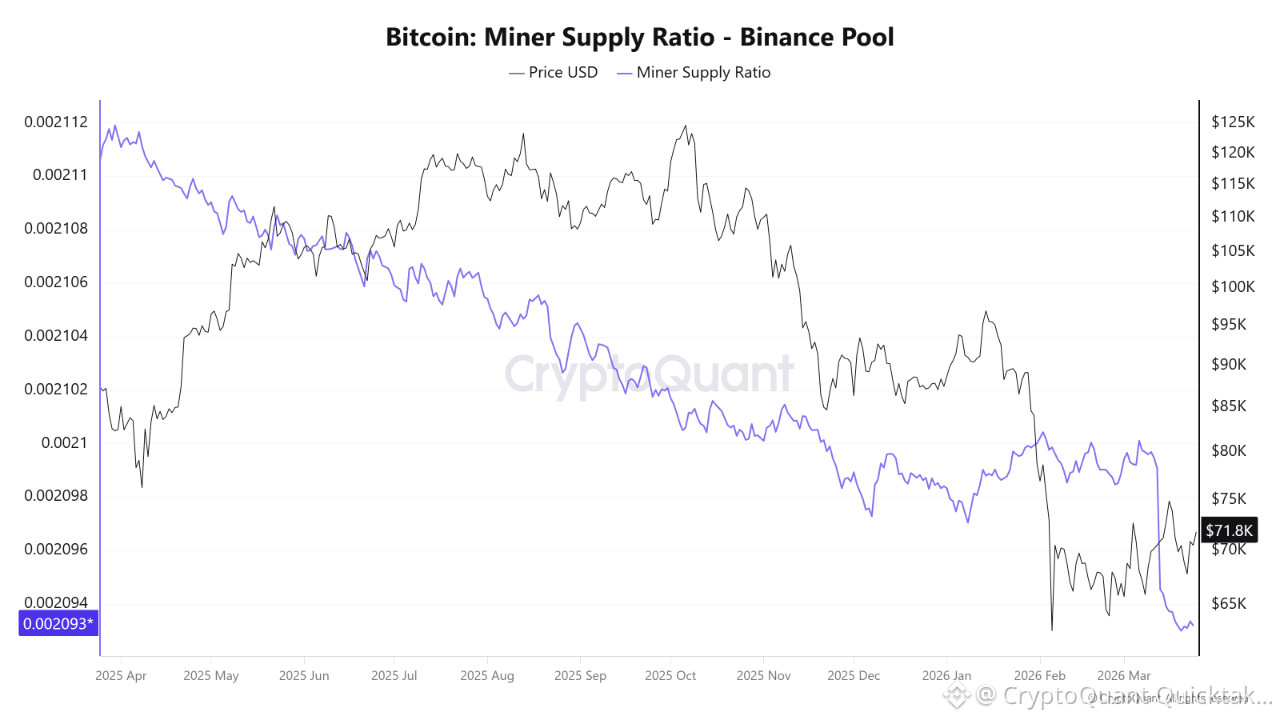
Since early 2025, the Miner Supply Ratio has been steadily declining, indicating that miners are sending less BTC to Binance. Despite this, Bitcoin’s price first increased and then dropped sharply. This shows that price can still fall even when miner selling pressure decreases.
Miners face key costs such as electricity, hardware, operations, and financing. Their break-even level varies depending on market conditions, and after the halving, these costs increased significantly. In 2026, efficient large-scale miners operate around $34K–$43K, while the industry average is $75K–$87K. This suggests that most miners are either near break-even or operating at a loss.
Miners are the only participants consistently generating new BTC supply. A decline in their selling reduces natural spot market supply pressure and can tighten liquidity in the short term.
However, in this chart, despite the drop in Miner Supply Ratio, price continues to decline. This clearly indicates that current selling pressure is not coming from miners. Instead, it is driven by spot investors, ETF flows, whales, and broader macro risk factors.
In the latest phase, the Miner Supply Ratio is near its lows, suggesting miners are either unwilling or unable to sell due to cost pressure. This confirms that the supply side is weak.
Despite reduced supply, the continued price decline highlights a lack of demand. For Bitcoin to form a bottom, demand must return. So far, there is no strong evidence of new demand, which means the price remains vulnerable to further downside.
Written by PelinayPA