
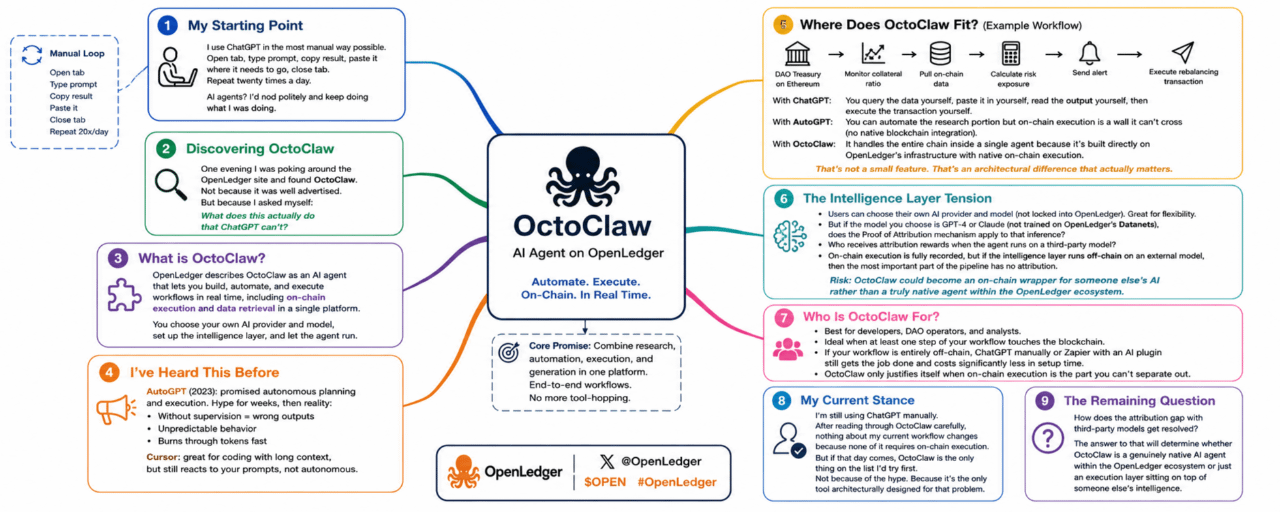
I'm the kind of person who uses ChatGPT in the most manual way possible. Open tab, type prompt, copy result, paste it where it needs to go, close tab. Repeat twenty times a day. Whenever someone talked to me about AI agents, I'd nod politely and keep doing what I was doing, because nothing I'd seen was different enough to change the habit.
Then one evening I was poking around the OpenLedger site on my own and found OctoClaw.
Not because it was well advertised. But because I asked myself a very simple question: what does this actually do that ChatGPT can't?
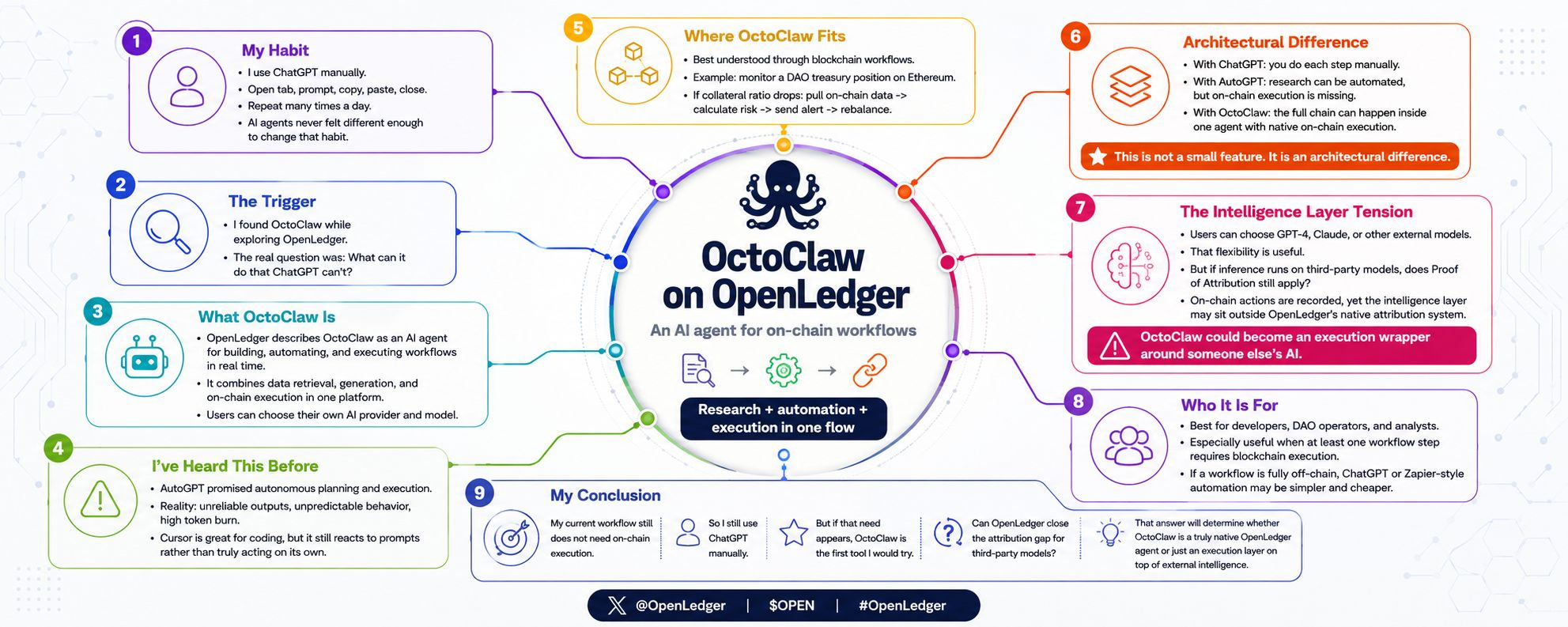
OctoClaw is described by OpenLedger as an AI agent that lets you build, automate, and execute workflows in real time, including on-chain execution and data retrieval within a single platform. Users choose their own AI provider and model, set up the intelligence layer, and let the agent run. The core claim is combining research, automation, execution, and generation in one place instead of jumping between separate tools for each step.
Sounds reasonable. But I've heard this before.
AutoGPT launched in 2023 with exactly that promise: an agent that plans autonomously, executes autonomously, loops until the job is done. The community was intensely hyped for a few weeks, then most users discovered that an agent running without supervision produces wrong outputs in unpredictable ways and burns through tokens fast. Cursor went a different direction, focused on coding with long context windows, but it's still a tool that reacts to your prompts rather than autonomously executing the next step on its own.
So where does OctoClaw sit in that picture?
Take a specific workflow. Say you're managing a DAO treasury and need to monitor the collateral ratio of a lending protocol on Ethereum. Every time the collateral ratio drops below a certain threshold, you want an agent to automatically pull on-chain data, calculate the risk exposure, send an alert, and execute a rebalancing transaction if conditions are met, all without you sitting in front of a screen watching it. With ChatGPT, you query the data yourself, paste it in yourself, read the output yourself, then execute the transaction yourself. With AutoGPT, you can automate the research portion but on-chain execution is a wall it can't cross because there's no native blockchain integration. OctoClaw, by design, handles that entire chain inside a single agent because it's built directly on OpenLedger's infrastructure with native on-chain execution.
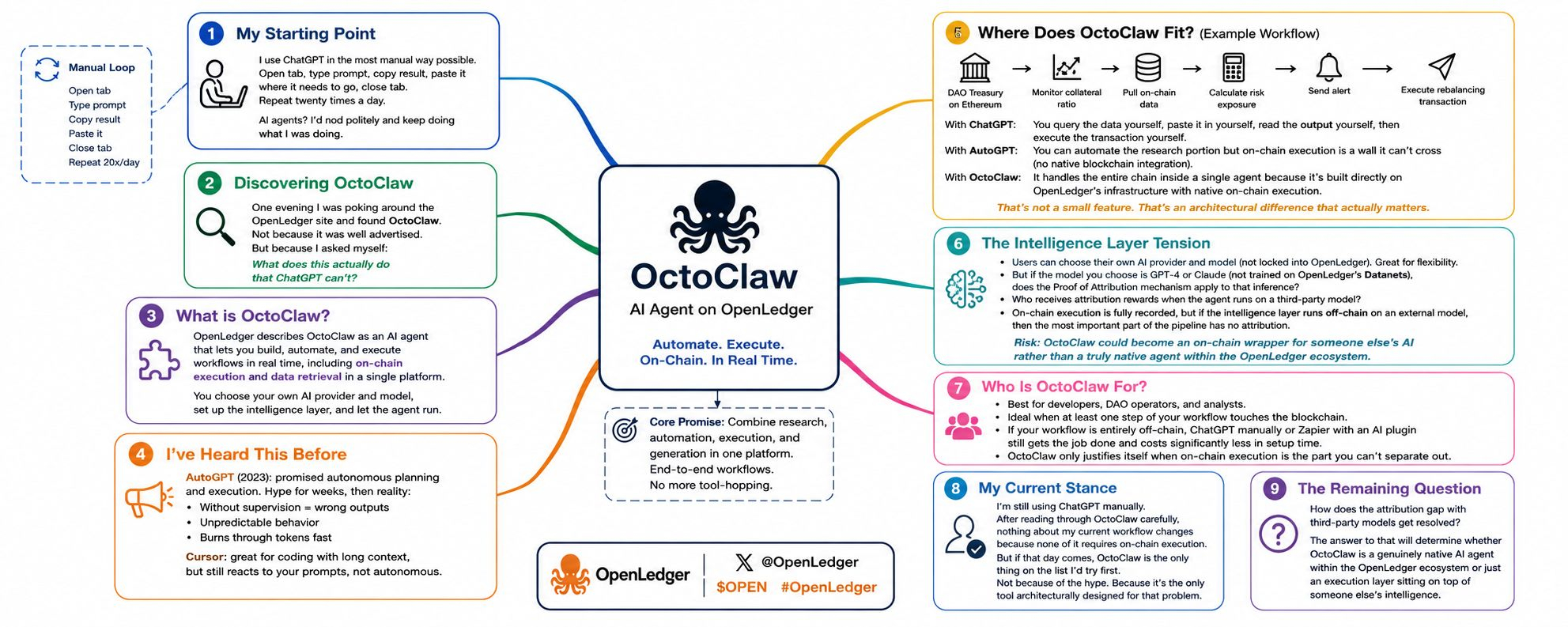
That's not a small feature. That's an architectural difference that actually matters.
The technical point I kept coming back to is how OctoClaw handles the intelligence layer. Users can choose their own AI provider and model, not locked into a single OpenLedger model. From a flexibility standpoint this is the right call. But it creates an interesting tension in the system: if the model you choose is GPT-4 or Claude, meaning a model not trained on OpenLedger's Datanets, does the Proof of Attribution mechanism apply to that inference? Who receives attribution rewards when the agent runs on a third-party model? This is an architectural question that hasn't been answered clearly. The on-chain execution is fully recorded, but if the intelligence layer runs off-chain on an external model, then the most important part of the pipeline has no attribution. OctoClaw risks becoming an on-chain wrapper for someone else's AI rather than a truly native agent within the OpenLedger ecosystem.
One more point on who this tool is actually built for. OctoClaw makes the most sense for developers, DAO operators, and analysts who need to automate workflows where at least one step touches the blockchain. If your workflow is entirely off-chain, ChatGPT manually or Zapier with an AI plugin still gets the job done and costs significantly less in setup time. OctoClaw only starts to genuinely justify itself when on-chain execution is the part of the workflow you can't separate out.
I'm still using ChatGPT manually. After reading through OctoClaw carefully, nothing about my current workflow changes because none of it requires on-chain execution.
But if that day comes, OctoClaw is the only thing on the list I'd try first. Not because of the hype. Because it's the only tool architecturally designed for that specific problem.
The remaining question is how the attribution gap with third-party models gets resolved. The answer to that will determine whether OctoClaw is a genuinely native AI agent within the OpenLedger ecosystem or just an execution layer sitting on top of someone else's intelligence.