

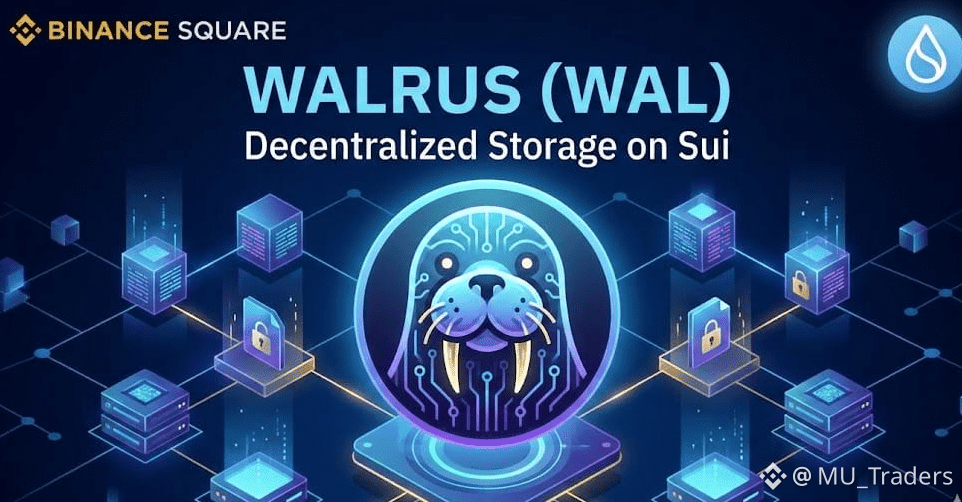
You’ve probably heard about DeFi, smart contracts, and blockchains solving financial problems. But what if the next big crypto trend isn’t finance alone, it’s data storage? That’s exactly the narrative behind Walrus (WAL), a project on the Sui blockchain tackling decentralized storage and governance in a way that could reshape how big files and sensitive data live on-chain. (Walrus Docs)
What Walrus Actually Is
At its core, Walrus is a decentralized storage network where developers and users can store large chunks of data — anything from AI datasets to videos — without relying on a centralized cloud like AWS. It solves a big problem: blockchains are great at transactions but terrible at storing big data directly. Walrus fixes this by splitting files into encoded pieces and distributing them across many storage nodes. (Binance Academy)
This means your data stays accessible and verifiable through blockchain proofs, but the heavy storage itself lives off-chain in a decentralized network. That’s powerful for Web3 apps, NFTs, decentralized websites, gaming assets, and AI model storage. (Superex)
The Tech That Makes It Work
Erasure Coding and RedStuff
Walrus doesn’t just copy data everywhere like some older storage projects. It uses advanced erasure coding — think of it like intelligent redundancy. When you store a file, Walrus breaks it into shards and encodes them using a custom algorithm called RedStuff. Even if many nodes fail, the network can rebuild the original file from a subset of shards. (Superex)
Compared to full replication systems, this method keeps storage costs relatively low while maintaining high durability. (Binance Academy)
Sui Blockchain as the Control Layer
All the metadata — like what file belongs to whom and how long it should be stored — lives on Sui, not in the storage nodes. That means you get cryptographic proofs, smart contract control, and global coordination all secured by Sui’s decentralized network. (Walrus Docs)
This approach makes Walrus not just a storage layer but a programmable infrastructure where developers can build storage-driven dApps rather than just file uploads. (Walrus Docs)
Why WAL Token Matters
You can’t talk about Walrus without talking about its native token, WAL.
Payment and Utility
Storage Fees: When someone stores data on Walrus, they pay in WAL tokens. (Walrus Docs)
Staking and Rewards: Node operators and delegators stake WAL to secure the network and earn rewards. (Walrus Docs)
Governance: WAL holders have voting rights on important decisions like protocol upgrades and economic parameters. (BSC News)
This aligns incentives across providers, users, and the community. If you’re a trader, that means WAL isn’t just speculative. It’s economic fuel for a live, growing network. (Walrus Docs)
What Sets Walrus Apart From Others
Real Programmability
Unlike older decentralized storage projects that just host files, Walrus lets developers integrate storage directly into smart contracts. You could have a game that stores assets on Walrus and enforces rules right on Sui, or an AI dataset that’s always verifiable and available through coded logic. (Superex)
Efficiency and Cost
Walrus uses erasure coding to reduce storage overhead. Instead of spending 10x or more on data redundancy, Walrus targets about a 4–5x redundancy factor, cutting long-term costs for users and making it competitive with traditional cloud storage for large applications. (Binance Academy)
Integration and Web2 Support
Developers can interact with Walrus through command-line tools, standard APIs, and software development kits, making it easier for legacy apps and Web3 apps alike to plug in. (Walrus Docs)
Multi-Use Support
Walrus blobs — the stored big files — are reflected as objects on Sui. That means smart contracts can read, modify, expire, or delete storage objects programmatically. This makes storage more than a service; it becomes a blockchain primitive. (Walrus Docs)
Real Adoption and Ecosystem Growth
Walrus wasn’t just built as a cool idea. It raised $140 million before mainnet launch with backing from big names like a16z Crypto and Franklin Templeton Digital Assets, showing institutional confidence in the vision. (CoinDesk)
Major decentralized apps and infrastructure projects are already integrating with Walrus for scalable storage. Its mainnet went live on March 27, 2025, and the protocol is now fully operational. (Superex)
What This Means for You as a Trader
As someone watching charts and fundamentals, here’s the key takeaway:
WAL is more than a meme token or DeFi governance token. It’s the utility token powering a real, high-demand storage infrastructure at a time when decentralized data markets are exploding. (cryptodiffer.com)
If decentralized AI, Web3 games, NFT ecosystems, and on-chain dApps grow, they all need storage. Walrus sits right at that intersection, making WAL a token worth keeping on your radar.
Final Thoughts
Walrus is not just another blockchain project. It’s a next-generation decentralized storage network built with real engineering, community support, economic incentives, and long-term utility. For average traders curious about real crypto innovation, this is the kind of project that goes beyond price charts — it’s about real infrastructure adoption. (Superex)
Ready to dive deeper? Check out the Walrus docs or follow its ecosystem updates to see how developers are already building on it.