
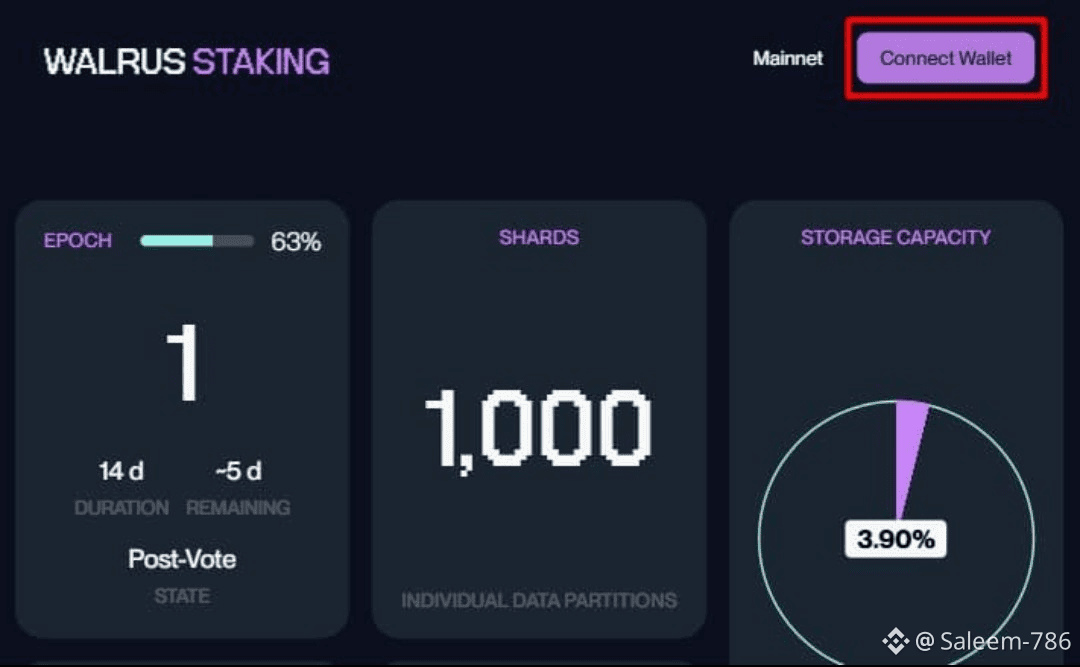
When people talk about staking, the conversation usually starts and ends with numbers. How much you stake. What the reward rate is. How fast you can exit. I went into the Walrus documentation expecting something similar. I assumed I would skim it, understand the mechanics, and move on.
That didn’t happen.
What stood out almost immediately is that staking in Walrus is not designed to reward urgency or size. It’s designed to reward understanding. And more specifically, understanding timing.
In Walrus, staking is not just a financial action. It’s a coordination tool. When you delegate WAL to a storage node, you’re influencing which nodes are trusted to hold real data in future epochs. That sounds abstract at first, but it becomes very concrete once you think about what Walrus is actually storing. These aren’t tiny on-chain values. These are large files. Articles. Audio. Video. Archives that people expect to be available and correct.
Because of that, Walrus treats storage as something heavy. Something physical, almost. Moving shards between storage nodes means moving large amounts of data. It’s slow. It’s costly. It’s not something you want to do impulsively.
That design choice explains almost everything else about how staking works here.
Shards are reassigned every epoch, but the committee responsible for the next epoch is selected ahead of time. Not at the end. Not at the last second. It’s selected around the midpoint of the previous epoch. At first, that feels like an unnecessary delay. But once you consider what storage nodes actually need to do, it makes sense.
A node that’s about to receive more shards might need to expand storage capacity. It might need to provision more bandwidth. It might need to prepare operationally. Walrus gives operators that time instead of forcing them to react instantly.
This is where timing starts to matter more than amount.
If you stake WAL early enough, before the committee for the next epoch is selected, your stake influences that selection. Your delegation helps determine which nodes are chosen and how much responsibility they receive. If you stake after that midpoint, your stake isn’t ignored. It’s just deferred. It becomes active in the following epoch instead.
Nothing breaks. Nothing is punished. You just wait.
That waiting is not a bug. It’s the system protecting itself from chaos.
Unstaking keep to the same logic. If you request withdrawal early enough, the system has time to account for it before the next committee takes over. If you request it later, your stake remains active through the rest of the epoch, continues earning rewards, and only becomes withdrawable when the next epoch begins.
At first, this felt restrictive to me. Most staking systems are designed to feel flexible, even if that flexibility comes at the cost of stability. Walrus makes the opposite trade-off. It limits flexibility to preserve predictability.
And predictability matters when data is involved.
What also changed how I thought about this system is where rewards come from. Rewards aren’t abstract emissions disconnected from usage. They come from storage fees. That means staking rewards are tied directly to whether people are actually using Walrus to store data.
If usage grows, rewards reflect that. If usage slows, rewards adjust. There’s no illusion of guaranteed yield here. Just participation in a system that only pays when it’s doing real work.
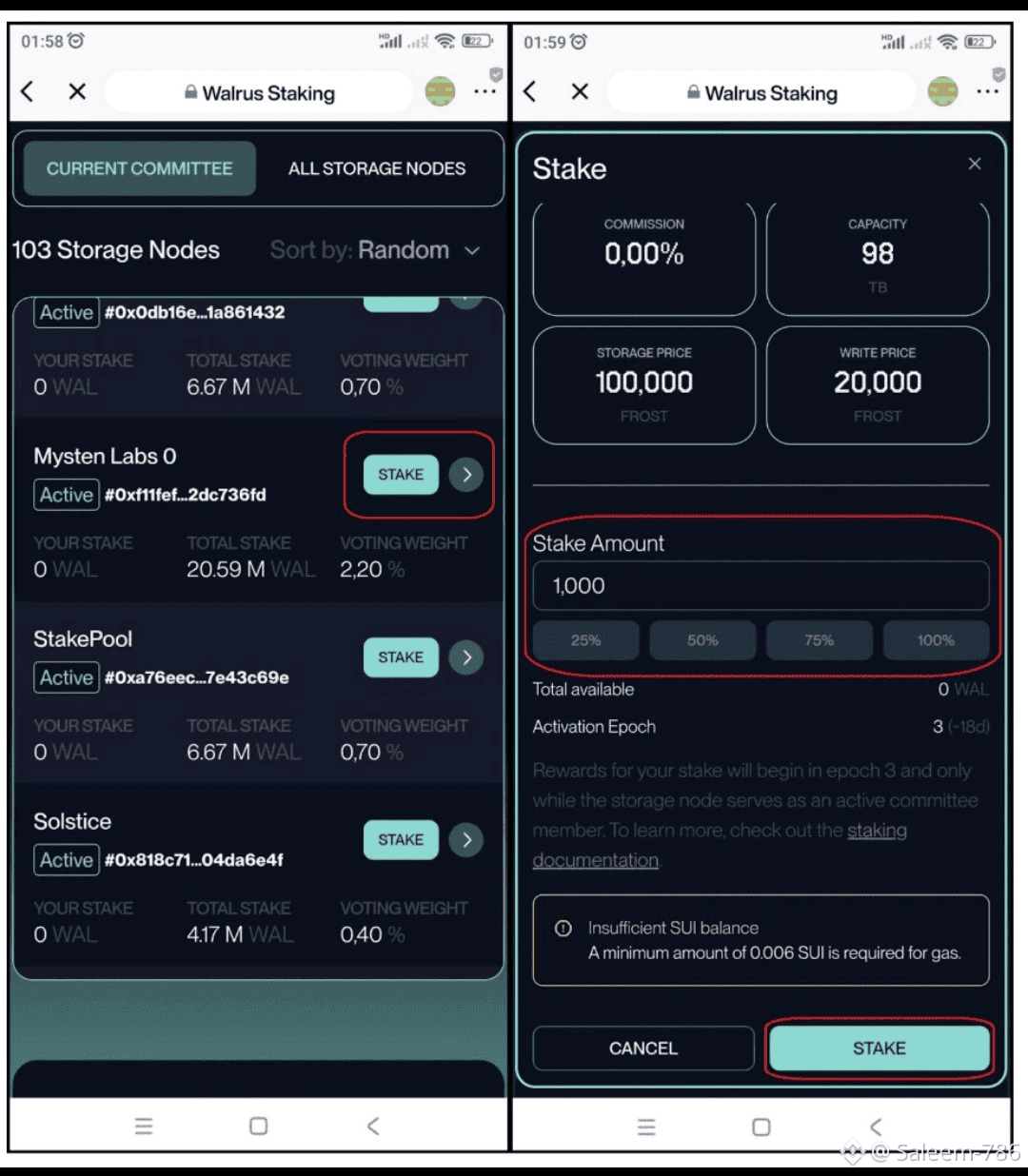
The staking dApp itself reinforces this mindset. You don’t just stake into a pool and forget about it. You see storage nodes. You see which ones are currently in the committee. You can stake to nodes that aren’t in the committee yet, knowing that you’re influencing future epochs rather than chasing immediate results.
That makes staking feel less like farming and more like choosing sides. You’re not just locking tokens. You’re show confidence in operators and in the system’s long-term structure.
Another detail that stayed with me is how clearly Walrus separates “requesting” an action from “executing” it. Requesting an unstake doesn’t mean your stake disappears instantly. It means the system now knows your intent and schedules that change at a point where it won’t destabilize storage operations.
This approach feels slow if you’re used to financial products. But it feels responsible if you’re thinking about infrastructure.
After spending time with the documentation, I realized something important. Walrus is not optimizing for traders. It’s optimizing for people who care whether their data will still be there later.
That’s probably why timing matters more than amount. A large stake placed late doesn’t help the system prepare. A smaller stake placed early does. Walrus values coordination over force.
This also explains why the system is gaining attention now. As more applications start storing meaningful data on decentralized networks, the weaknesses of fast-but-fragile designs become obvious. People are no longer just experimenting. They’re relying on these systems.
Walrus feels built for that phase.
It doesn’t rush decisions. It doesn’t pretend data is lightweight. It doesn’t promise instant gratification. Instead, it assumes that storage is serious work and designs incentives accordingly.
Reading through the staking mechanics didn’t make me excited in the usual crypto sense. It made me calm. And that’s rare.
Calm usually means the system knows what it’s doing.
Ultimately, staking in Walrus feels less like a gamble and more like a pledge. Not to a price point, but to a method. You commit to understanding epochs, to planning ahead, and to accepting that reliability takes time.
Once I stopped thinking about staking as “lock tokens, earn yield,” and started thinking about it as “help the system stay stable,” the whole design made sense.
And honestly, that shift in perspective matters more than any reward number.