


@Walrus 🦭/acc | #Walrus | $WAL |
Introduction: Why Data Infrastructure Matters in Web3
As blockchain technology matures, the industry is reaching a clear realization: decentralization is incomplete without decentralized data. While blockchains excel at consensus, settlement, and smart contract execution, they are fundamentally inefficient for storing large volumes of data. Media files, datasets, application logs, AI inputs, game assets, and user-generated content cannot live natively on-chain without severe cost and performance tradeoffs.
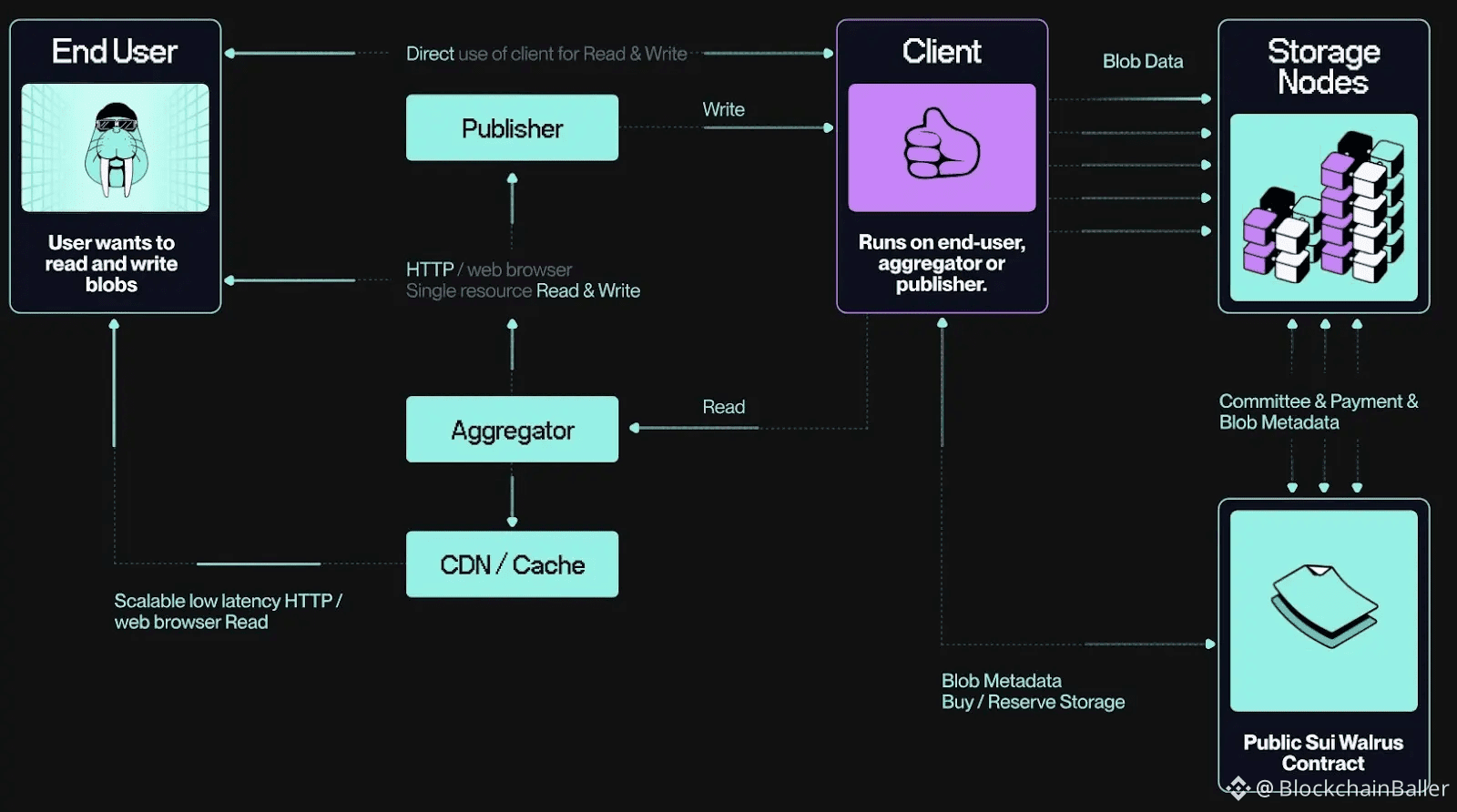
Walrus was created to solve this problem at its root. It is a decentralized storage and data availability protocol designed to support large-scale, privacy-preserving, and censorship-resistant data for Web3. Rather than competing with blockchains, Walrus complements them by acting as a specialized data layer one that enables modern decentralized applications to scale without reverting to centralized cloud infrastructure.
The Core Vision Behind Walrus
Walrus is built on a simple but powerful premise: data ownership should be as decentralized as asset ownership. In today’s Web3 landscape, many applications use decentralized execution while still relying on centralized storage providers for critical data. This creates hidden points of control, censorship risk, data loss exposure, and long-term dependency on corporations.
Walrus replaces this model with protocol-enforced guarantees. Data is distributed across independent nodes, encrypted by default, and governed by cryptographic rules rather than corporate policies. Users retain control. Providers are incentivized economically. Trust is enforced by code.
This philosophy positions Walrus not merely as a storage solution, but as a foundational infrastructure layer for decentralized systems.
Built on Sui: A Strategic Foundation
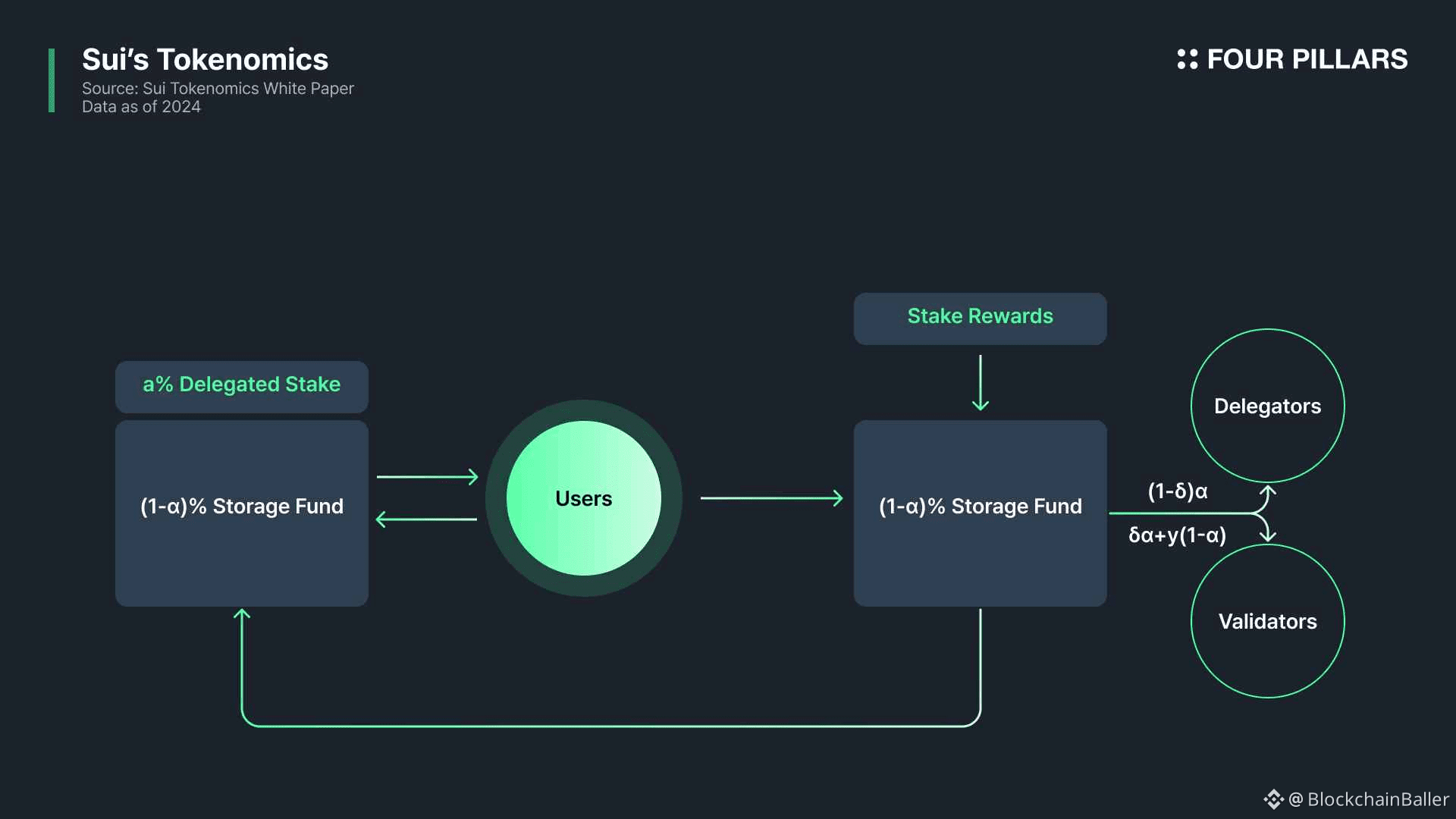
Walrus is built on the Sui, a high-performance Layer 1 blockchain known for its object-centric architecture, parallel execution, and low latency. This choice is deliberate and strategic.
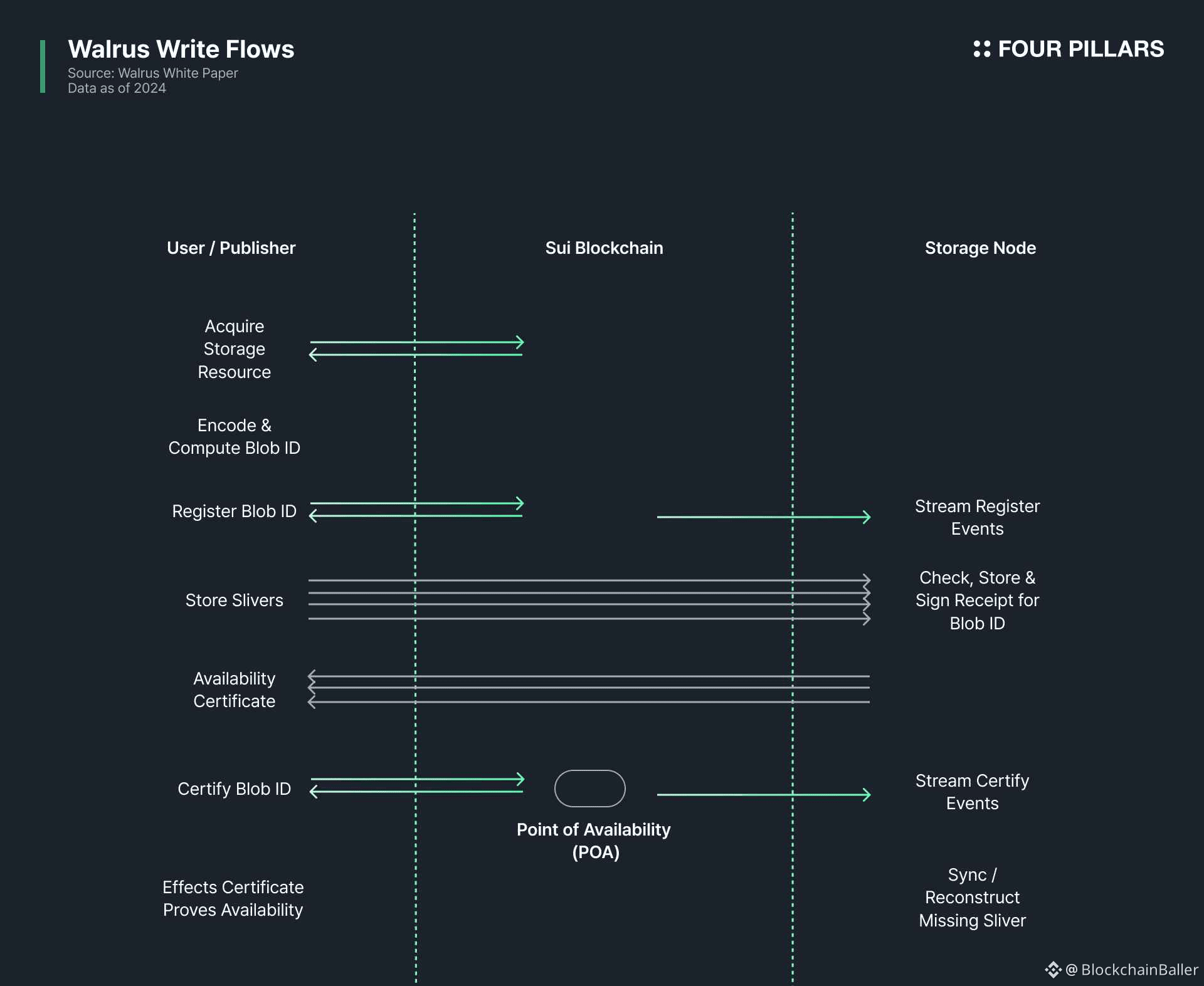
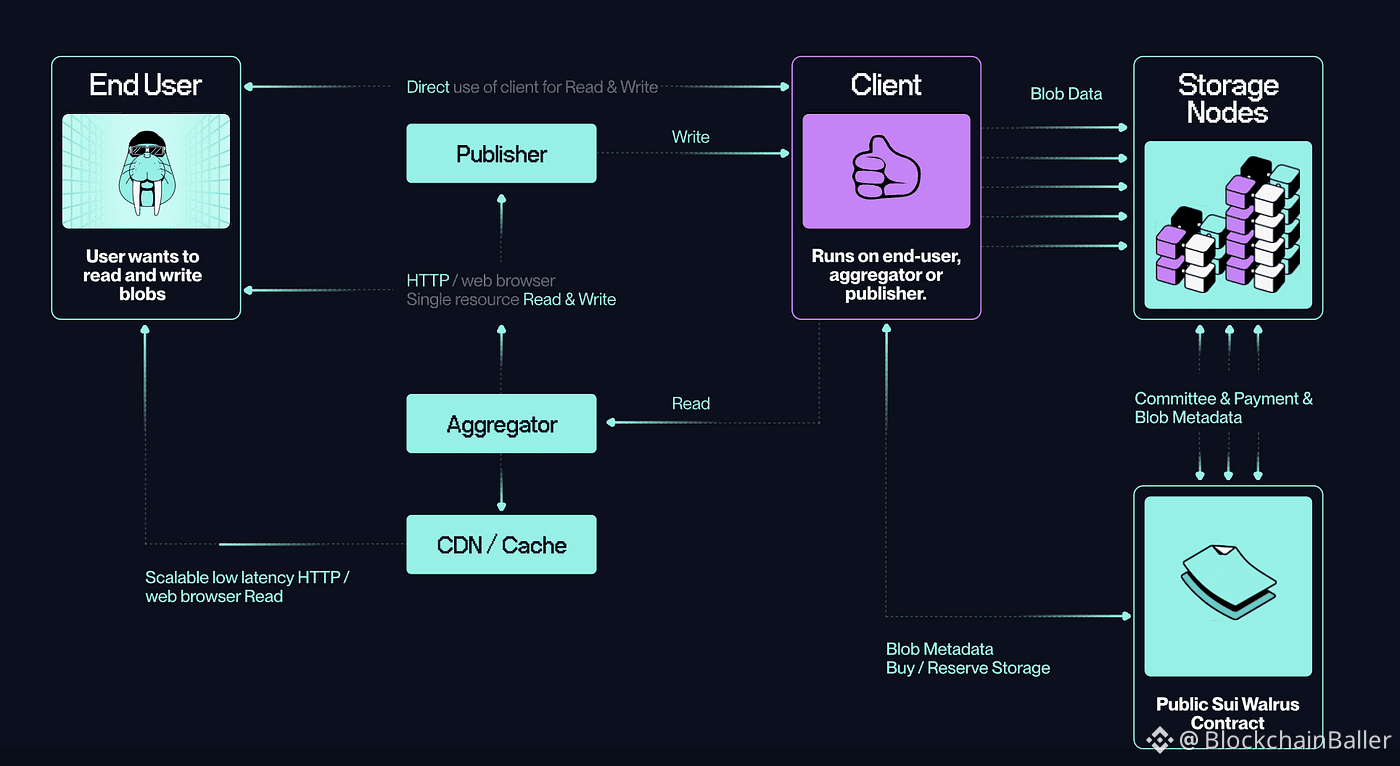
Sui is optimized for fast execution and scalable throughput, but like all blockchains, it is not designed to store large blobs of data directly. Walrus leverages Sui’s strengths by anchoring data references, ownership, and verification on-chain, while keeping the data itself off-chain in a decentralized storage network.
This separation of concerns—execution on Sui, data on Walrus—creates a modular architecture that is efficient, scalable, and future-proof.
Blob Storage and Erasure Coding: The Technical Core
At the heart of Walrus is its blob-based storage model combined with erasure coding. Instead of storing full copies of data across multiple nodes, Walrus breaks large files into fragments, encodes them with redundancy, and distributes those fragments across the network.
Erasure coding provides two critical advantages:
1. Resilience – Data can be reconstructed even if a subset of nodes is offline or unavailable.
2. Efficiency – Compared to simple replication, erasure coding significantly reduces storage overhead and cost.
This approach allows Walrus to store large datasets reliably without wasting resources, making it suitable for enterprise-grade and consumer-scale applications alike.
Privacy by Design, Not by Promise
Privacy is a first-class principle in the Walrus protocol. Data stored on Walrus can be encrypted before it is distributed across the network, ensuring that storage providers cannot read, analyze, or censor the content they host.
This design enables:
Confidential enterprise data storage
Private application state for dApps
Secure personal file storage
Sensitive datasets for AI and analytics
Access control is enforced cryptographically. Only users holding the correct keys can decrypt and access the data. Privacy is not dependent on trust—it is guaranteed by mathematics.
Censorship Resistance and Data Sovereignty
Walrus naturally inherits censorship resistance from its architecture. Because data is encrypted, fragmented, and distributed across many independent participants, no single entity can block, alter, or delete content.
This is a critical distinction from centralized cloud services, where providers can suspend accounts, remove files, or comply with arbitrary takedown requests. Walrus makes such actions structurally difficult, aligning with the core Web3 principle of permissionless access.
Data sovereignty remains with the user—not with the platform, node operator, or infrastructure provider.
The Role of the WAL Token
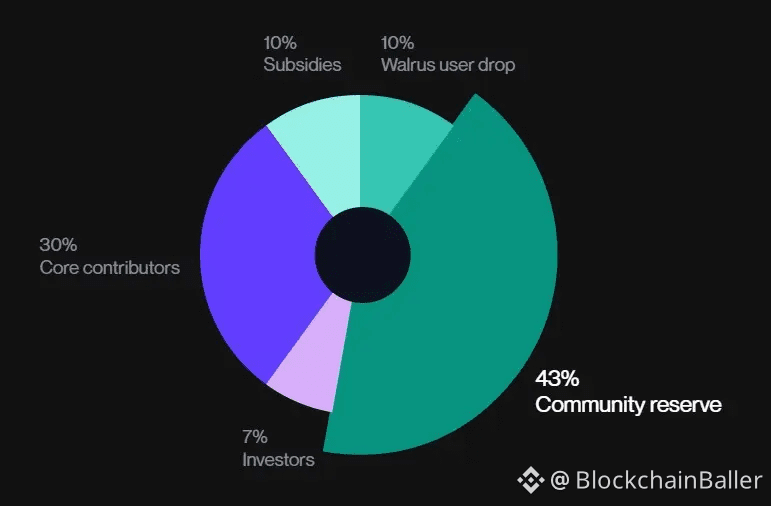
The WAL token is central to the Walrus ecosystem. It is not designed as a speculative instrument, but as a coordination and incentive mechanism that keeps the network secure, performant, and decentralized.
WAL is used for:
Incentives – Storage providers earn WAL for reliably storing and serving data.
Staking – Providers may stake WAL as collateral, creating accountability.
Governance – Token holders vote on protocol upgrades, parameters, and long-term direction.
Network Alignment – Economic incentives ensure honest behavior and discourage abuse.
By tying rewards to performance and penalties to failure, Walrus aligns participant behavior with network health.
Decentralized Governance and Long-Term Evolution
Walrus governance is community-driven. WAL holders can participate in proposals related to:
Storage economics
Incentive structures
Network parameters
Feature upgrades
Strategic development priorities
This governance model ensures that Walrus evolves transparently and in alignment with its users rather than under centralized control. Decisions affecting the protocol are made by stakeholders who are economically and philosophically invested in its success.
Developer Integration and dApp Design
For developers, Walrus solves a persistent architectural problem. Many decentralized applications today rely on centralized storage for images, videos, datasets, and logs—creating hidden centralization risks.
Walrus enables developers to:
Store large assets off-chain with cryptographic guarantees
Reference data from smart contracts using hashes or object IDs
Avoid expensive on-chain storage costs
Maintain decentralization across the full application stack
This is especially valuable for applications where data volume is large but trust and availability are critical.
Use Cases Across the Web3 Stack
Walrus is designed to support a wide range of real-world and Web3-native use cases:
NFTs and Digital Media
High-resolution images, videos, and metadata can be stored without relying on centralized servers.
Gaming
Game assets, maps, updates, and state snapshots can be distributed in a decentralized way.
AI and Data Science
Training datasets, inference inputs, and model outputs can be stored securely and privately.
Decentralized Social Platforms
User content can be hosted without surrendering control to centralized providers.
Enterprise and Institutional Use
Encrypted records, documents, and logs can be stored with auditability and resilience.
Cost Efficiency and Market Dynamics
Traditional cloud storage operates on centralized infrastructure with high margins and long-term lock-in. Walrus introduces a decentralized storage marketplace where providers compete and pricing is shaped by supply and demand.
Erasure coding reduces redundancy costs, and decentralized competition discourages rent-seeking behavior. Over time, this model is expected to deliver more competitive pricing while maintaining resilience and security.
Data Availability for Modular Blockchains
As modular blockchain architectures gain traction, data availability becomes a critical requirement. Execution may happen on rollups or off-chain systems, but data must remain accessible and verifiable.
Walrus is well positioned to act as a data availability layer, ensuring that application data remains retrievable even when execution is decoupled from settlement.
Enterprise Credibility and Institutional Appeal
From an enterprise perspective, Walrus offers a compelling alternative to centralized storage:
Encryption-first design
Protocol-enforced guarantees
Transparent incentives
No single point of control
Reduced vendor dependency
Trust is enforced by code and cryptography, not contracts or corporate assurances.
Strategic Positioning in the Web3 Ecosystem
Walrus does not attempt to replace blockchains or compete with execution layers. Its strength lies in specialization. By focusing exclusively on decentralized data storage and availability, Walrus strengthens the overall Web3 stack and improves composability across ecosystems.
This modular approach reflects the direction Web3 is heading: specialized layers working together rather than monolithic systems trying to do everything.
The Long-Term Future of Walrus
As Web3 adoption accelerates, data-heavy applications will become the norm. AI agents, immersive digital worlds, decentralized social networks, and enterprise blockchain systems all require scalable, private, and resilient data storage.
Walrus is built for this future. It treats data as first-class infrastructure—designed, governed, and secured with the same rigor as financial systems.
Conclusion: Walrus as Foundational Infrastructure
Walrus is not simply a decentralized storage protocol. It is a trust-grade data infrastructure layer designed for the next generation of Web3 applications.
By combining erasure-coded blob storage, privacy-preserving encryption, decentralized incentives, and deep integration with the Sui blockchain, Walrus provides professional, scalable, and censorship-resistant infrastructure.
The WAL token anchors this ecosystem, aligning governance, security, and economic incentives around reliability and long-term sustainability.
As Web3 continues to evolve, protocols like Walrus will define its architecture. Data is no longer an afterthought—it is infrastructure. And Walrus is building that infrastructure for a decentralized, privacy-first, and resilient digital future.