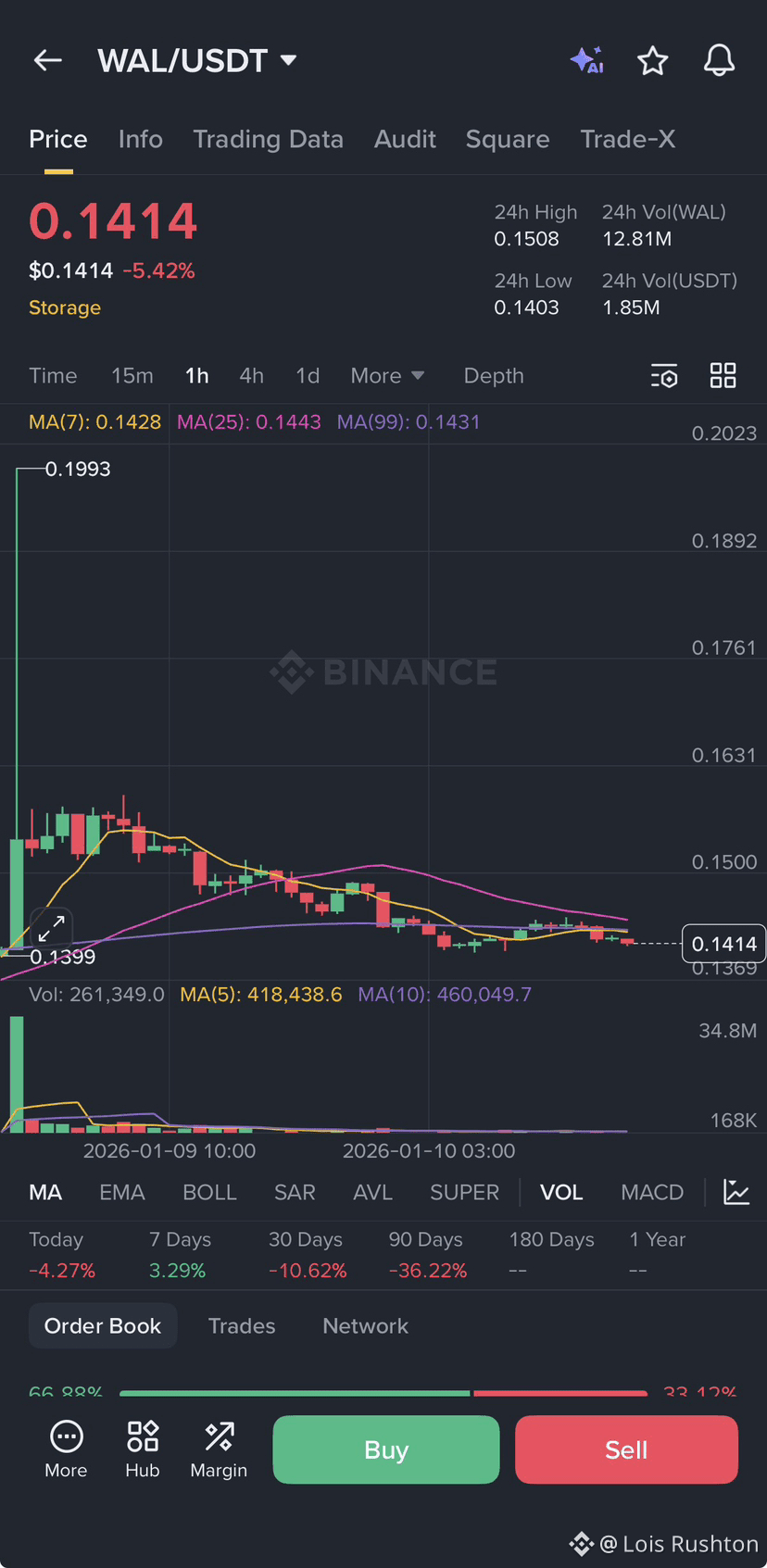
For a long time, most decentralized storage networks had the same problem: it’s easy to attract nodes when rewards are simple, but it’s hard to keep a network reliable when things get messy. Storage doesn’t fail because “we ran out of space.” It fails when nodes disappear, bandwidth dries up, or nobody wants to help during repairs. That’s the part users feel instantly — missing files, slow retrievals, random downtime.
Walrus has been pushing its $WAL token utility in a direction that feels more practical: reward the work that keeps the network alive, not the “I showed up” participation. That aligns with how Walrus is designed around verifiable availability on Sui (Proof of Availability), where nodes stake WAL and are only really valuable if they continuously prove they’re doing what they promised.
What “real work” looks like in a storage network
When I say “real work,” I’m talking about the stuff nobody tweets about, but everyone depends on:
Staying online consistently (uptime isn’t optional for storage)
Keeping assigned data pieces actually available (not just stored once and forgotten)
Responding quickly when the network needs repair or rebalancing
Handling bandwidth spikes when usage jumps (because peak load is when networks get exposed)
$WAL approach is basically: if you contribute to availability and resilience, you deserve rewards. If you’re just there to farm easy incentives without helping when the network is under stress, you shouldn’t get paid the same. That’s very aligned with the idea of incentivized availability and onchain accountability through PoA.
 Why this matters more than “more nodes” ever will
Here’s the uncomfortable truth: a storage protocol can have tons of nodes and still be unreliable.
Reliability comes from behavior, not headcount.
A network needs participants who show up during the boring moments: when nodes churn, when data needs rebuilding, when demand spikes, when challenges need answering, when latency matters. Incentives that only pay for joining the network can create the wrong crowd — people who optimize for rewards, not performance. Once you tie rewards to measurable performance, you naturally filter toward operators who treat this like infrastructure.
And that’s what I think Walrus is aiming for with WAL: fewer “tourists,” more “operators.”
The part people miss: incentives can adjust with network needs
I also like the idea of incentives shifting based on what the network needs right now. Sometimes the network needs more stable uptime. Sometimes it needs faster repair participation. Sometimes bandwidth and responsiveness matter more because usage is spiking.
A system that can nudge behavior dynamically feels more future-proof than a static reward schedule that gets exploited the moment someone finds the loophole. @Walrus 🦭/acc own positioning around WAL emphasizes minimizing adversarial behavior and encouraging efficient resource allocation — and this incentive direction fits that perfectly.
My honest takeaway: more complex, but way more sustainable
Yeah, it’s a bit more complex than “stake and chill.” But I’d rather have a network that stays reliable than one that looks simple on paper and breaks under pressure. If Walrus keeps tightening rewards around uptime, availability proofs, repair participation, and real bandwidth contribution, then $WAL starts acting less like a speculative “storage token” and more like a coordination tool for a dependable data layer.
And for infrastructure, trust is everything. You don’t win by being loud. You win by working when nobody’s watching.