


Walrus makes "delete' in storage systems feel simple right up until someone tries to rely on it.
Nothing breaks. The network keeps moving. Availability metrics don't flinch. Repair keeps running. but yet the release pauses, because the word everyone used ,'remove' does not clear a sign-off the same way for everyone in the room.
And that pause is annoying in the specific way only ops pauses are. Not "is the chain down". More like: "Can I put my name under this, yes or no'.
Walrus Protocol doesn't treat storage like background thing though. @Walrus 🦭/acc turns storage into obligations that run for a window. If a team decides a blob should not exist anymore, the window is already live. The assignment is already out. Someone is already on the hook for keeping it healthy for the rest of that stretch... even if the product team changed its mind a while ago.
From the app side, removal looks immediate. A reference disappears. Access is revoked. The UI updates. From that vantage point, the data is already 'gone'.
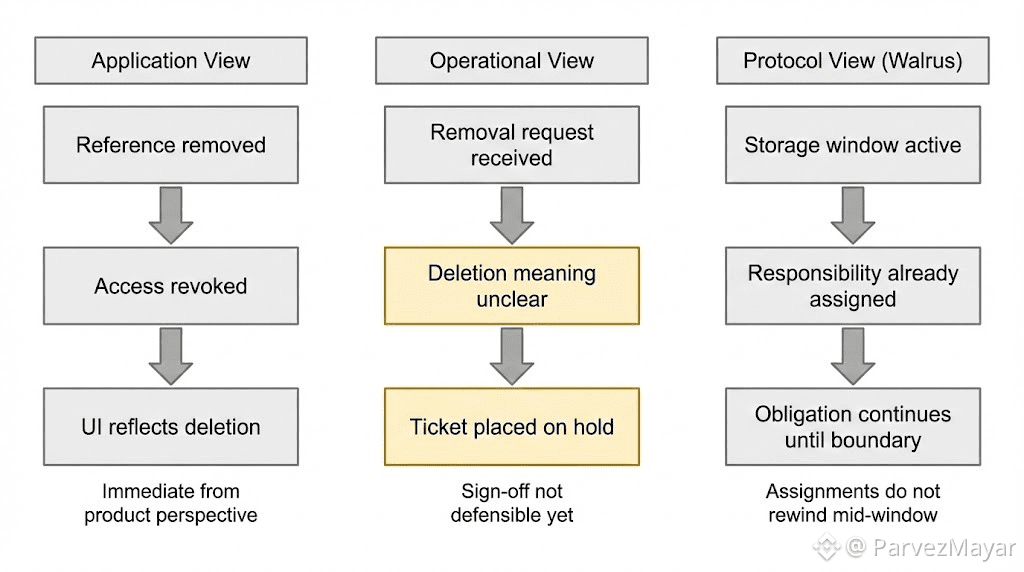
The desk doesn't get to use that word while the current epoch window is still open. "Gone" reads like a claim. Claims need a boundary.
The hold starts with a practical question that nobody wants to answer twice... what does 'deleted' mean for this request? Unreachable? Unpaid? Or actually out of responsibility?
People answer fast. And differently. One person means "users can not fetch it." Another means "we're not funding it anymore." A third means "it is not in scope for repair". Same English word. Three different liabilities.
It's not about whether the bytes "exist." It's whether anyone can state, on record, that this blob is out-of-scope before the window rolls. That is the thing that eliminates momentum by the way, you can nott close a ticket with a sentence you can't defend later.
Walrus is not "ignoring deletion" at any cost. Storage assignments don't rewind. Repair logic doesn't pause because a dashboard changed state. Once responsibility is handed out, it runs its course unless an unwind path is defined.
Bunch of teams only meet that fact when they are forced to put it in writing. The first time "remove" shows up in a checklist. The first time legal asks what exactly changed. The first time someone tries to tag an incident as 'resolved" and realizes they don't have language for "resolved" inside an open window.
I have witnessed teams hit this a bit late, when data stops being a toy. Something needs to be pulled. The first instinct is damage control fast, final. But erasure is not the default path here. Survival is. So 'remove' appears to be as decay tied to the same windowing that made durability workable in the first place.
And it creates these awkward truths that don not fit product UX as a team:
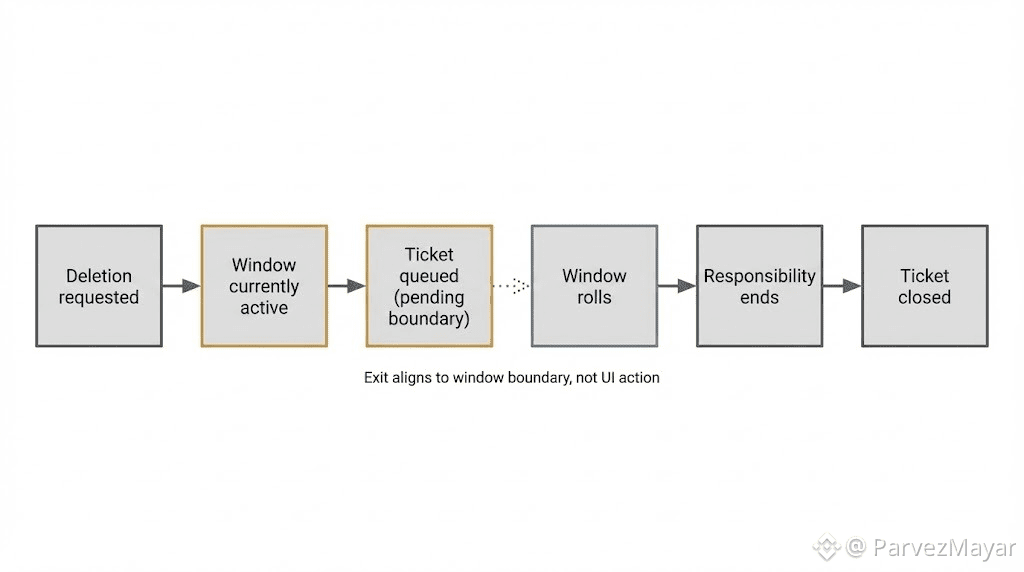
You can stop serving something and still be inside the window. You can cut access and still be inside the window. Stop paying...still inside the window.
It's not dramatic. It is just something messy.
So workflows bend. Not in theory. In paperwork.
A pre-delete step appears. Someone insists on a "pending removal" state, because 'deleted" is too definitive. The decision moves earlier than anyone likes, because nobody wants to discover a deletion request mid-window when the obligation clock is already running.
"Remove" becomes a request that waits for the boundary. Deletions go into a queue. The queue clears when the window rolls, because that's the only moment the desk can describe without improvising language.
Exit stays constrained by the same machinery that keeps things alive. After the fact, the window still applies. The queue still exists.
And someone is still staring at the ticket, not waiting for the UI to update... waiting for the boundary to arrive so they can finally close it without making up a story. #Walrus $WAL