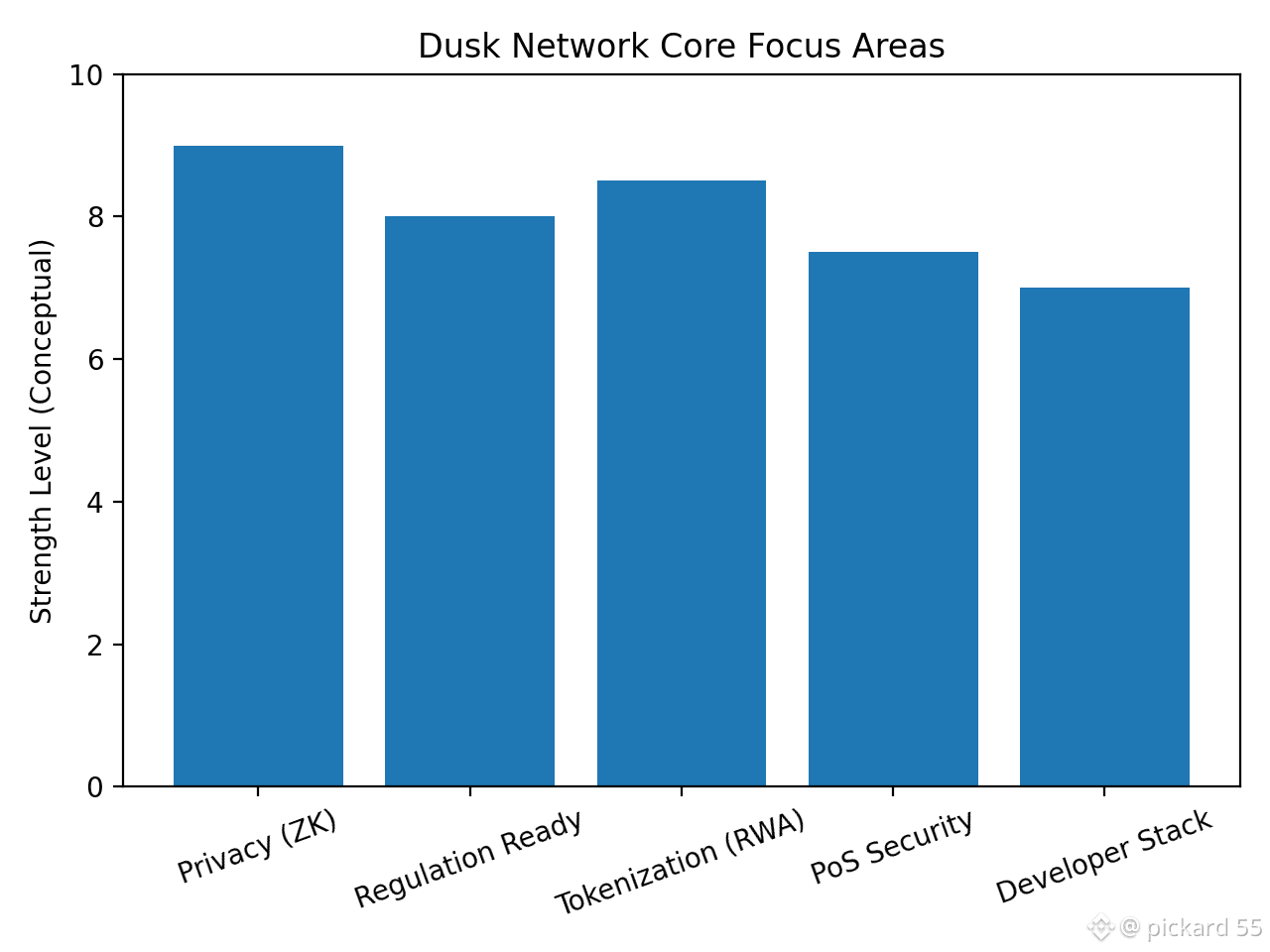
Dusk is one of those projects that makes more sense the longer you sit with the real problem it is trying to solve. Most blockchains are built for maximum transparency by default, because open verification is the easiest way to coordinate strangers. But regulated finance does not work like that. In the real world, markets need selective disclosure, compliance checks, and privacy for sensitive trading activity, while still keeping settlement verifiable and audit-ready. Dusk’s entire thesis is that the next wave of onchain adoption will not be driven only by memes or speculation, but by real financial instruments and compliant market infrastructure that can actually survive regulation and institutional requirements. That is exactly the lane @dusk_foundation keeps building toward, and it’s why $DUSK is more than just a “privacy coin” narrative.
Start from the mission: Dusk positions itself around opening access to institution-level assets directly from a wallet while keeping self-custody, and it frames the current world as fragmented liquidity and costly coordination between issuers, institutions, and users. The idea is simple: bring real markets onchain, but do it in a way that does not break the rules of finance or the privacy needs of participants. The use-case direction is not random either. Dusk highlights regulated building blocks like confidential security tokens, security token exchange infrastructure, digital share registries, proxy voting flows, and self-custody models designed for tokenized assets. These are boring topics to most crypto timelines, but that is precisely why they matter: boring is where the real volume lives when TradFi finally moves at scale. �
Dusk Network +1
What makes Dusk interesting technically is that it does not treat privacy as a bolt-on feature. In its own whitepaper, the network is described as a blockchain-based distributed ledger secured via a Proof-of-Stake consensus approach, built to preserve privacy when transacting with the native asset DUSK, while supporting zero-knowledge proof primitives on the generalized compute layer. The paper also separates the system conceptually into the native asset layer (DUSK) and a general compute layer, while keeping one shared state space. That’s an important design decision because it lets the chain be opinionated about what the base asset is used for (staking, fees, and core state transition entry points), while still enabling application logic on top. �
Dusk Network
Consensus is another place where Dusk’s design signals what it is optimizing for. The whitepaper describes a privacy-preserving leader extraction approach called Proof-of-Blind Bid that forms the basis of its Segregated Byzantine Agreement (SBA) consensus mechanism. In plain terms, the network wants strong finality and PoS efficiency, but it also wants privacy characteristics that reduce metadata leakage that can appear even when cryptography is strong. When you read Dusk through the lens of “regulated markets,” this matters because market participants often care as much about hiding activity patterns as they do about hiding transaction amounts. �
Dusk Network
From an architecture point of view, Dusk has evolved toward a modular stack, which is what you would expect if the endgame is multiple execution environments serving different compliance and developer needs. In Dusk documentation, you’ll see references to core components and dual transaction models (Phoenix and Moonlight), plus execution environments like DuskEVM and DuskVM, and a native bridge concept for trustless transfers between execution layers. This is a practical direction: EVM compatibility lowers friction for developers, while a dedicated VM can enable deeper privacy-focused functionality where needed. �
DOCUMENTATION +2
Phoenix is worth mentioning because it represents how Dusk thinks about privacy-preserving transfers and smart contracts as “first-class.” Dusk has published research-style updates around Phoenix as a privacy-preserving transaction model, and has also discussed security proofs related to it. The important takeaway for a normal reader is not the math details, but the implication: if you want regulated assets and confidential activity, you need a transaction model that can express privacy without destroying verifiability. Dusk is actively building and formalizing that layer rather than outsourcing it. �
Dusk Network +2
Now zoom out to what the market can actually touch. One of the most notable “real world” signals recently is Dusk Trade. There has been public messaging that the Dusk Trade waitlist is open and that it’s a regulated RWA trading platform built with NPEX, described as a licensed exchange with around €300M AUM, aiming to bring tokenized assets and funds onchain. Whether you join the waitlist or not, the strategic meaning is clear: Dusk is trying to build compliant distribution and market rails, not just publish tech posts. In crypto, many projects talk about RWAs; fewer show a credible route to regulated market structure. �
Binance +2
Mainnet maturity also matters here. Dusk announced its mainnet milestone publicly in early 2025, framing it as a major step after years of development. People can argue about timelines all day, but a functioning mainnet changes the conversation from “promise” to “delivery,” especially for regulated finance narratives where reliability is a prerequisite. �
Dusk Network +1
And because many of us are literally writing on Binance Square, it’s also relevant that Binance has an active CreatorPad campaign tied to Dusk content creation, with published dates and rules. That’s not a tech feature, but it does affect community growth and content velocity, and it’s a straightforward reason you’re seeing more Dusk discussion right now. �
Binance
So what is the clean way to interpret $DUSK from here, without turning this into hype? I see it as a bet on a specific future: a world where onchain markets need privacy plus compliance, where institutions demand selective disclosure and auditability, and where “finance-grade” blockchains separate settlement guarantees from execution environments so builders can choose the right tool. If Dusk keeps shipping on modular execution (DuskEVM for standard tooling, DuskVM for deeper custom needs), strengthens the privacy transaction layer (Phoenix/Moonlight), and proves real distribution through regulated rails like Dusk Trade, then the narrative stops being marketing and becomes infrastructure.
Of course, risks are real. Regulated finance is slow, partnerships take time, and user adoption is not guaranteed. Also, privacy tech is notoriously hard to communicate, which can delay mainstream understanding. But that is also why the upside exists: if Dusk nails the intersection of regulation, tokenization, and privacy-preserving settlement, it may end up competing in a category that most general-purpose L1s are not optimized to win.
For now, my personal approach is to watch concrete delivery signals: documentation maturity, mainnet upgrades, developer traction around DuskEVM, and whether regulated RWA flows actually land with credible market participants. If those pieces keep moving, becomes less about short-term price action and more about whether crypto can finally host real markets without forcing everyone to trade their privacy away.