

When traders talk about “complexity,” we usually mean too many moving parts: more venues, more risks, more things that can break at the worst time. Developers feel the same pain, especially once an app needs real data at scale images, game assets, AI datasets, social content, full websites not just a few bytes in a smart contract. That’s where Walrus has been getting attention lately: it’s trying to make decentralized storage feel less like a custom engineering project and more like an integrated piece of the stack you can actually ship with. Walrus was first introduced publicly in mid-2024, and Mysten Labs published its official whitepaper announcement on September 16, 2024, noting that the early developer preview had already stored over 12 TiB of data big enough to signal it wasn’t just a toy demo.
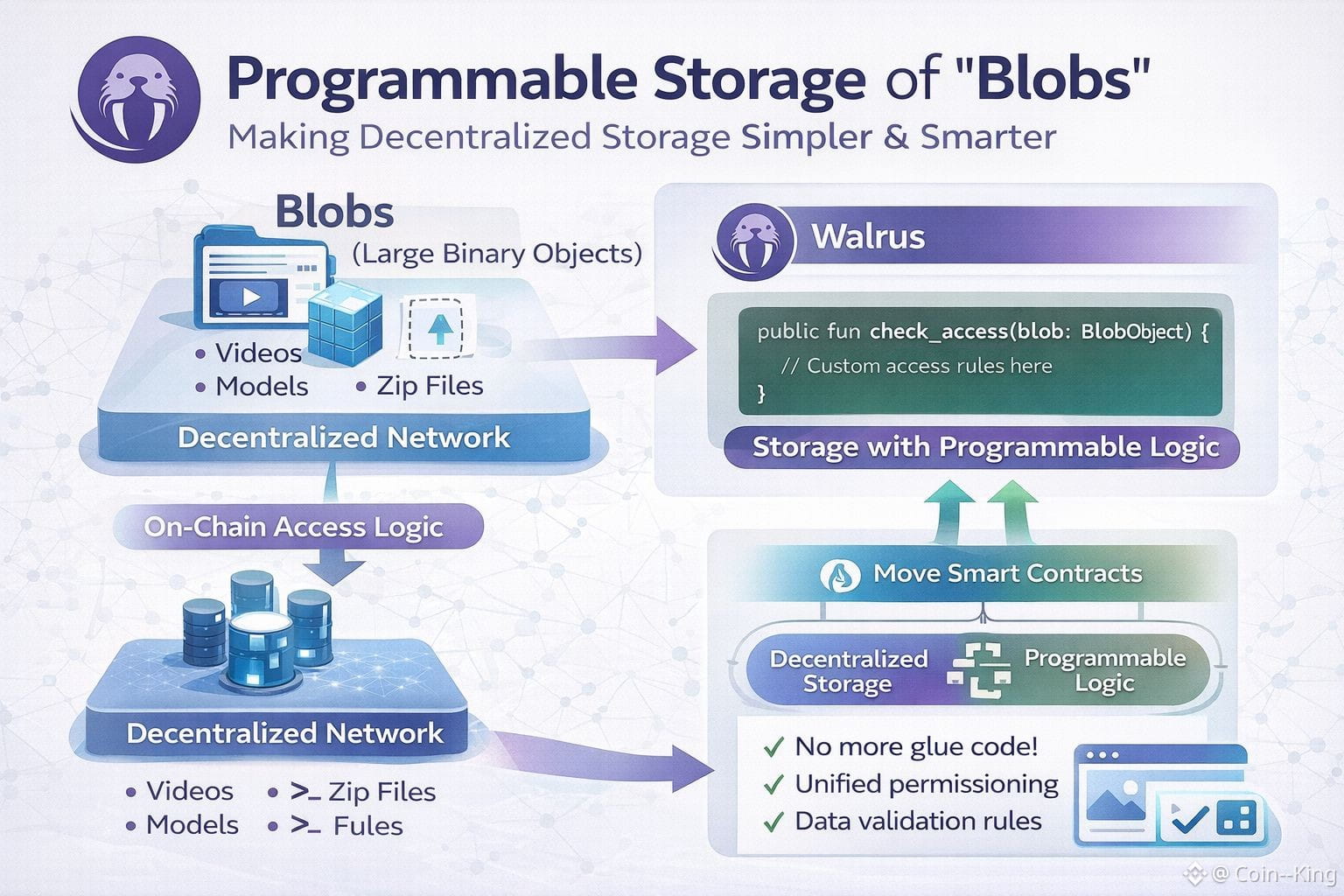
The core idea sounds simple: store “blobs” (big binary objects) in a decentralized network, but make that storage programmable. A “blob” is just developer slang for a chunk of raw data think a video file, a model checkpoint, or a zip of website assets. Traditionally, teams end up juggling centralized buckets, CDN rules, access control, and some glue code to connect it all back to on-chain logic. Walrus tries to collapse that sprawl by pairing storage with logic you can attach to it especially if you’re already working in the Sui ecosystem and using Move smart contracts. That programmability is the part that reduces complexity: instead of building a separate permissioning layer and a separate “data validity” layer, you can design app behavior around stored data in a more unified way.
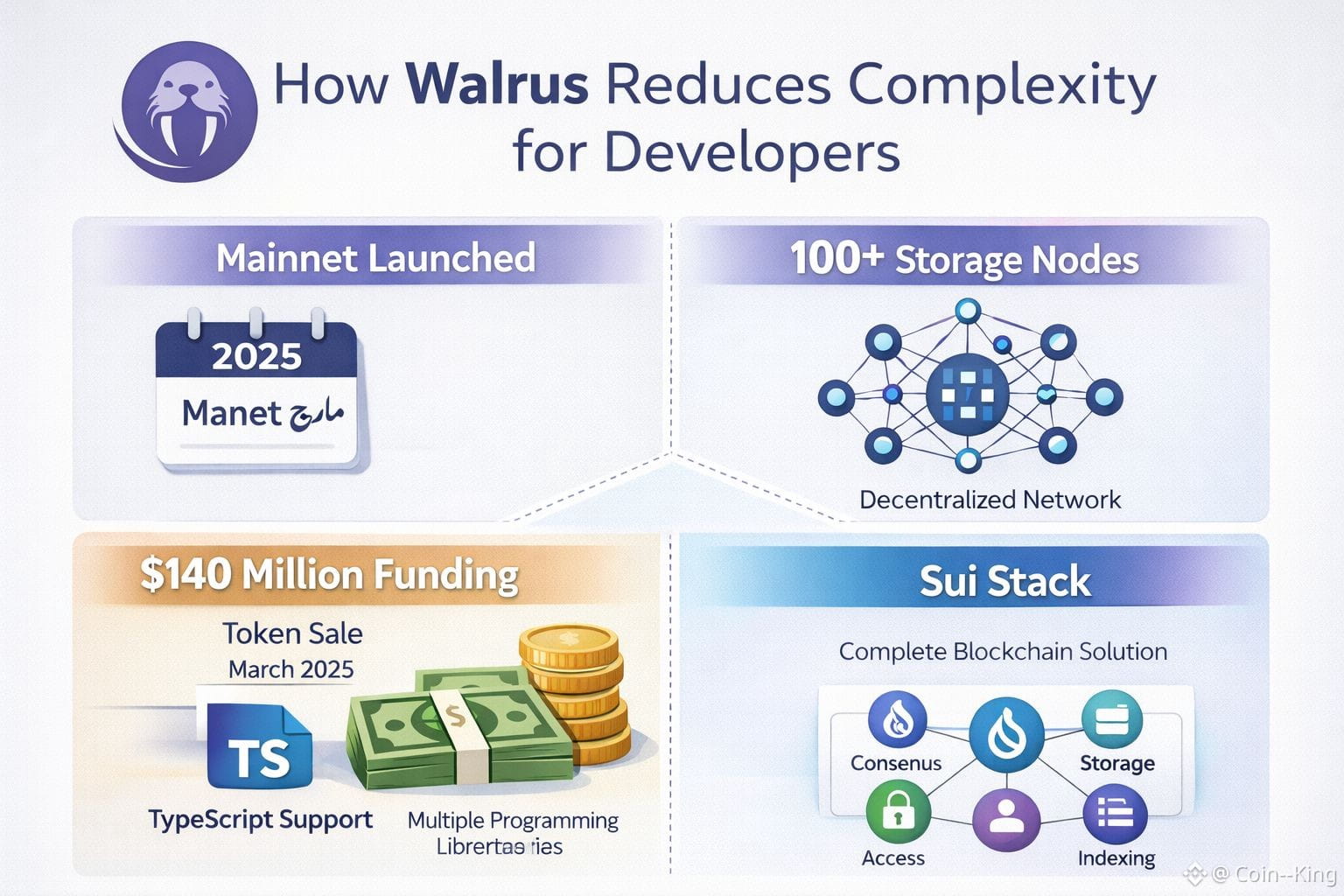
A big reason it’s trending is timing. Walrus’s production mainnet went live in 2025, with docs describing a decentralized network of “over 100 storage nodes,” and noting Epoch 1 beginning on March 25, 2025. Around the same window, CoinDesk reported Walrus raised about $140 million in a token sale ahead of mainnet launch (published March 20, 2025). Whether you love or hate token funded infra, markets notice when serious capital is backing a piece of plumbing because plumbing is what decides if apps can scale beyond narratives. And as Sui pushed its broader “Sui Stack” story in 2025 consensus, storage, access control, indexing Walrus increasingly showed up as the storage layer that completes that picture.
From a developer’s standpoint, the “complexity reduction” shows up in boring, practical places: tooling, SDKs, and fewer bespoke integrations. Walrus has an official TypeScript SDK flow that plugs into Mysten’s client tooling (installing packages like @mysten/walrus alongside Sui tooling), which is exactly the kind of thing that shortens the distance between “I get the concept” and “I shipped the feature.” The docs also point to an ecosystem of SDK options and community-maintained libraries in different languages, which matters because real teams don’t all build in one stack. When I see multiple SDK paths show up early, I read that as a signal the project expects usage, not just experimentation.
Under the hood, Walrus also tries to reduce complexity by reducing the brute-force cost of keeping data available. The research paper (posted May 8, 2025) describes a design called RedStuff, a two-dimensional erasure coding approach aimed at keeping overhead reasonable citing a 4.5x replication factor while enabling efficient “self-healing” recovery so the network doesn’t need to re-download an entire file just because a slice went missing. If “erasure coding” sounds intimidating, think of it like slicing a file into pieces plus some extra parity pieces, so you can reconstruct the original even if some pieces disappear. That matters because churn nodes coming and going is normal in decentralized networks, and handling churn without turning operations into a full time job is part of what “reducing complexity” really means.
As a trader, I’m allergic to overconfident infrastructure promises, so I watch what changes over time: mainnet realities, node counts, developer adoption, and whether tools keep getting simpler. The progress markers so far are concrete mainnet launch details, node counts, SDK documentation, and a published technical paper rather than just marketing claims. The bigger question is whether “programmable storage” becomes a standard mental model for app builders the way “programmable money” did for DeFi. If it does, Walrus’s real contribution won’t be a hype cycle it’ll be that fewer developers have to duct tape storage, access control, and on-chain logic into a fragile Rube Goldberg machine just to launch something users actually touch.