The Walrus protocol is more than just "another storage token." Its significance lies in solving a fundamental problem in the crypto space: determining the scalability of applications—that is, where the data is actually stored. Many blockchain projects struggle with large files, images, game assets, AI datasets, or documents. They often opt for centralized servers. Users abandon this technology not because it's "too advanced," but because of its fragile and unstable user experience.
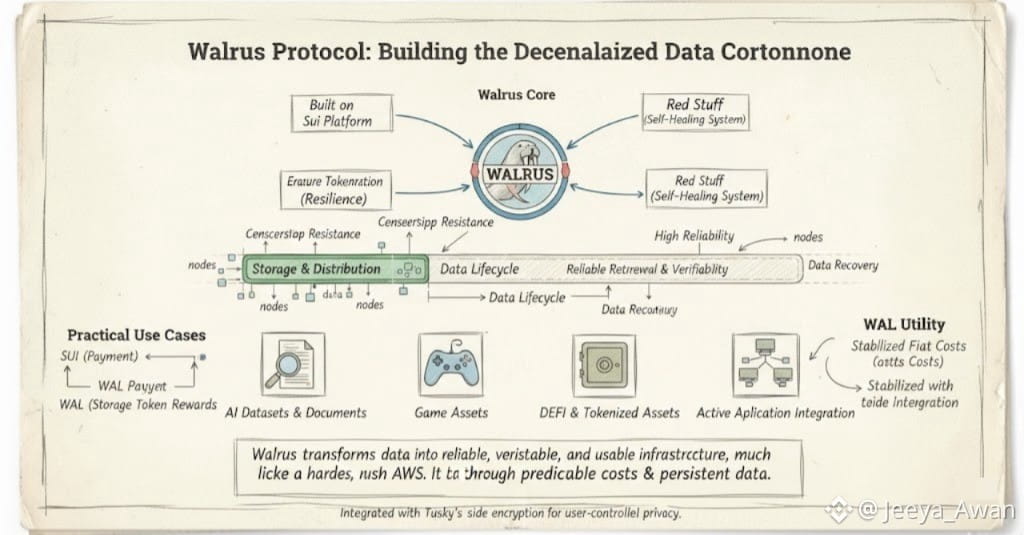
The Walrus protocol, built on the Sui platform, is designed to store large binary data (blob storage)—large, verifiable datasets that don't need to be stored directly on the blockchain. Its secret weapon is erase tokenization: data is divided into blobs and distributed across nodes, allowing for data recovery even if some nodes fail. This provides true censorship resistance and high reliability for applications that rely on persistent and verifiable data.
WAL technology will only realize its value if its use is real and reproducible. Criteria such as the growth of paid storage space, active application integration, reliable data retrieval, and sustained demand after the initial hype will determine whether Walrus can evolve from a simple "token" into a cornerstone of the decentralized data market. Walrus's goal is not merely storage for storage's sake; it aims to build a configurable infrastructure that developers can trust, much like AWS infrastructure, not just a hard drive.
Red Stuff is at the heart of Walrus's technology—a two-dimensional tokenized system designed for resilience and self-healing. Lost data can be efficiently recovered, avoiding costly replication. In decentralized storage, the real challenge lies not in storing data, but in maintaining reliable storage without incurring exorbitant replication costs.
Walrus is designed to handle large data blocks and their availability, and is fully integrated with Sui through smart contract coordination. The higher the programmability and verifiability of the storage layer, the more it can serve as the foundation for applications, rather than just a passive data repository. WAL, as a payment token, stabilizes fiat currency storage costs and distributes rewards among nodes and participants. This alleviates the pricing problems typically faced by storage tokens.
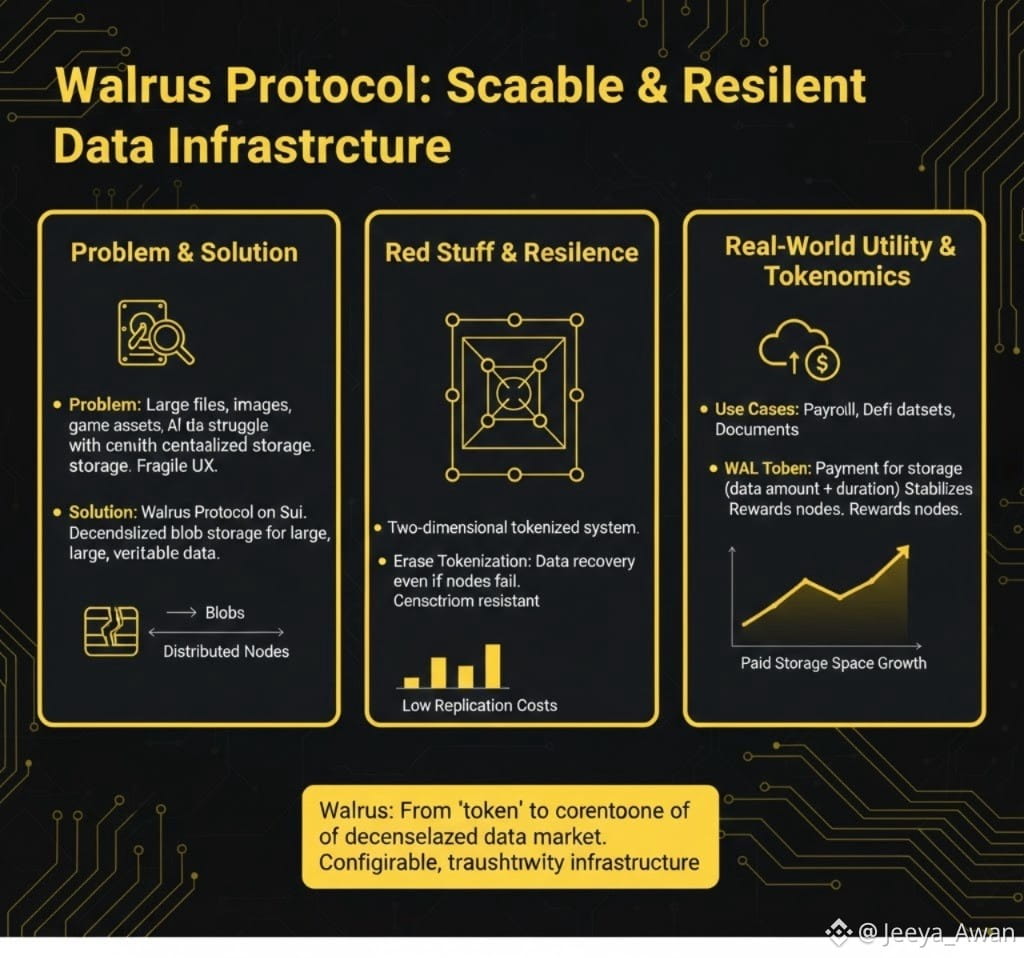
Practical use cases are crucial. Users transact using SUI and store data using WAL, with fees proportional to the amount of data and storage duration. This brings anticipated demand: larger storage space, longer holding periods, and more frequent circulation of WAL across the network. If Walrus becomes the default layer for persistent application data, WAL could evolve into a usage-based asset that generates storage rewards, rather than a speculative token.
Risks remain. Circulating supply dynamics, adoption barriers, and dependence on the Sui ecosystem could all hinder its growth. Usage must align with the token's economic characteristics to maintain its value. Developers choosing established platforms like Filecoin or Arweave, or migrating to other blockchains, could dampen demand.
Nevertheless, the stable development of Walrus is worth watching. Reliability isn't just about appearances; it aims to gradually build developer trust through predictable costs, consistent assumptions, and reliable data storage. Once trust is established, application design no longer needs to be defensive, functionality is preserved, data records accumulate, and the product becomes consistently robust and reliable. The prerequisite for efficient infrastructure operation is both invisibility and trustworthiness, which is precisely Walrus's goal.
Tusky's client-side encryption complements this: users control their own keys, ensuring data security and transferability. The migration process is simple and seamless, requiring no re-encryption or reliance on centralized service providers. Integration with Walrus enables the construction of a decentralized architecture where verification, persistence, and resilience coexist, supporting AI, decentralized finance, and blockchain applications without sacrificing control.
In short, Walrus is more than just data transmission; it transforms data into a reliable, verifiable, and usable infrastructure. Over time, continued developer adoption and reasonable incentives for Walrus promise to make it the long-awaited infrastructure layer for cryptocurrency applications.