

One of the most repeated assumptions in crypto is that maximum transparency produces the best markets. It sounds principled. It is also wrong the moment real financial behavior enters the system.
Full transparency does not make markets fairer at scale. It makes them fragile.
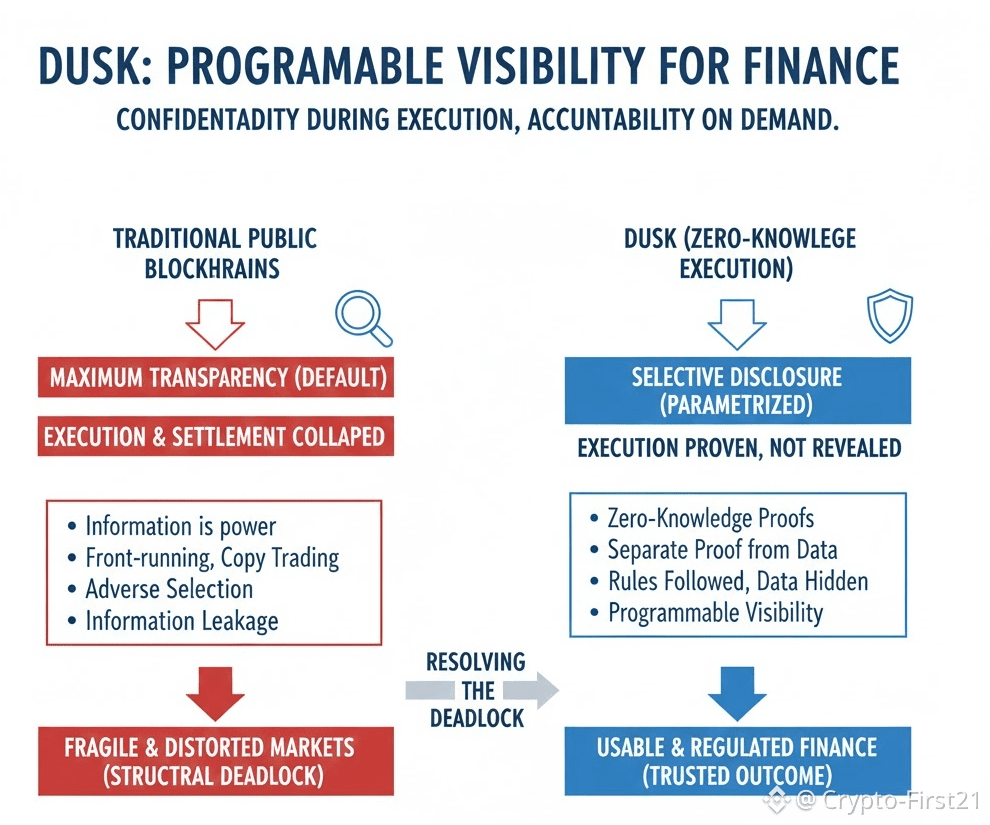
In real finance, information is power. A fund manager broadcasting positions in real time hands strategy to competitors. A trading desk exposing execution intent before settlement invites front running, copy trading, and adverse selection. Even when rules are followed perfectly, information leakage turns rational behavior into a disadvantage. The result is not accountability, but distorted execution.
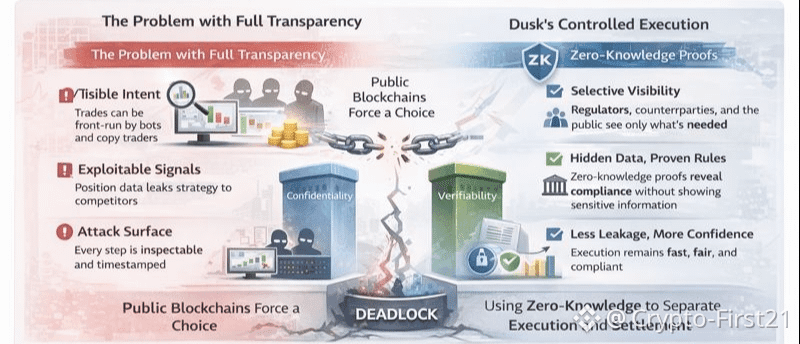
This is not a philosophical argument about openness versus secrecy. It is a structural deadlock. Finance requires two opposing properties at once: confidentiality during execution and verifiability after the fact. Most public blockchains force a choice. Either everything is visible, or the system retreats into private infrastructure that loses the benefits of a shared network.
Dusk is designed around resolving that deadlock, not by hiding execution, but by proving it.
Public blockchains collapse execution and settlement into a single visible surface. Every intermediate state is inspectable, timestamped, and replayable. That works for simple transfers. It fails for regulated workflows.
Consider a compliant secondary market. Eligibility checks, transfer restrictions, position limits, and jurisdiction rules all need to be enforced. If every step of that logic is public, counterparties can infer sensitive data even when balances are technically correct. Transparency becomes an attack surface.
Dusk’s execution model uses zero knowledge proofs to separate what must be proven from what must be revealed. A transaction can demonstrate that rules were followed without exposing the data that makes the proof true.
This is where programmable visibility matters. Not all participants need to see the same thing. Regulators may require full audit access. Counterparties may need confirmation. The public only needs assurance that the system behaved correctly.
A simple analogy is social media privacy settings. You do not choose between everyone sees everything and no one sees anything. You choose who sees what. Zero knowledge brings that same control into execution logic.
As of early 2026, Dusk’s mainnet is live, and the project has moved from architecture to operation. At the same time, stablecoins and tokenized real world assets continue to grow, pushing more regulated value onto public rails. Institutions are no longer asking if they should explore on chain settlement, but under what conditions they can stay.
Those conditions are operational, not ideological. If execution leaks strategy or compliance data, adoption stalls. If systems support selective disclosure with cryptographic guarantees, retention becomes possible.
Zero knowledge in Dusk is not about making everything private. It is about making execution usable. Confidentiality during action, accountability on demand.
If crypto wants to host real finance, it must stop treating transparency as a default virtue and start treating it as a parameter. Markets do not need to see everything to trust the outcome. They need proof that the rules were followed.
