
Walrus and WAL in Simple Human Terms
A gentle starting point
Let me explain Walrus the way I’d explain it to a friend who’s curious but not technical. The internet runs on data, but most of that data sits inside big companies’ cloud servers. That works, until it doesn’t. Prices change. Access gets blocked. Accounts get frozen. A service shuts down. And suddenly your app, your files, or your product is stuck.
Walrus is built around a simple emotional goal: make it possible to store and serve large data without having to trust one gatekeeper. Not as a dream, but as a working system with rules, proofs, and incentives. I’m going to walk you through how it works from beginning to end, why it was designed this way, what to watch to judge its health, what can go wrong, and what a realistic future might look like.
What Walrus is actually for
Most blockchains are amazing at recording small truths. Who owns this token. Who voted on this proposal. Which trade happened. But they struggle with big files. Videos, images, app assets, AI datasets, and large documents are heavy. If a blockchain tried to hold all that data directly, it would get slow and expensive fast, because blockchains usually replicate data broadly for safety.
Walrus steps in as a specialized layer for big data. It focuses on blob storage and data availability. Blob just means a large piece of data, basically a file. Data availability means something deeper than “I uploaded it once.” It means the network keeps enough of your data alive so that people can retrieve it later when they need it.
This is why Walrus feels less like a normal storage product and more like a market for availability. You’re not only paying for space. You’re paying for a reliable promise over time.
Where it lives and why that matters
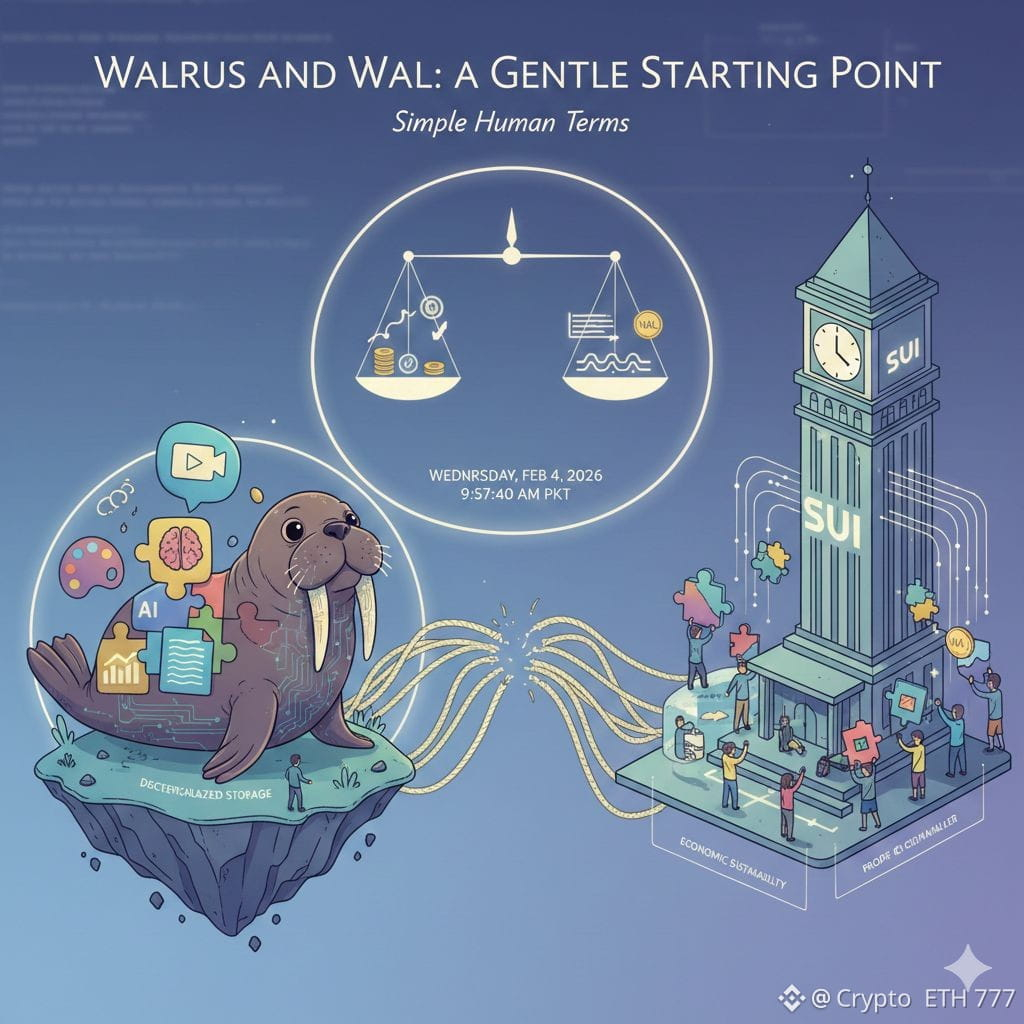
Walrus is closely tied to the Sui ecosystem, using Sui as the coordination layer. Here’s the human way to understand that.
Think of a city with a strong courthouse. The courthouse does not store everyone’s belongings, but it keeps official records, enforces contracts, and resolves disputes. That’s what the chain is doing for Walrus. It helps track who stored what, for how long, and under what rules, while the heavy data itself is kept in the storage network designed for big files.
This split is not a random choice. It’s one of the key reasons Walrus can aim for scale without turning onchain storage into a financial and technical nightmare.
How a file moves through Walrus step by step
First, someone wants to store a file. It might be an app uploading a batch of images, an AI agent saving data, or a user storing something important. In Walrus language, that file is treated as a blob.
Next, Walrus prepares the blob for decentralized storage. Instead of simply making many full copies, Walrus relies on erasure coding. This is the moment where the story becomes interesting, because erasure coding changes the whole trust model.
A friendly analogy helps. Imagine you wrote a long letter and you want it to survive even if some mailboxes get destroyed. You could photocopy the whole letter and put copies in many places, but that’s expensive. Erasure coding is like turning your letter into many puzzle pieces in a way where you only need a portion of them to rebuild the full letter. That means the system can lose some pieces and still recover the original.
After encoding, the pieces are distributed across many storage nodes in the network. The nodes are just independent operators providing storage and bandwidth, but the magic is in the structure: no single node needs to hold the entire file for the file to remain retrievable later.
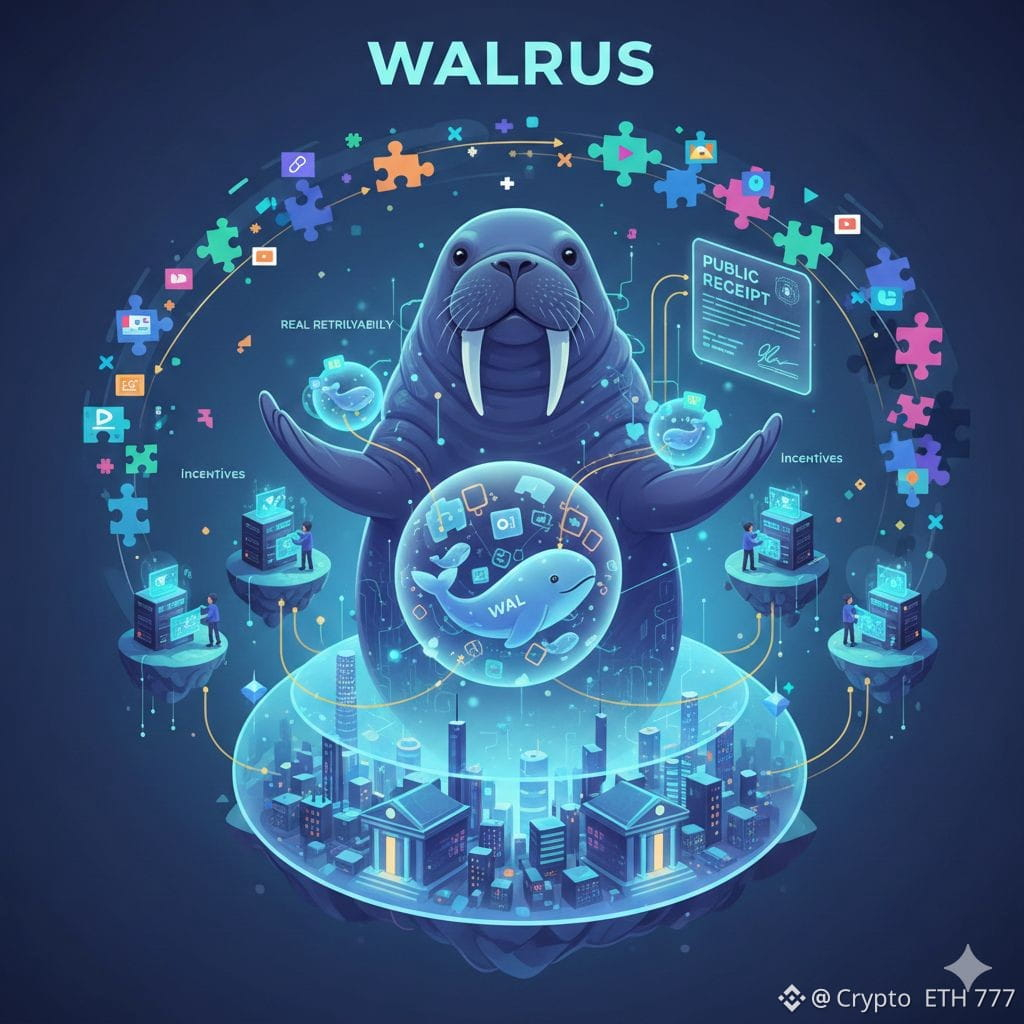
Then comes the part that makes this feel more “blockchain native” than a normal storage service. Walrus produces an onchain proof that the blob has been accepted and is available. You can think of this as a public receipt. It’s the difference between “trust me, I stored it” and “here’s a verifiable record that the system committed to storing it.”
Finally, when someone needs the file later, they request it, gather enough pieces, and reconstruct the original blob. If a few nodes are offline, the design is supposed to remain resilient, because the file can still be rebuilt from the remaining pieces.
Why Walrus chose erasure coding and blobs
This is where the project’s personality shows.
Full replication is brute force reliability. It’s safe, but it wastes a lot of resources. Erasure coding tries to deliver reliability with less waste, which is important if you want decentralized storage to be genuinely cost-competitive.
But there’s a trade-off hiding inside that efficiency. With full replication, long-term availability is almost automatic because so many copies exist. With erasure coding, availability becomes a balance that must be actively maintained. The system depends more on incentives, on a healthy set of storage nodes, and on the economics of keeping shards online month after month.
This connects directly to your core insight.
Walrus turns decentralized storage into a data-availability market where erasure-coded blobs reduce storage trust assumptions but shift economic pressure onto long-term storage incentives. That creates a hidden sustainability constraint most users are mispricing.
In plain English, that means this: the system can look extremely efficient and strong at the start, but the real test is whether it can keep people motivated to store and serve data over long periods, when hype cools and costs keep arriving like clockwork. If It becomes normal for users to expect cheap availability forever, while operators feel the real weight of time, the tension eventually surfaces.
Where WAL fits in and what it is really doing
WAL is the token that supports the network’s economic and security model. It’s used around staking, governance, and incentives that keep the storage network honest and alive.
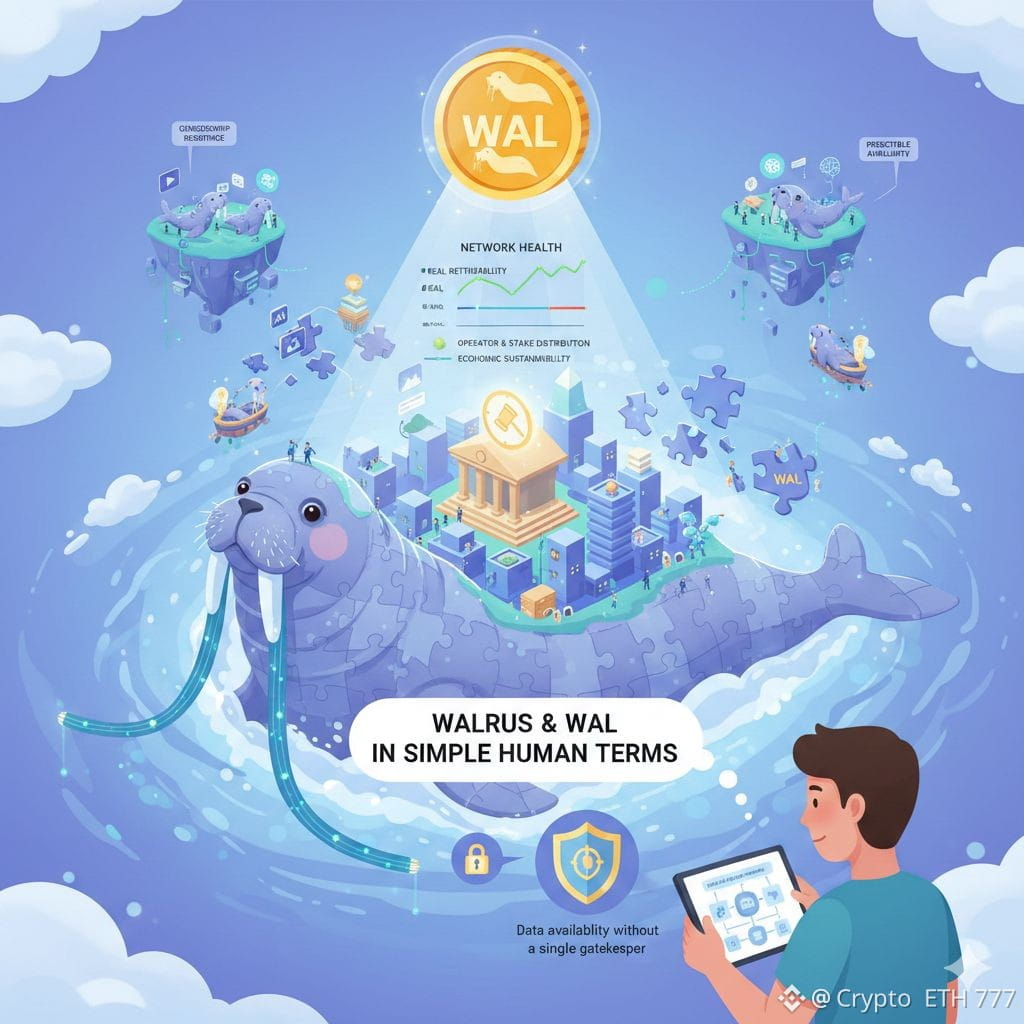
The simplest way to understand it is this. Storage nodes are not volunteers. They’re businesses. They need reasons to stay reliable. WAL is part of how the protocol tries to turn reliability into a rewarded behavior, and unreliability into a punished one.
People can stake to support operators, operators can earn rewards when they behave properly, and governance can adjust parameters when the network learns new lessons. They’re not just storing data, they’re participating in a living economy that tries to keep promises measurable.
If an exchange is mentioned in this world, the clean one to mention is Binance, but the deeper point is this: price action is not the same thing as network health. Network health is whether the storage promise stays real.
A gentle truth about privacy
Sometimes people describe Walrus as privacy-focused, and there is a practical way that can be true. You can encrypt your data before storing it, and you can keep raw content offchain while only keeping references and proofs onchain.
But it’s important to separate “I can store data privately by encrypting it” from “this protocol is a private payments system.” Walrus is mainly positioned as decentralized storage and data availability. Keeping that distinction clear helps you judge it fairly.
What metrics really matter if you want to judge Walrus honestly
A healthy storage network has a different heartbeat than a trading token.
The first metric is real retrievability. When users fetch blobs, do they get them reliably. When traffic spikes, does performance collapse. Does the network behave like infrastructure, not like a demo.
The second metric is operator and stake distribution. If a small number of operators control most storage responsibility, the system becomes weaker than it appears, because censorship and outages become easier. Decentralization is not a slogan, it is a measurable shape.
The third metric is economic sustainability. Does the pricing of storage and availability reflect time honestly. Does the incentive model keep operators around without needing extreme inflation or constant emergency tweaks. Long-term systems live or die on whether their incentives can survive boredom.
The fourth metric is developer adoption that sticks. Not just headlines, but real apps and workflows that rely on it because it works, not because it is fashionable.
Risks and weaknesses that deserve respect
Every serious protocol has risks, and you get stronger as an investor or builder when you can name them clearly without panic.
There is centralization risk. Delegated systems can drift toward a few big winners, because delegators chase perceived safety and returns.
There is incentive tuning risk. If rewards are too small, operators leave. If rewards are too large, the system might become dependent on unsustainable subsidies.
There is complexity risk. Erasure coding and availability proofs are powerful, but complex systems can fail in complex ways. That does not mean failure is likely, it means careful engineering and real-world testing are not optional.
There is expectation risk. Users often assume decentralized storage means permanent storage. But many networks are better understood as selling availability for a paid duration. Confusing these can lead to disappointment even when the system behaves exactly as designed.
A realistic future, without fantasy
If Walrus succeeds, it probably won’t be because everyone instantly stops using cloud services. The more realistic future is quieter. Walrus becomes a dependable base layer for apps that need censorship resistance, predictable availability, and a more open market for data.
We’re seeing the world move into a data-heavy era. AI agents, content platforms, onchain games, and new kinds of digital ownership all need large data that does not belong inside a single company’s server room. If Walrus can keep its economic promises stable over time, it can become one of those invisible pieces of infrastructure that people rely on without thinking, like roads or electricity.
And if it cannot keep those promises, the market will reprice it, not with opinions, but with real behavior: operators leaving, costs rising, and users choosing other options. That is the honest test.
A calm closing
I like Walrus as an idea because it respects reality. It doesn’t pretend storage is free. It doesn’t pretend time is cheap. It tries to build a system where availability is provable and incentives are designed, not assumed.
If you keep one thought in your pocket, keep this. The best infrastructure is not the loudest. It’s the kind that keeps working when nobody is watching. If Walrus grows into that kind of quiet reliability, it won’t just store blobs. It will give people more freedom to build, more confidence to create, and a little more peace in a world where control over data has been too centralized for too long.

