

Most decentralized storage protocols are designed as if the world will willingly become its own DevOps department. They assume every application will handle encoding, fragmentation, proof handling, and node selection directly. That assumption might look elegant in a whitepaper, but it collapses the moment you try to ship a real product. Businesses do not adopt infrastructure because it is philosophically pure. They adopt it because it is operationally usable. That is the underrated direction Walrus is taking inside the Sui ecosystem: not merely decentralizing storage, but building a service layer that makes decentralized storage commercially deployable.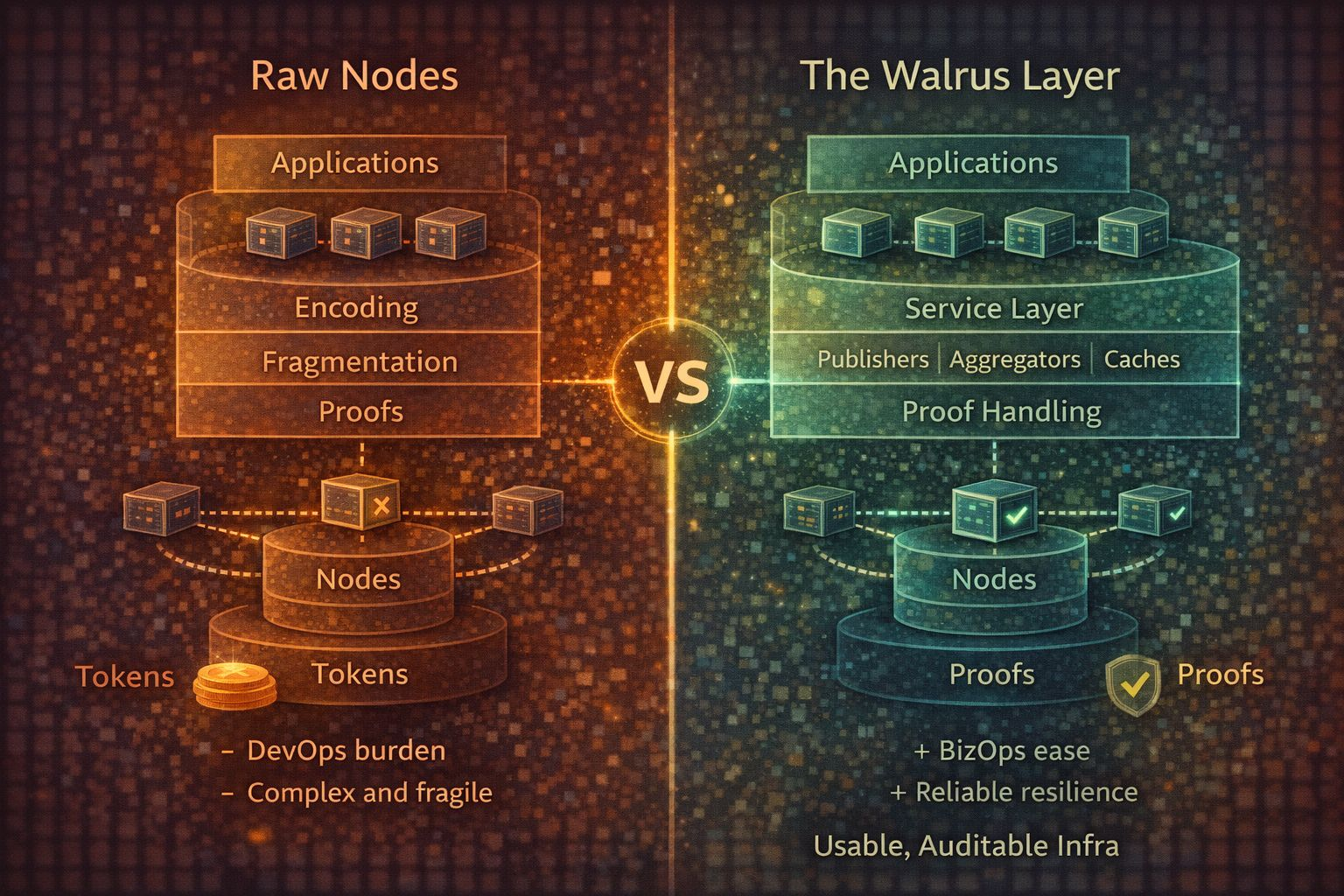 The common mental model for decentralized storage is still too primitive. People imagine a swarm of nodes and a token payment, as if storage is a direct user-to-node interaction. But the real internet has never been node-to-node. It has always been service-to-user. Your phone does not talk to raw storage servers in some ideal peer-to-peer architecture. It talks to upload endpoints, caching systems, content delivery layers, retry logic, monitoring pipelines, and operational middlemen who smooth out chaos into reliability. The reason Web2 feels “instant” is not because it is simple it is because it is layered.
Walrus quietly accepts this reality instead of pretending it does not exist.
Instead of designing a protocol that only works if every user becomes a storage engineer, Walrus creates space for a permissionless operator economy: publishers, aggregators, and caches. These are not marketing concepts. They are structural roles. And by making them explicit, Walrus is building something rare in crypto infrastructure: a system that can scale not just technically, but operationally.
The most important shift: decentralized storage as a service contract
Walrus is not trying to convince the world that decentralized storage is a magic permanent hard drive. It treats storage as a contract-based service: something that can be delivered, verified, and audited. This matters because businesses don’t need ideology they need guarantees. They need to know that when a file is uploaded, it is available later, retrievable under defined conditions, and provably correct. Walrus pushes the network toward that maturity by treating storage not as a one-time write, but as a lifecycle of responsibility with observable checkpoints.
That lifecycle is where the service layer becomes crucial. A protocol can be decentralized and still be unusable. Walrus is engineering the missing middle: the layer where professionals can provide reliability without introducing blind trust.
Publishers: Web2 convenience without Web2 trust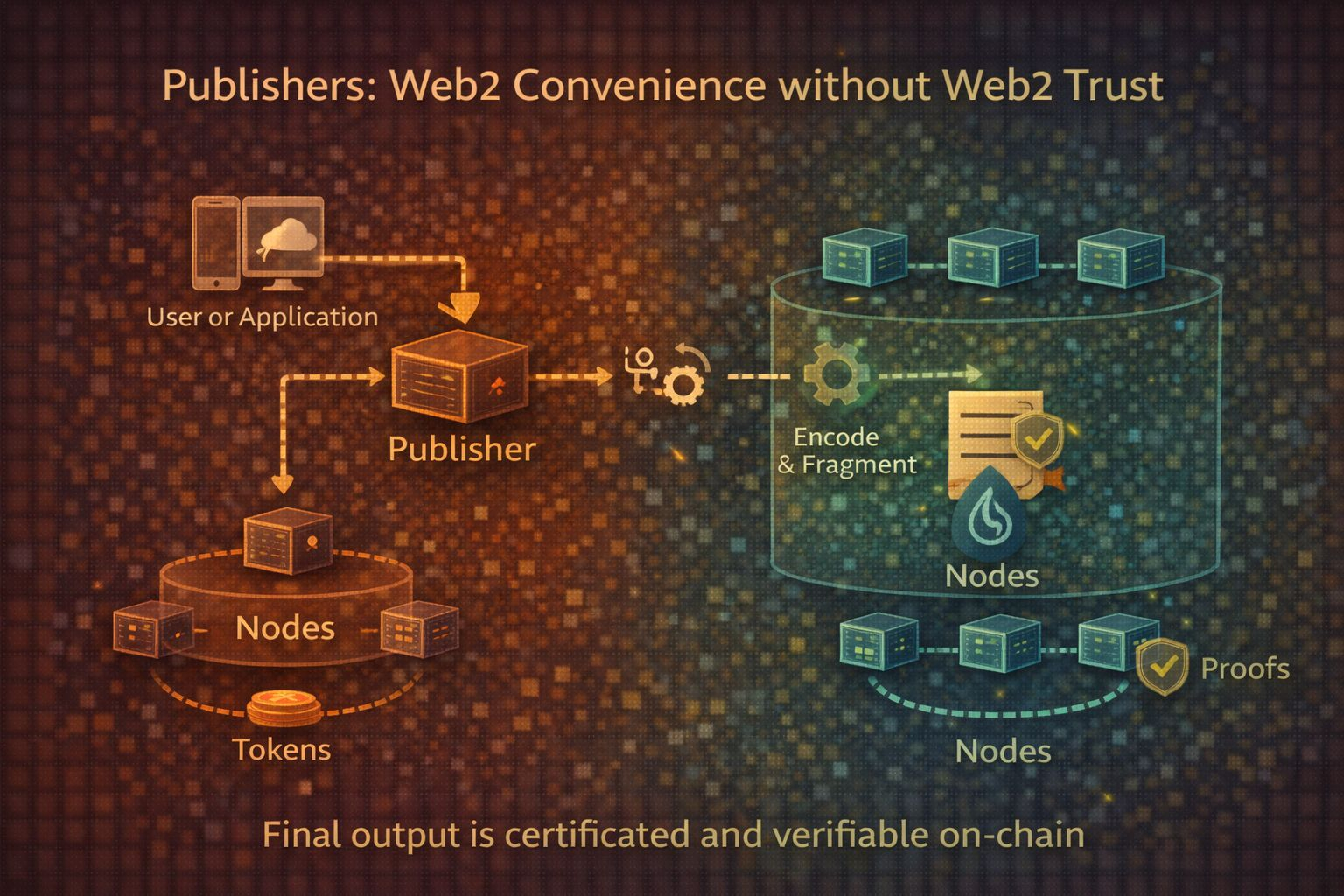 The publisher role is deceptively simple but extremely important. A publisher in Walrus is essentially a professional uploader: an operator that takes in raw data from users or applications, performs the encoding and fragmentation process, distributes the fragments across storage nodes, and collects the necessary signatures or commitments needed to generate a certificate.
In a traditional decentralized model, the user is forced to do all of this. That is not how products scale. Most teams want “upload → done,” not “upload → encode → coordinate nodes → handle failure states → retry → verify certificate.” Walrus recognizes that if decentralized storage is going to be used by normal applications, someone has to absorb this complexity.
The key point is that Walrus does not require you to trust the publisher. The publisher can provide convenience, but the output is still verifiable. The on-chain evidence remains the source of truth. If the publisher fails, the user can detect it. If the publisher behaves maliciously, it cannot forge availability. The publisher becomes a service provider, not a trusted gatekeeper.
That is the difference between decentralization that survives real-world usage and decentralization that collapses under its own complexity.
Aggregators and caches: a CDN layer that can be audited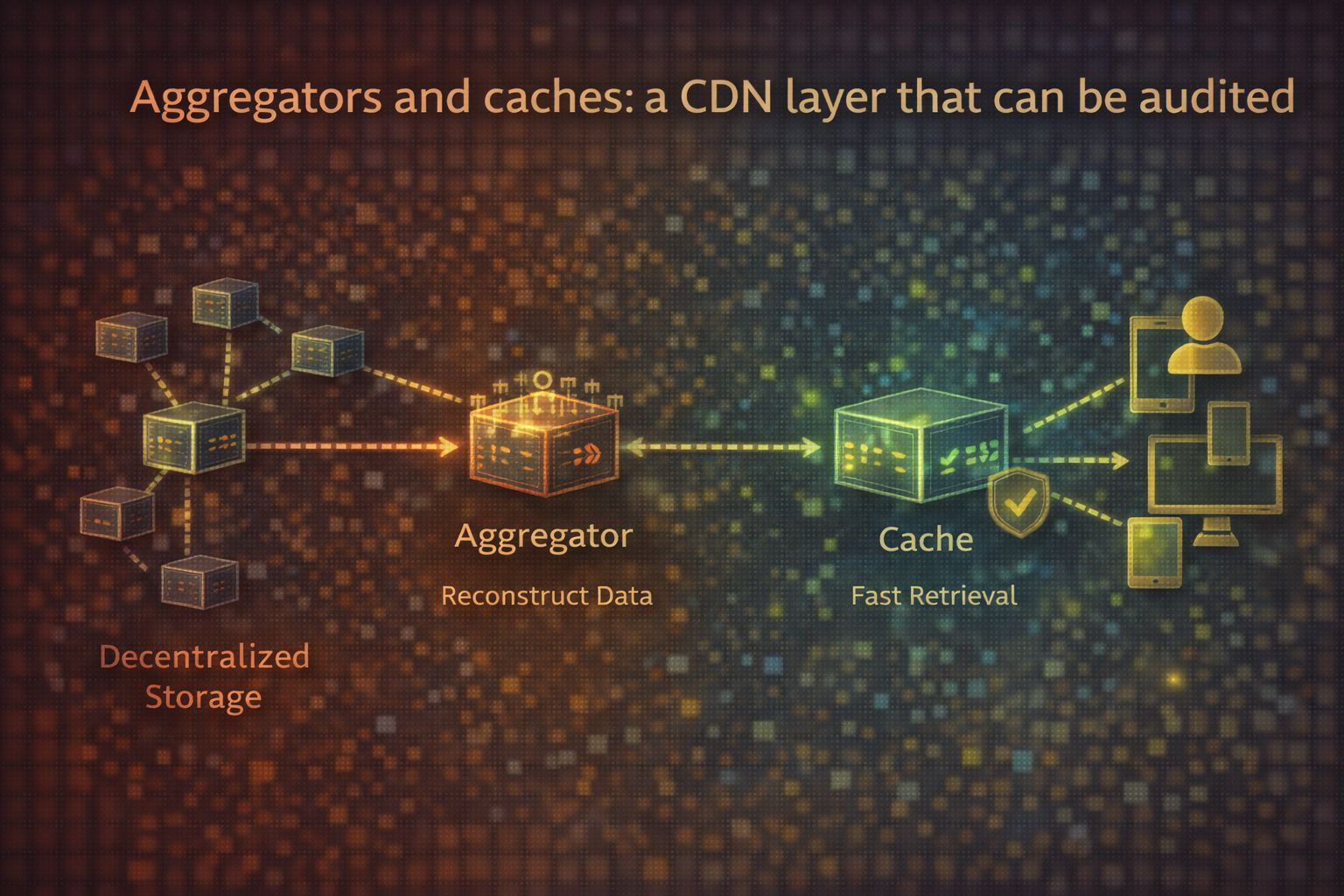 Reading data in decentralized storage is often the hidden weakness. Uploading is manageable. Retrieval is where latency, bandwidth overhead, and reconstruction costs appear. Someone has to collect enough fragments, reconstruct the blob, and deliver it in a form applications can use. Without a service layer, every app becomes responsible for building its own mini-CDN. That is an adoption killer.
Walrus addresses this through aggregators and caches.
An aggregator acts like a reconstruction service. It retrieves fragments from the storage network, rebuilds the blob, and exposes it through standard interfaces such as HTTP. This is the missing “delivery” layer that makes decentralized storage behave like real infrastructure rather than an experimental backend.
Caches extend this model by acting like a CDN. They store reconstructed outputs close to demand, reducing repeated reconstruction costs and improving latency. This is not a trivial improvement it is the difference between a protocol that works on paper and a protocol that can serve millions of users.
But what prevents this from becoming Web2 again? The answer is verification. Walrus allows clients to verify correctness even when data is served through a cache. The cache may accelerate delivery, but it cannot redefine truth. That means Walrus can offer the usability patterns of Web2 without sacrificing the auditability of Web3.
This is where the protocol becomes business-ready. A business does not want to build a decentralized system that is slow, fragile, and hard to monitor. It wants a system where performance can be bought as a service while correctness remains cryptographic.
A real operator economy, not just a protocol narrative
Most decentralized protocols talk about “nodes” as if nodes are enough. Walrus implicitly recognizes that nodes are only the base layer. Real infrastructure creates roles. Roles create specialization. Specialization creates businesses. Businesses create uptime.
In Walrus, publishers can specialize in high-throughput ingestion, regional optimization, or developer-friendly upload tooling. Aggregators can specialize in API access, bulk retrieval, and blob reconstruction efficiency. Cache operators can specialize in low-latency delivery for media-heavy applications or AI datasets.
This is a serious design move because it acknowledges something crypto often ignores: uptime is not guaranteed by ideology. It is guaranteed by incentives and professional operations. When reliability becomes someone’s business model, reliability stops being optional.
That is how infrastructure ecosystems become durable.
The most overlooked engineering insight: storage nodes aren’t the only threat
Walrus documentation implicitly points out something most storage protocols under-discuss: storage nodes are not the only failure vector. Encoding is performed by clients, and clients can be wrong. A user device can fail. A publisher can misencode. An aggregator can reconstruct incorrectly. A cache can serve corrupted data. Real systems fail at multiple layers.
By explicitly designing for publishers and aggregators, Walrus forces itself to handle this reality. It cannot pretend that all clients are perfect. That constraint is actually a strength. It pushes the protocol toward stronger correctness guarantees and more explicit verification boundaries.
This is the difference between a protocol that can be demoed and a protocol that can be operated.
Observability: the quiet sign of mature infrastructure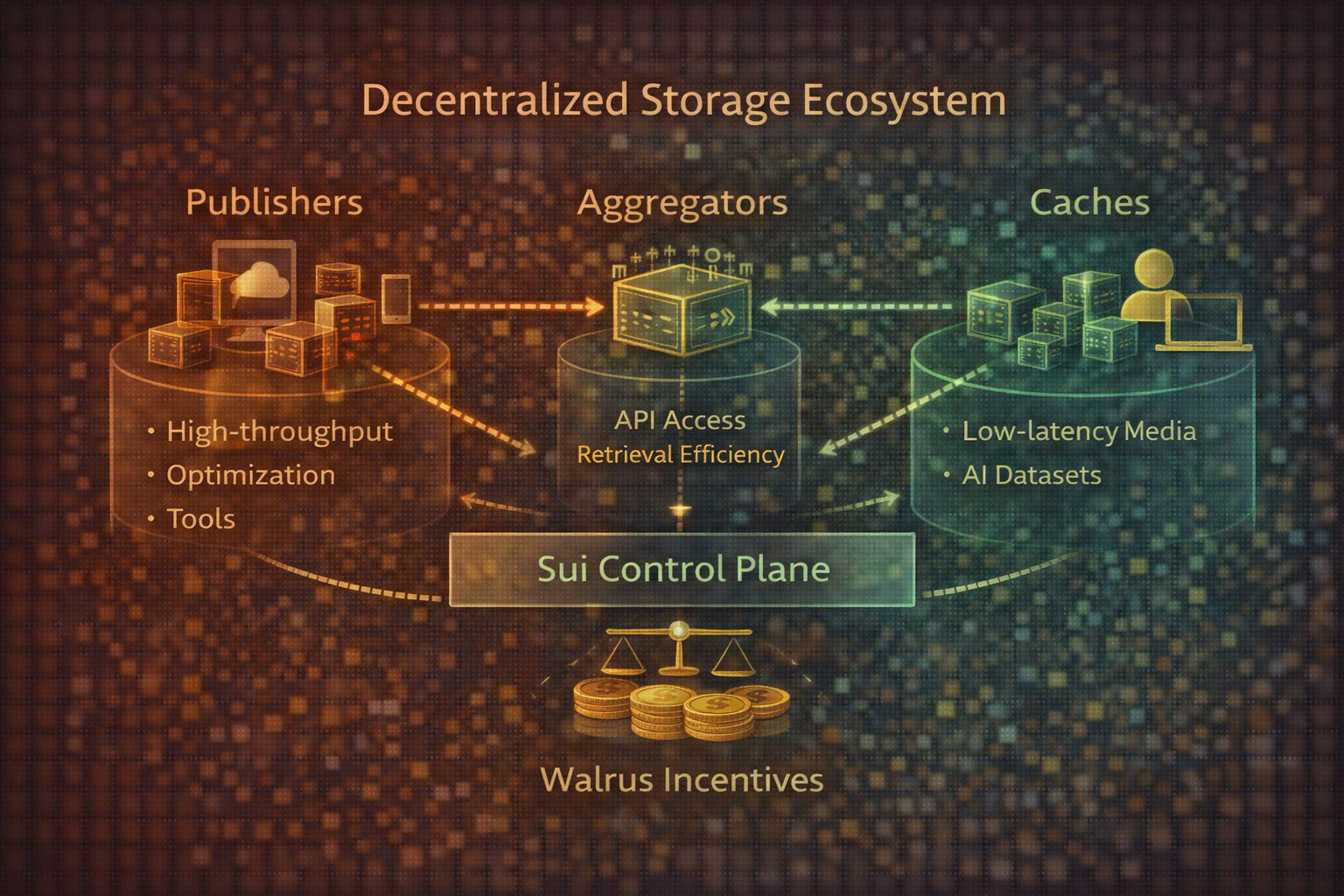 Infrastructure does not survive without monitoring. Most decentralized systems treat monitoring as an afterthought, leaving operators blind and forcing communities to guess whether the network is healthy. Walrus is moving in the opposite direction. The ecosystem’s emphasis on network visualization, node monitoring, and operator tooling signals something deeper: Walrus is cultivating an operational culture.
That matters more than most people realize. The transition from “protocol” to “infrastructure” is not defined by features. It is defined by whether humans can reliably operate it at scale.
Walrus is building for that reality.
The thesis: Walrus is decentralizing the cloud pattern itself
The most interesting thing about Walrus is not that it decentralizes disk space. Many projects already do that. The real shift is that Walrus decentralizes the entire cloud pattern around storage: uploads, delivery, caching, monitoring, retries, and service operators all without losing verifiability as the anchor.
Most protocols fail in one of two directions. They remain pure and unusable, demanding that every user interact with raw cryptographic complexity. Or they become usable by reintroducing trust through centralized gateways. Walrus is attempting a rarer third path: permissionless service providers delivering Web2-grade UX while the protocol remains cryptographically auditable.
That is why the Walrus service layer matters. It is not an accessory. It is the mechanism that turns decentralized storage into something businesses can adopt, monetize, and depend on. And if decentralized storage is ever going to become a default part of Web3 application architecture, this is the direction it must take: not just decentralizing storage, but decentralizing the operational services that make storage usable.
In the long run, the winners in infrastructure are not the loudest systems. They are the systems that become invisible because they work. Walrus is not building hype. It is building the boring, layered reality of the internet except this time, the service providers can be permissionless, and the guarantees can be verified.