

When something fails in crypto, the industry usually knows exactly what to say next. There are templates for it. Postmortems. Roadmaps. “Lessons learned.” Announcements about resilience and renewed focus. Failure, in most systems, comes with a clear recovery script. That’s why my question about Walrus felt so strange in hindsight. I didn’t ask what went wrong. I didn’t ask who was responsible. I asked something much simpler: what does success look like after a failure?
No one had a clean answer.
At first, that silence felt uncomfortable. In most projects, success after failure is easy to describe. Throughput returns to normal. Uptime stabilizes. Metrics recover. Users come back. But Walrus doesn’t live in a world where those signals mean what they usually mean. The more I thought about it, the clearer it became that the question itself might not fit the system I was asking it of.
Walrus isn’t built around smooth operation in the traditional sense. It’s built around guarantees. Data availability, retrievability, verifiability these are the pillars. But none of them map neatly to a success narrative after a failure, because Walrus doesn’t promise that things won’t break. It promises that when they do, certain properties won’t be violated. That’s a very different contract.
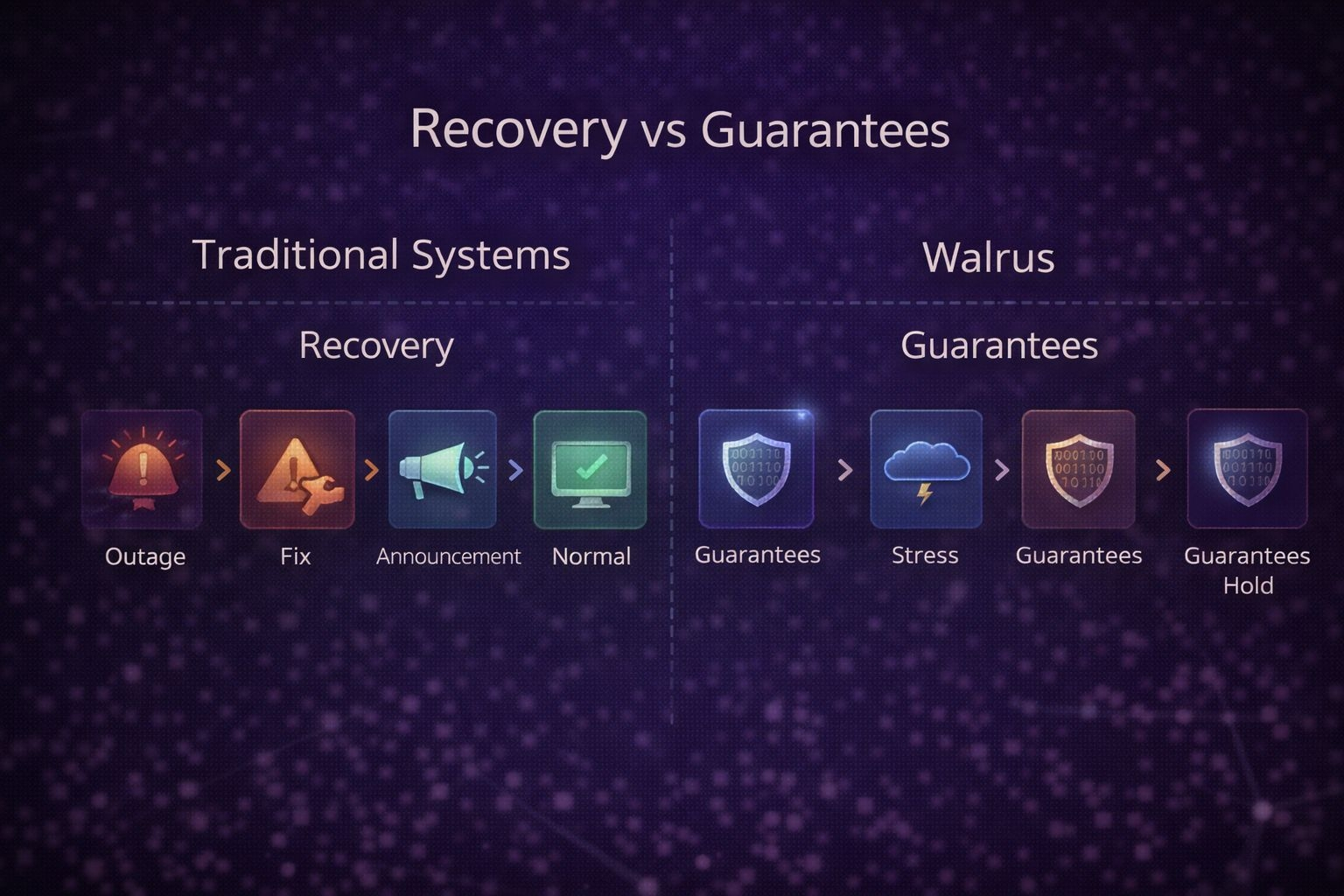
In most platforms, failure is defined by visible disruption. Something goes down. Access is lost. Performance degrades. Recovery means restoring what users expect to see. Walrus treats failure differently. A node going offline doesn’t necessarily mean failure. A sudden spike in access doesn’t mean stress. Even partial unavailability doesn’t automatically signal that the system has broken its promise. Failure, in Walrus’s world, is much narrower and much harder to observe: data becomes irretrievable, proofs become invalid, or guarantees collapse. Anything short of that lives in a gray zone.
That gray zone is where my question fell apart.
When I asked what success looks like after failure, people hesitated because they weren’t sure what kind of failure I meant. Operational hiccups? Network churn? Unexpected load? These things happen constantly and often don’t matter. They don’t trigger a recovery phase because nothing essential was lost. The system doesn’t celebrate a return to normal because “normal” was never a stable state to begin with.
Walrus assumes that the shape of demand is unknowable. Data may sit untouched for months and then suddenly be requested by hundreds of agents at once. Entire datasets may be replicated, queried, or referenced by systems that didn’t exist when the data was first stored. From that perspective, volatility isn’t a crisis it’s expected behavior. So if something looks like failure from the outside but the data remains accessible and verifiable, the system considers itself intact.
That reframes success in an uncomfortable way. Success isn’t the absence of incidents. It’s the absence of irreversible loss.
This becomes even more unsettling when you think about how Walrus is likely to be used. It’s not just a storage layer for humans uploading files. It’s a substrate for autonomous systems, indexing engines, AI workflows, and cross-chain coordination. These systems don’t behave politely. They don’t follow predictable access patterns. They don’t generate traffic that looks “healthy” by traditional standards. Walrus doesn’t try to correct that behavior. It absorbs it.
So when something goes wrong, the instinct to ask “did we recover?” doesn’t quite apply. Recover to what? A previous traffic pattern? A previous access distribution? None of those were guaranteed in the first place. The only meaningful recovery is one where the guarantees remain intact throughout the disturbance. And if they do, the system doesn’t need to announce success it never stopped succeeding.
That’s why my question landed awkwardly. It assumed a narrative arc Walrus doesn’t follow.
In most ecosystems, success after failure is a moment. A milestone. A return. In Walrus, success is continuous. Either the guarantees hold, or they don’t. If they don’t, that’s catastrophic. If they do, everything else is noise. There’s no emotional release, no “we’re back” moment, because nothing essential ever left.
This also explains why Walrus can feel unsatisfying to observe. There’s no clear dashboard that tells you everything is fine. No green lights signaling normal operation. Health isn’t a vibe; it’s a set of invariants. That’s hard to communicate, especially in an industry that thrives on visible progress and dramatic turnarounds.
But it’s also honest.
As systems become more machine-driven, the idea of recovery as a human-facing event starts to break down. Autonomous agents don’t care about apologies or updates. They care about whether data is accessible and proofs are valid. If a system degrades and then improves without violating its core guarantees, agents experience no meaningful failure at all. From their perspective, nothing needs to be celebrated.
This is where Walrus quietly diverges from how most decentralized platforms think about resilience. It doesn’t aim to look stable. It aims to be invariant under stress. That’s a much higher bar, and a much less visible one.
After sitting with this for a while, I realized the silence I encountered wasn’t avoidance. It was a mismatch between my question and the system’s philosophy. I was asking for a story. Walrus is built around properties. Stories have arcs. Properties either hold or don’t.
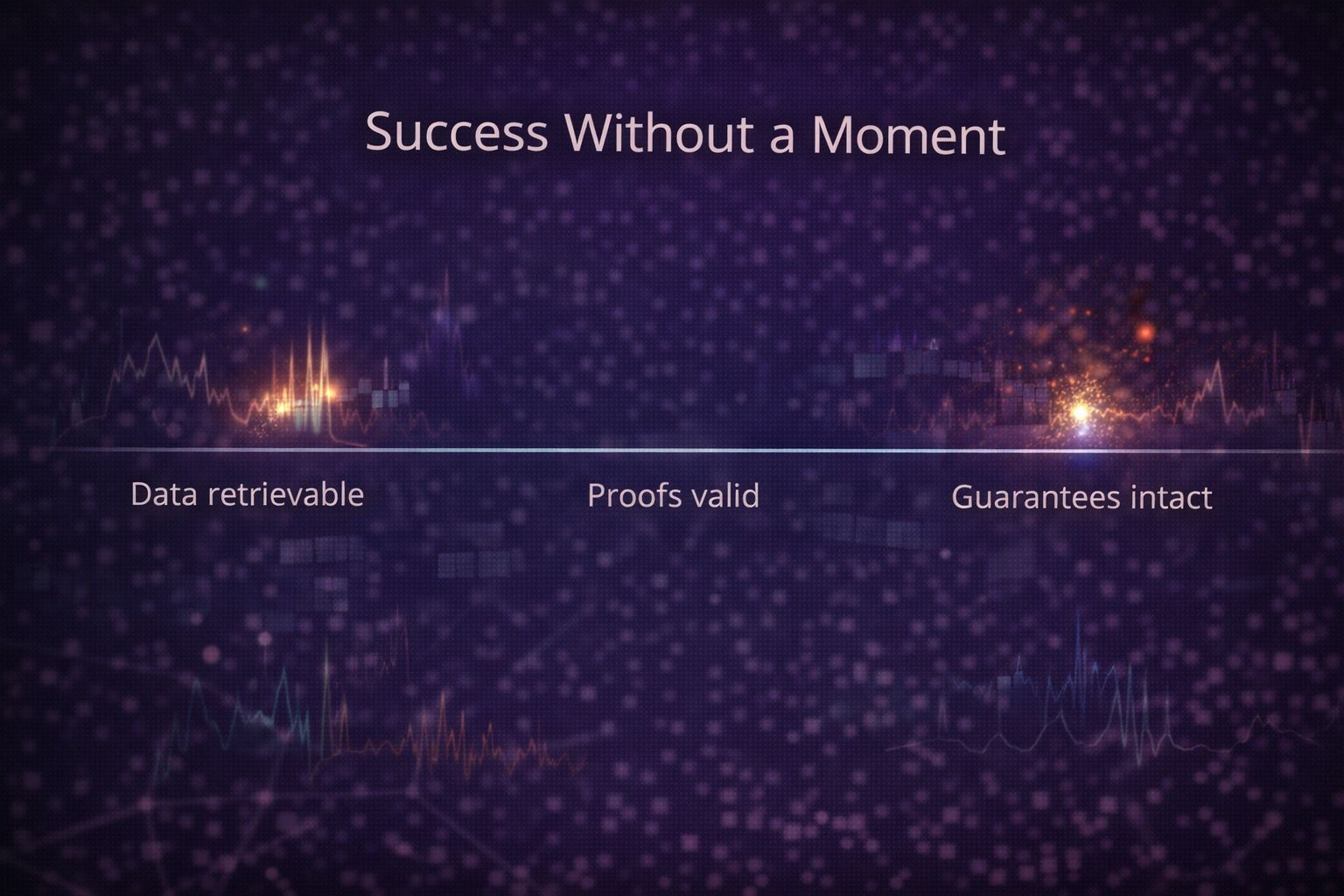
So what does success look like after a failure in Walrus?
It looks boring. It looks like nothing special happened. Data is still there. Proofs still work. Access is still possible. The system doesn’t need to declare victory because it never conceded defeat. That’s deeply unintuitive, especially for people used to equating resilience with recovery narratives.
But maybe that’s the point.
As decentralized infrastructure matures, success may stop being something we notice. It may stop being something that comes after failure. Instead, it becomes something quieter: the refusal of certain things to ever break, no matter how messy the environment becomes.
Walrus doesn’t give you a satisfying answer to the question I asked. And that initially feels like a weakness. But the more I think about it, the more it feels like a sign that the system is playing a different game entirely one where success isn’t a moment you point to, but a condition that never disappears.