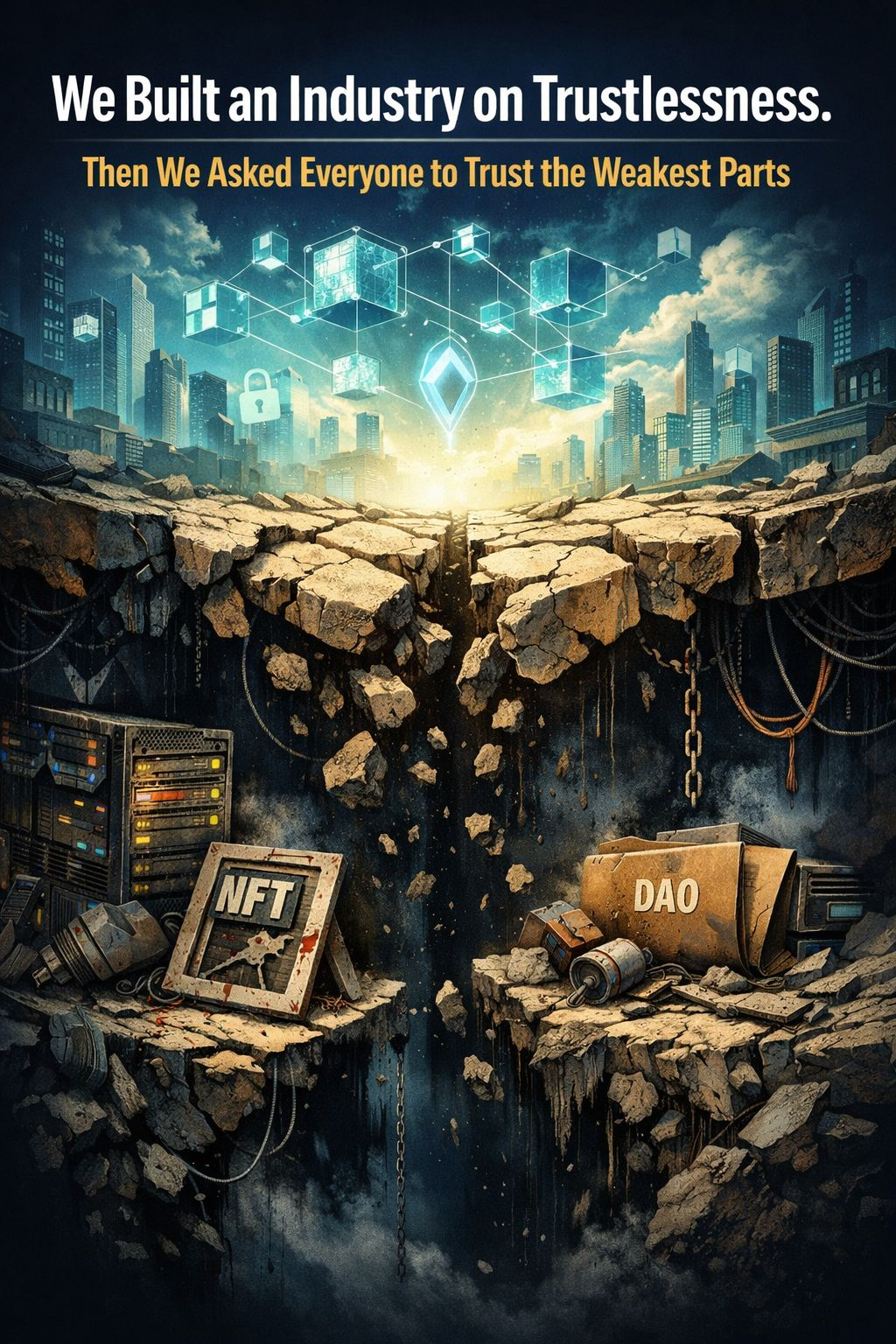
There’s a quiet contradiction sitting at the center of Web3. Most of us see it. Few of us linger on it.
We talk endlessly about decentralization, ownership, and censorship resistance. We repeat those words until they feel solid. But beneath them, the foundations are often soft. Especially when it comes to data. Storage. Reliability. The parts no one shows on a landing page.
We say blockchains are immutable. Then we store everything that actually matters somewhere else.
We say users own their assets. Then the images, files, or records quietly depend on services that can disappear.
We say trust is minimized. Then we ask people to trust that nothing will go wrong.
That gap is not theoretical. It shows up slowly, and then all at once.
NFT collections still exist on-chain, but their content is gone.
DAOs lose context for decisions that shaped them.
Games ship worlds that don’t age well because their data doesn’t last.
Interfaces break, archives vanish, links rot.
No dramatic failure. Just erosion. Quiet failure.
What’s frustrating is not that this happens. It’s that we’ve learned to accept it.
When something breaks, we blame “early tech.” When data disappears, we say users should have known better. When systems rely on centralized components, we wave it away as a temporary compromise. Temporary has lasted years.
We’ve convinced ourselves that innovation excuses fragility.
Most of the existing “solutions” don’t really solve this. They delay it.
Some are decentralized in name but centralized in practice.
Some rely on goodwill instead of enforcement.
Some assume participants will behave forever without clear incentives or consequences.
A lot of Web3 infrastructure is held together by optimism and social pressure. That works until it doesn’t.
This is where it helps to stop chasing big ideas and start looking at boring questions. Who is responsible when data goes missing? What happens when someone stops doing their job? What incentives exist after attention fades?
These questions aren’t exciting. But they’re unavoidable.
Walrus enters the picture here, not as a breakthrough narrative, but as an attempt to deal with this exact discomfort. It focuses on decentralized, privacy-preserving data storage and transactions, built with the assumption that things will fail unless the system actively resists that failure.
Walrus operates on Sui and approaches storage in a straightforward way. Data is split into pieces, distributed across many participants, and stored redundantly. No single operator holds everything. No single failure wipes data out. The goal isn’t elegance. It’s durability.
What matters more than the technical choices is the structure around them. Walrus tries to align behavior with outcomes. If participants store data reliably, they are rewarded. If they don’t, there are consequences. Not social consequences. Economic ones.
This sounds obvious. It’s surprisingly rare.
Too much of Web3 relies on informal trust. Trust that nodes stay online. Trust that operators remain motivated. Trust that costs won’t change. Trust that someone else will fix problems later.
Walrus doesn’t assume trust. It assumes incentives drift over time and designs around that reality.
The token, WAL, exists inside this system to make that accountability possible. Not as a promise of future value, but as a mechanism to enforce behavior. Participants have something to lose if they act carelessly. That alone changes how systems behave over time.
This kind of infrastructure matters more than many people realize.
NFTs are often discussed as financial instruments or cultural objects. But underneath, they are references to data. If the storage layer fails, the ownership narrative collapses.
DAOs depend on memory. Proposals, discussions, records, and context. Without reliable storage, governance becomes shallow and ahistorical.
Games depend on assets persisting. Worlds only feel real if they survive updates, downtime, and neglect. Fragile storage breaks immersion faster than bad design.
Long-term Web3 adoption won’t come from faster block times or clever abstractions alone. It will come from systems that keep working when no one is paying attention.
That’s the part we tend to ignore.
Walrus doesn’t try to fix UX, governance, and trust all at once. It focuses on one layer and treats it seriously. Data should be available. Private when needed. Resistant to censorship. And difficult to lose without consequence.
That’s not revolutionary. It’s responsible.
And responsibility is something Web3 struggles with.
We like to talk about permissionless systems, but we avoid accountability. We like autonomy, but we resist obligation. We want permanence without maintenance.
That doesn’t work. It never has.
If Web3 is going to grow up, it needs fewer slogans and more unglamorous infrastructure. Fewer assumptions that things will “just work.” More systems designed for boredom, not hype.
Projects like Walrus feel important not because they promise transformation, but because they acknowledge reality. They accept that trust has to be engineered. That storage is not a side problem. That reliability is earned, not declared.
Maybe that’s what maturity looks like in this space.
Not louder claims about decentralization.
Not endless reinvention.
Just fewer things breaking quietly in the backgro
und.
And a willingness to build for the long haul, even when no one is watching.