
Most decentralized applications don’t fail where people expect them to.
They don’t collapse at consensus. Tokens move. Contracts execute. The chain does what it promises. The weakness usually sits somewhere quieter, in the layer everyone assumes will “just work.”
Data.
For developers, storage often enters the conversation late. Logic comes first. Execution gets refined. Incentives are tuned. And only then does the question surface: where does all of this actually live once the transaction is finished?
Walrus doesn’t wait for that question.
The first signal isn’t technical. It’s behavioral. Data placed into Walrus stops feeling like an extension of your application and starts behaving like something the system has already claimed responsibility for. That shift is subtle, but once you notice it, it’s hard to ignore.
In many stacks, data still feels conditional. It exists because someone is paying attention. Because a provider is reputable. Because a backup exists somewhere else “just in case.” Persistence is emotional, rooted in trust and habit more than structure.
Walrus strips that comfort away.
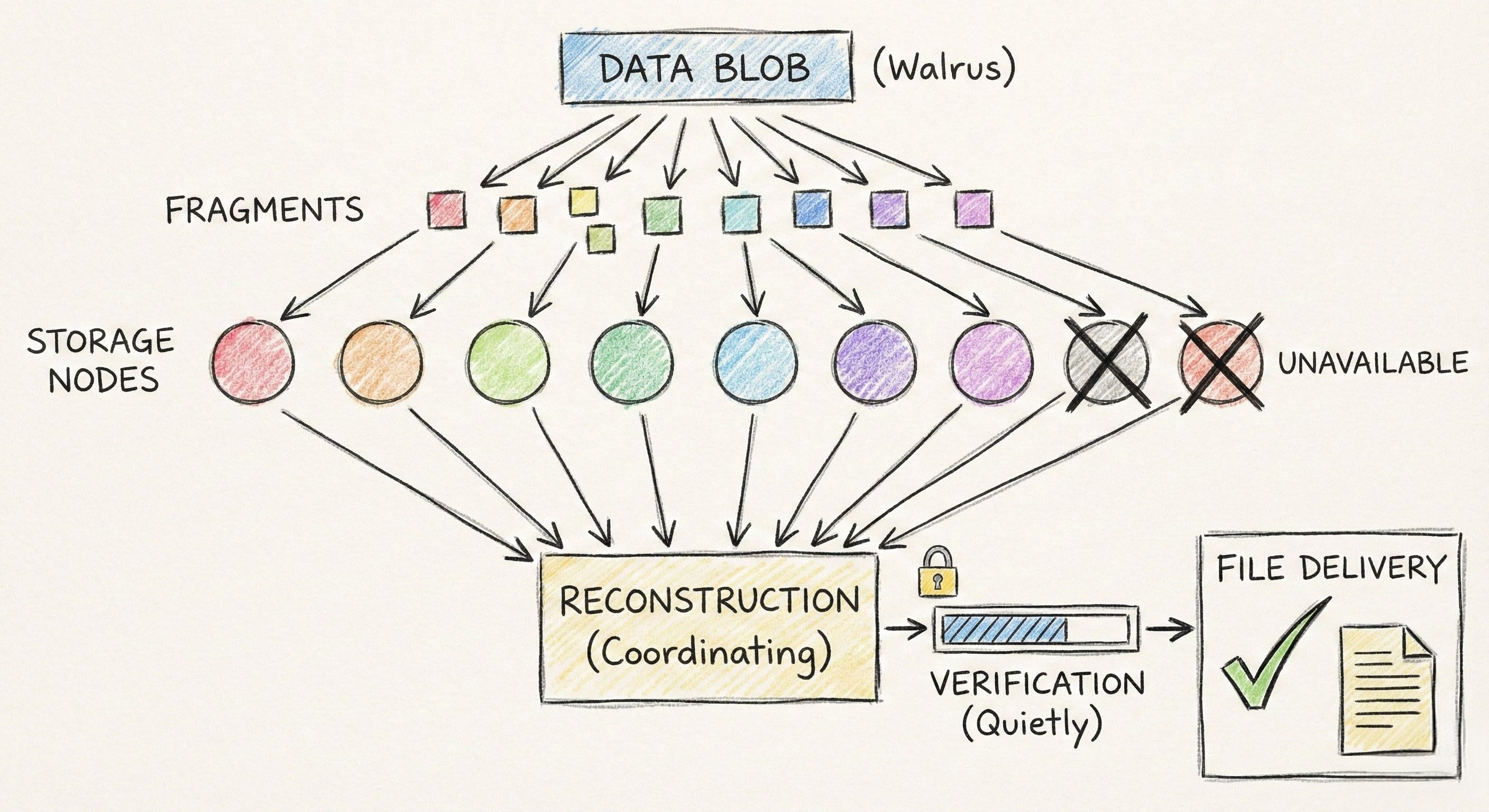
Data enters as blob storage, without context, priority, or narrative. The network doesn’t care whether the file supports a flagship feature or an abandoned experiment. It treats everything as large unstructured data that must survive indifference. Meaning is supplied by applications. Survival is handled elsewhere.
That separation is intentional.
Behind the surface, fragmented data storage takes over. The data no longer exists as a single object you could point to or rescue manually. Distributed fragments carry responsibility collectively. No node knows the whole. No actor can quietly become the fallback.
Nothing announces this transition. Nothing asks for approval.
And that’s where pressure begins to form.
Developers usually feel it later, when an application reaches back for data it assumed was “obviously there.” The request doesn’t fail. Reconstruction is still possible. But readiness no longer feels guaranteed in the way centralized storage trains you to expect.
This is where availability without reassurance shows itself.
The system keeps checking. Not loudly. Not with dashboards or alerts. Continuous availability verification runs whether or not the application is still active, whether or not the team remembers the original intent. Data is either reconstructible within threshold, or it isn’t and the distinction emerges through timing, not error codes.
That behavior forces a different kind of discipline.
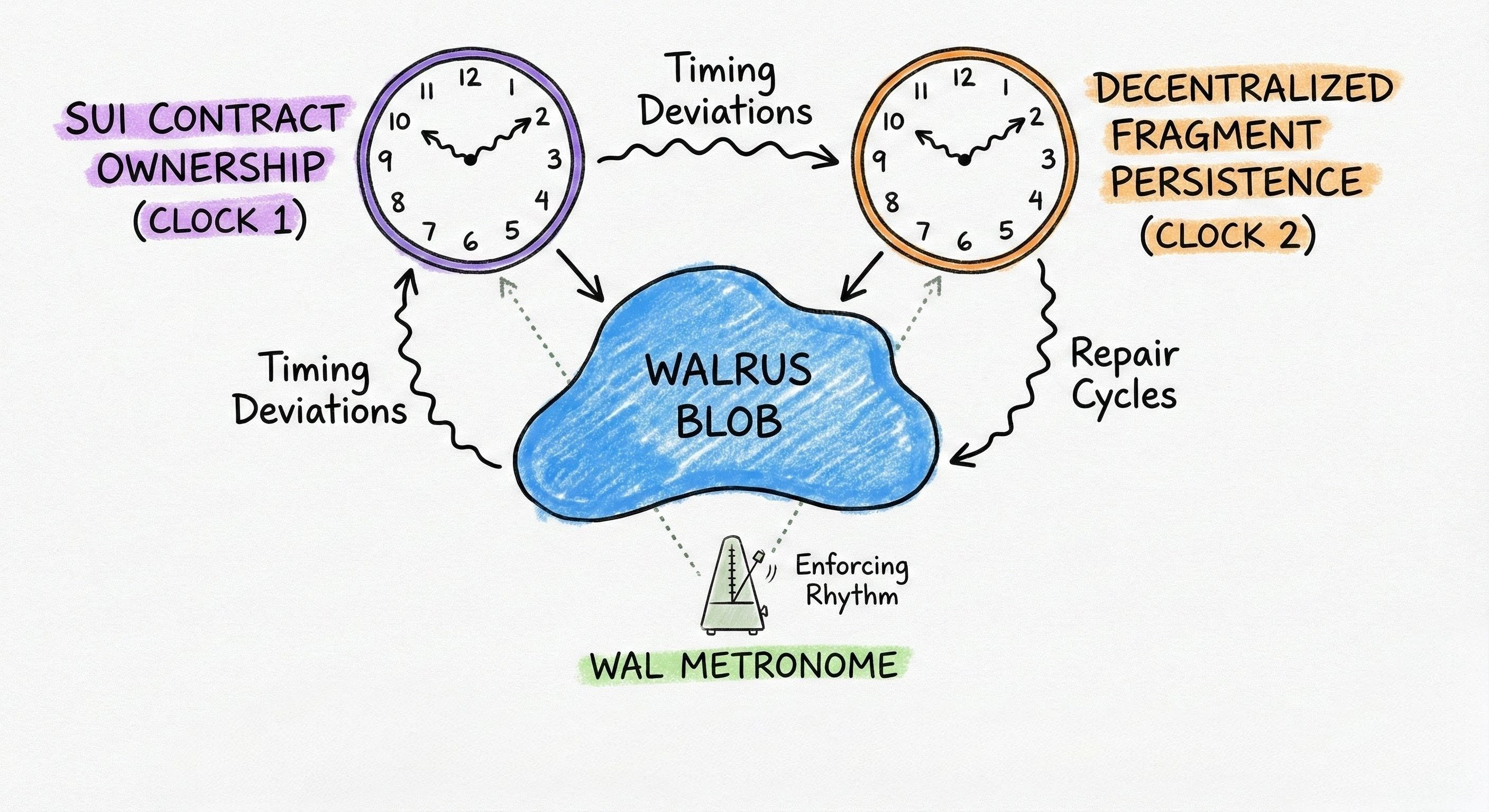
Applications built on Walrus stop treating storage as passive infrastructure. They start designing around the reality that availability is a condition maintained over time, not a state achieved once. Workflows grow more honest. Assumptions get challenged earlier. The phrase “we’ll deal with that later” loses its usefulness.
Under load, this becomes impossible to ignore.
Multiple systems reach for the same data. Reads overlap. Repairs continue without ceremony. The network doesn’t pause to accommodate convenience. Availability under load isn’t negotiated, it’s enforced through structure and coordination that never asks to be noticed.
This is also where WAL becomes perceptible in practice. Not as a headline feature, but as a quiet constraint. Time stops being abstract. Keeping data alive without intention starts to carry weight. The system doesn’t threaten. It simply remains consistent.
Some teams adapt quickly. Others resist.
They try to recreate old guarantees through extra layers, manual checks, human oversight. But Walrus doesn’t collapse into those expectations. It keeps behaving the same way: verifying, reconstructing, coordinating, even when no one is watching.
That consistency changes how developers think.
Not about decentralization as ideology. But about responsibility as architecture.
Walrus doesn’t promise that data will always feel comfortable to depend on. It promises that data will not disappear just because attention does. Decentralized data distribution becomes less about resilience marketing and more about operational honesty.
At some point, the realization lands quietly:
The data no longer belongs to your application. Your application borrows reliability from the system.
That’s the real shift Walrus introduces.
Not new primitives. Not new abstractions.
But a storage layer that refuses to pretend that trust, intent, or memory are stable foundations. The system keeps checking. The network keeps coordinating. And whether your app is ready or not, the data continues to exist on its own terms.
That’s when decentralization stops being theoretical and starts shaping how things are actually built.