@Walrus 🦭/acc is not another decentralized storage play promising to "decentralize everything"; it's a meticulously engineered data settlement layer designed to solve the specific, high-cost problems that will bottleneck the on-chain AI and media economies, and its technical choices create a distinct, high-stakes financial environment for its native token, WAL.
The market chronically misprices infrastructure by evaluating it on yesterday's use cases. Everyone understands decentralized storage as a cheaper, more resilient alternative to Amazon S3 for storing NFTs or front-end files. This view is obsolete and misses the capital shift. The real demand driver is the multi-trillion-dollar AI and generative media sector, which requires a way to turn massive, unstructured datasets think petabytes of video for model training or millions of 3D asset files into verifiable, tokenizable, and tradable on-chain assets. Current solutions are financially non-viable for this. Full replication (like early Filecoin or Arweave's initial model) is prohibitively expensive at scale, while traditional 1D erasure coding makes data recovery a bandwidth nightmare, creating unacceptable latency for an AI pipeline querying thousands of data shards. Walrus enters this gap not with narrative, but with a cryptographic engine, Red Stuff, designed explicitly for this new reality.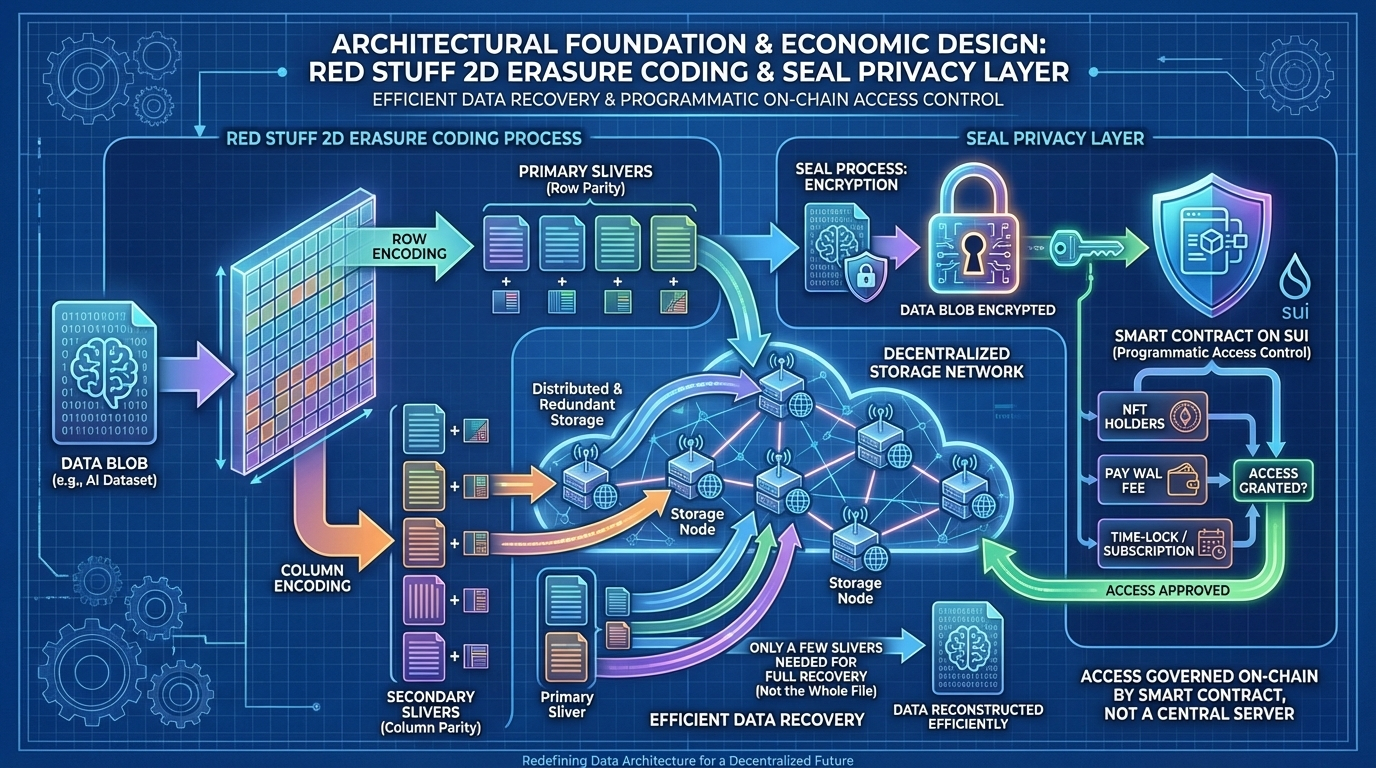
Red Stuff's two dimensional erasure coding is not just a technical improvement; it's a redesign of storage economics that directly dictates liquidity behavior for WAL. By encoding data across both rows and columns into "slivers," recovery of any lost data requires contacting only a small, predictable subset of nodes. This transforms the security model from a "trust-minimized but capital-heavy" replication game to a "cryptographically verifiable and capital-efficient" one. For a network operator, this means the capital required to participate as a storage provider is not tied to blindly replicating whole datasets but to providing robust bandwidth and compute for the encoding/decoding process. The consequence for WAL tokenomics is that staking rewards must incentivize a different kind of resource provision high-availability compute for coding not just raw hard drive space. This aligns validator economics more closely with the needs of the AI data consumer, who pays for retrieval speed and reliability, not just storage permanence.
This architecture creates a unique, and potentially volatile, feedback loop between data utility and token demand. In most storage networks, token demand is a simple function of storage space rented. In Walrus, the launch of Seal its on-chain encryption and access control service complicates this model profoundly. Seal allows data to be stored encrypted on the network with decryption keys and access logic managed by smart contracts. This means the data itself becomes a programmable financial primitive. A private AI dataset can be token-gated and licensed dynamically; a game's core asset bundle can be unlocked only upon NFT purchase. The financial implication is that the WAL token is no longer just a medium for paying for storage. It becomes the required settlement asset for a growing universe of private data access transactions, each with its own micro-fee. Demand for WAL thus becomes a derivative of the complexity and value of the data relationships being formed on-chain, not just the volume of bytes stored. This is a higher-variance, higher-potential demand curve.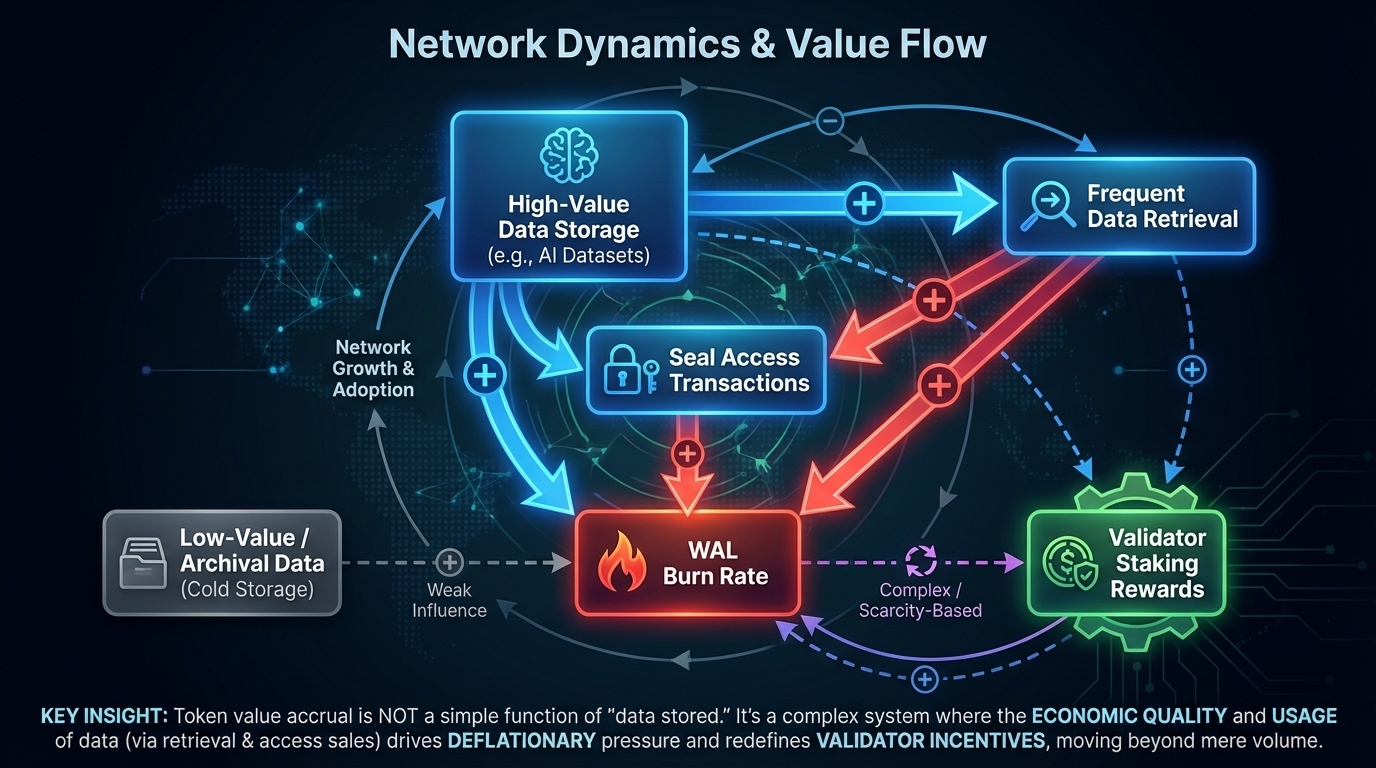
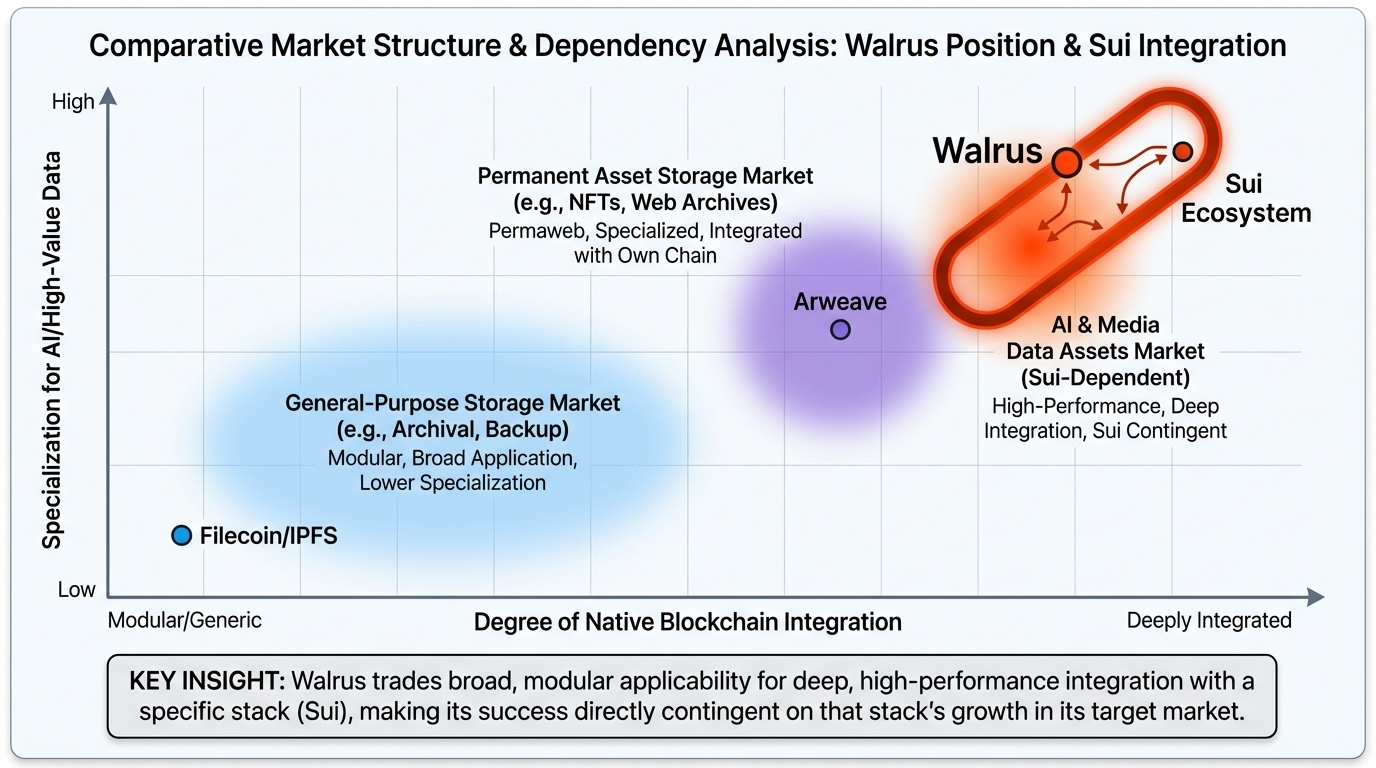
This exposes Walrus's critical dependency and its greatest strategic risk: the Sui blockchain. Walrus's design, where data availability proofs and access control contracts live natively on Sui, creates unparalleled efficiency for developers already in that ecosystem. The settlement is fast and the user experience seamless. However, this is a profound liquidity and adoption gamble. It chains Walrus's fate to Sui's success in attracting the very AI and media applications Walrus is built for. Should developer activity or value accreted on Sui plateau, Walrus becomes a world-class engine installed in a niche vehicle. The counter-argument that deep vertical integration is necessary to achieve the performance required for AI is valid. But from a trader's perspective, this makes analyzing Walrus inseparable from analyzing Sui's on-chain metrics: Total Value Locked (TVL) in DeFi is less important than the volume and value of data-rich transactions from non-speculative applications. One must watch for Sui-based AI agent platforms or media DAOs gaining traction; that is the true leading indicator for WAL utility.
The institutional $140 million raise from firms like a16z and Franklin Templeton is often cited as a bullish signal. The more insightful read is that this capital represents a specific bet on a regulatory pathway. Traditional cloud storage is a minefield of compliance (GDPR, CCPA, sector-specific rules). A fully anonymous, immutable storage network like Arweave presents an insurmountable compliance hurdle for regulated entities. Walrus, through Seal, offers a compelling alternative: data can be stored on a decentralized network, yet access can be programmatically restricted, logged, and compliant with policies encoded in smart contracts. For an institutional player, this isn't about "decentralization ideology"; it's about diversifying away from cloud vendor lock-in while maintaining a defensible audit trail. The institutional flow into WAL, therefore, will not be a speculative tide. It will be a slow, deliberate trickle tied to pilot projects that prove this compliance narrative, making token price action potentially lumpy and news-driven around enterprise partnership announcements.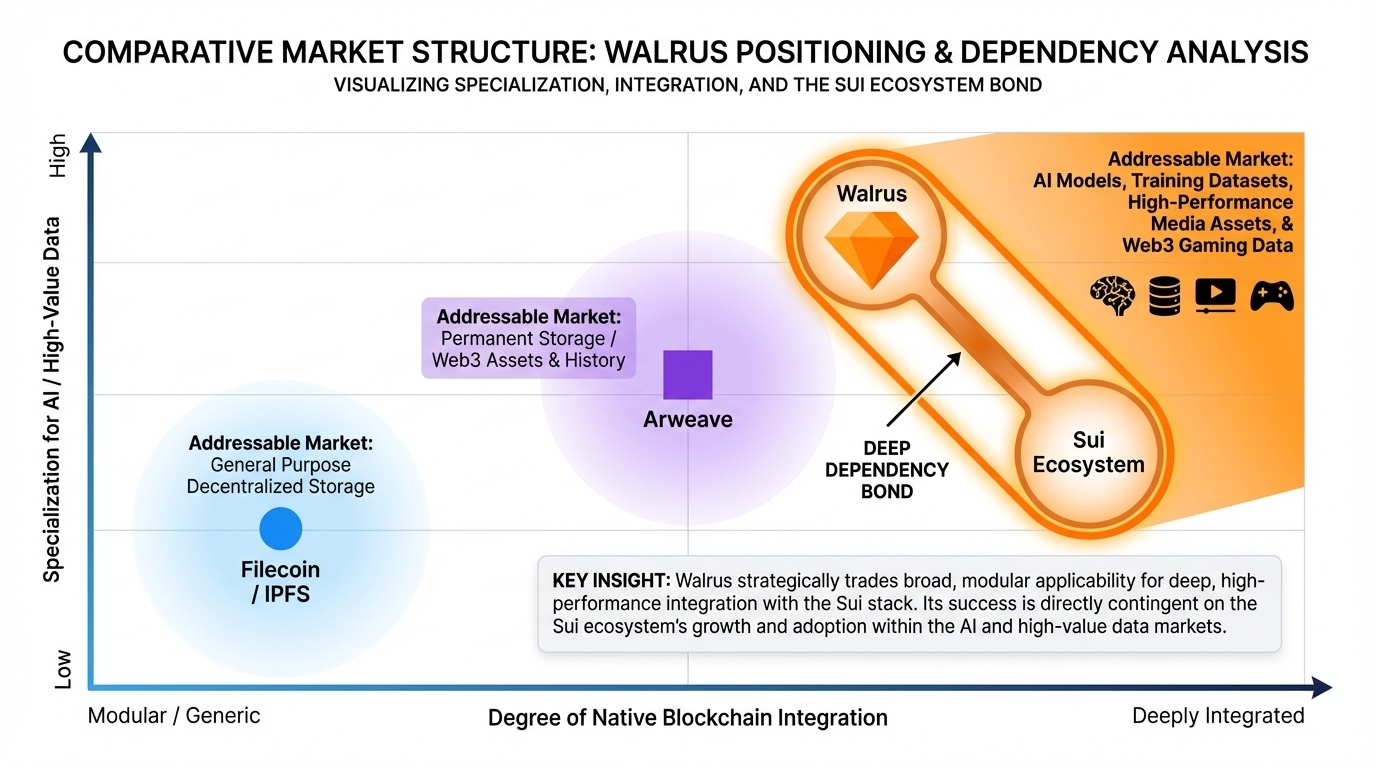
Finally, the market is completely overlooking the upcoming deflationary burn mechanism's dynamic. Unlike a simple burn tied to transaction volume, a burn tied to a storage network's core activity creates a non-linear relationship with network growth. As more high-value AI datasets are stored which are large and require frequent, paid access the burn rate accelerates. However, if the network is filled with low-value, "write-once, read-never" archival data, the burn stagnates. Thus, the token's scarcity is not a function of mere usage, but of the economic quality of the data stored. This makes analyzing on-chain metrics for Walrus uniquely nuanced. One must look beyond total petabytes stored and instead track metrics like "retrieval transaction volume" or "Seal contract interactions" to gauge the velocity of high-value data. A network at 50% capacity with high retrieval traffic is vastly more bullish for WAL scarcity than a network at 100% capacity that is dormant.
Walrus represents a fundamental bet that the next wave of crypto value will be built on data-as-asset, not data-as-record. Its entire architecture, from Red Stuff's efficient recovery to Seal's programmable privacy, is engineered for that specific future. Trading or investing in WAL, therefore, is not a bet on decentralized storage adoption broadly. It is a concentrated bet that the Sui ecosystem will become the primary settlement layer for the AI economy's data, and that Walrus's specific technical compromises deep Sui integration, complex validator economics, and compliance-focused privacy are the correct ones to capture that value. The risks are high and tightly coupled, but the reward, if the AI data thesis plays out, is a position in the fundamental plumbing of a new asset class.