
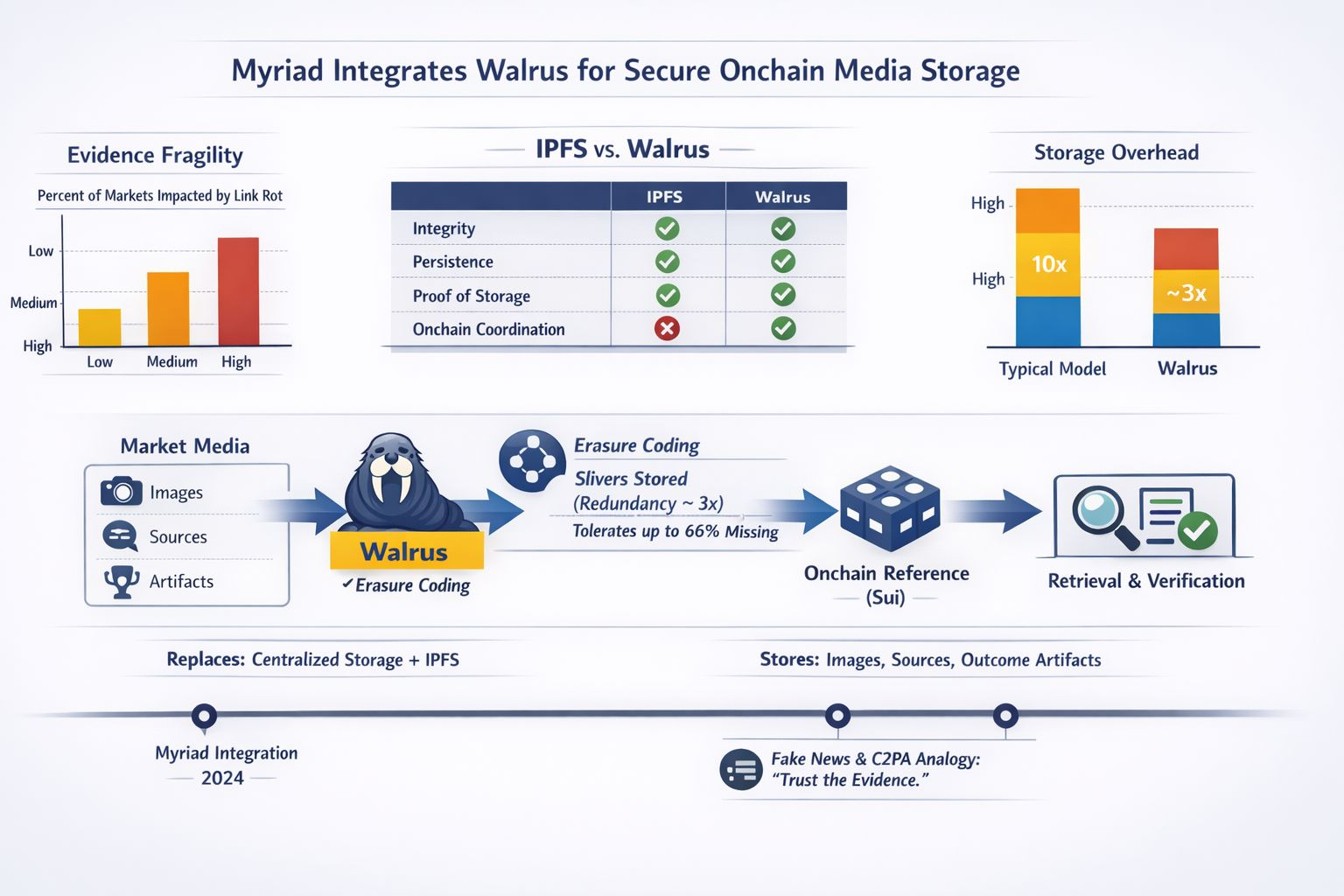
@Walrus 🦭/acc You can usually tell when a market is alive because prices move fast and people argue about what they mean. Prediction markets add a twist: the debate isn’t only about odds, it’s about evidence. A contract might settle based on a government statement, a league score page, or a single report. If that source link changes, disappears, or gets edited later, the market’s “truth” can feel fragile. That fragility sits behind Myriad’s decision to integrate Walrus and move the media attached to each market—images, supporting sources, and the final outcome artifacts—into a storage layer meant to be publicly checkable over time. Myriad’s own framing is pretty direct: Walrus replaces its prior mix of centralized storage and IPFS, so a market’s context is harder to quietly rewrite after people have traded on it.
Myriad’s premise is that markets shouldn’t float in a vacuum. It grew out of the Decrypt and Rug Radio ecosystem, and it tries to keep your attention on one page: read the coverage, see the market, make your call. When that works, it feels less like gambling and more like thinking out loud, with a price attached. But it also exposes a weakness people rarely name. Even if trades are onchain, the supporting media often isn’t. Links rot. Screenshots get replaced. The “proof” everyone argued about turns into a dead tab, and suddenly the market’s settlement looks like it’s based on something you can’t even verify anymore.
Walrus is relevant because it’s built for the exact kind of data markets keep tripping over: large, unstructured files. Mysten Labs describes Walrus as a decentralized storage network that takes a big blob of data, splits it into smaller pieces (“slivers”) using erasure coding, and distributes those slivers across many storage nodes. The system is designed so the original blob can be reconstructed even if up to two-thirds of those slivers are missing, while keeping storage overhead far closer to a few multiples than the “every validator stores everything” approach typical blockchains rely on.
That design choice matters because it’s not enough for market media to be tamper-evident; it has to be there when someone comes back later to check it. IPFS is excellent at integrity—if you retrieve content by its identifier, you can verify it hasn’t been altered—but persistence often depends on pinning and retention. IPFS’s own docs are blunt about it: to ensure data persists and isn’t deleted during garbage collection, you pin it on one or more nodes. Walrus tries to make availability something you can reason about more directly. Its docs describe support for proving that a blob has been stored and is available for retrieval later, and it leans on Sui for coordination and payments, with stored blobs represented on-chain in a way that smart contracts can check and manage over time. For a prediction market, that’s the difference between “the link used to work” and “the exact artifact the market referenced is still retrievable, and you can verify it.”
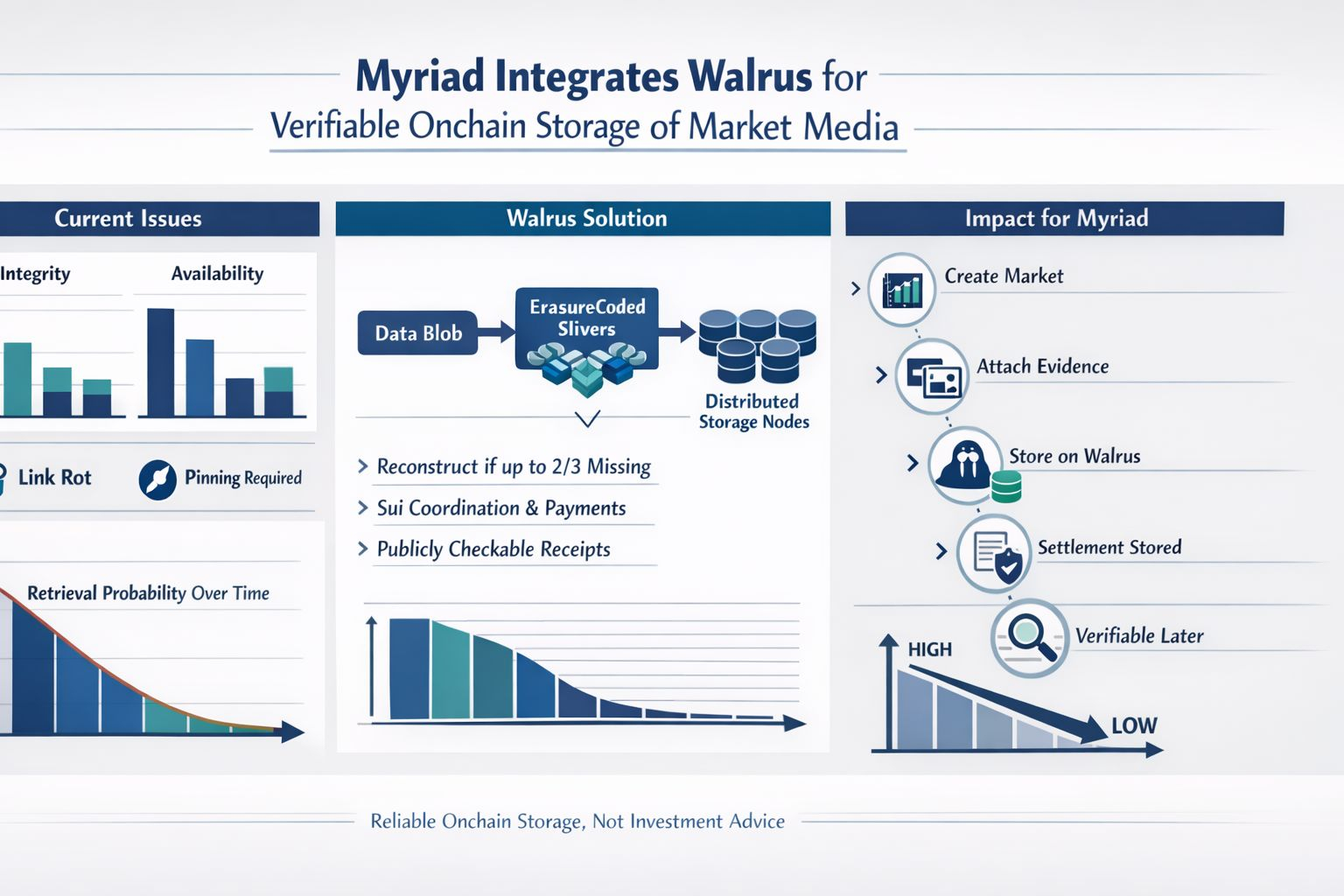
This is also why Walrus isn’t just a footnote in the Myriad story; it’s the connective tissue. If Myriad wants its markets to feel grounded, then the media isn’t decoration—it’s the substrate. A market that resolves on “what happened” needs receipts that don’t evaporate when a website redesigns its URLs or an account deletes a post. And it’s not hard to see why Myriad is leaning into this now: prediction markets are increasingly treated as real-time signals for politics, war, sports, and entertainment. That loudness comes with risk. Axios recently argued that major prediction platforms have a fake news problem, because speed and engagement can outrun careful sourcing and context. If markets are going to function like a kind of headline machine, the evidence layer has to be sturdier than whatever happens to be trending on a given afternoon.
There’s a broader cultural parallel here, too. Deepfakes and cheap AI media have turned “show me where that came from” into a normal request. The C2PA standard and Content Credentials effort is one attempt to attach cryptographically bound provenance records to digital content so people can judge what they’re seeing. Onchain storage isn’t the same solution, but it rhymes with the same instinct: keep the receipts, and make it difficult to quietly rewrite the past once attention has moved on.
And Walrus is starting to show up in use cases that don’t feel like small experiments. In January 2026, Team Liquid said it migrated roughly 250TB of match footage and brand content to Walrus, framing it as an infrastructure upgrade with practical benefits. Big archives don’t care about buzzwords; they care about access, durability, and not losing history because one vendor changes direction. That kind of real-world load doesn’t prove perfection, but it does make the “store market media reliably” pitch feel less theoretical.
None of this guarantees markets will be wise or fair. People can still coordinate, misunderstand evidence, or trade on rumors. But raising the baseline matters. If trades are transparent while the supporting material is ephemeral, trust just gets pushed to the edges. Myriad integrating Walrus is a bet that those edges can be tightened, so prediction markets don’t just price the world in real time—they also keep a clearer, checkable record of how they did it.