
Bitcoin and altcoins are all undergoing strong adjustments.
The cryptocurrency market continues to face selling pressure in the Wednesday morning trading session (US time), as investors react to the prospect of a tighter monetary policy from the US Federal Reserve (Fed). Bitcoin has lost the $67,000 mark, down 3.1% in the past 24 hours, trading around $66,804 at 1:13 AM ET.
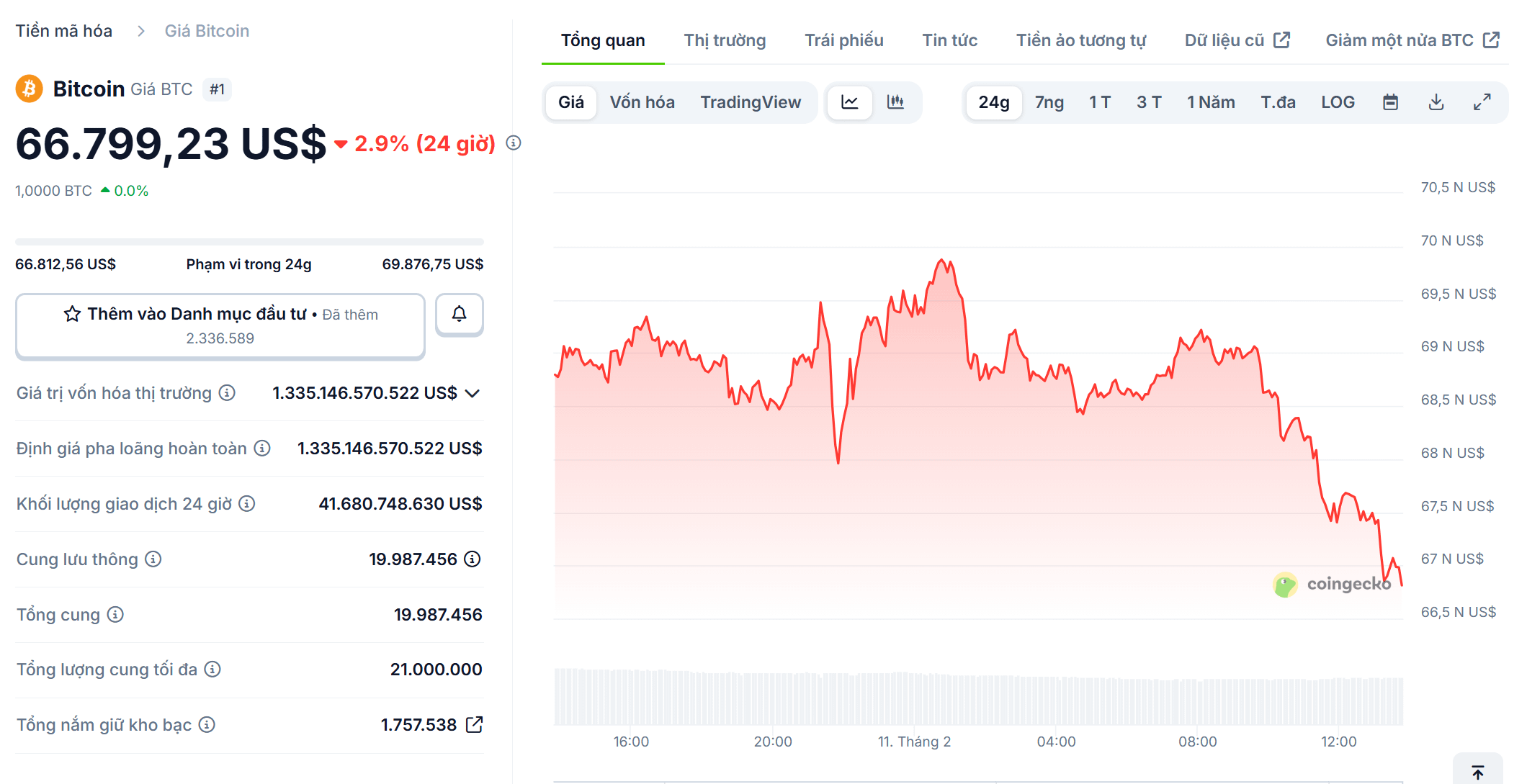
Bitcoin has lost the $67,000 mark, down 3.1% in the past 24 hours.
Not only Bitcoin $BTC , but other large-cap cryptocurrencies have also recorded significant declines. Ethereum $ETH fell 4.1% to $1,965. XRP $XRP lost 4.3% of its value, while BNB dropped 4.5%. The adjustment occurs against the backdrop of the global financial market reassessing expectations for US interest rate policy in 2026.
This development indicates that cautious sentiment is returning, especially after the previous recovery phase thanks to ETF capital and expectations of monetary easing.
Hawkish Fed expectations put pressure on liquidity.
According to many analysts, the main reason for this decline is the change in expectations related to the US macro policy. The nomination of Kevin Warsh as Fed Chair has raised concerns about a tighter policy cycle, with fewer interest rate cuts than previously forecasted.
Analysts believe that the outlook for tightening liquidity often puts pressure on risky assets, including technology stocks and cryptocurrencies. With higher capital costs and the ability to pump money into the financial system being restricted, speculative cash flows tend to weaken.
Some experts suggest that Bitcoin's important support range currently lies between $60,000 - $65,000. If this area holds, the market could form an accumulation base. Conversely, if macro pressures continue to increase, the possibility of a deeper adjustment cannot be ruled out.
Derivatives data show that the 'de-leveraging' process has taken place.
Signals from the derivatives market indicate that a large portion of high-leverage positions has been liquidated in recent sessions. Funding rates on many exchanges have returned to neutral levels, reflecting a significant 'cleaning out' of short-term speculative cash flows.
This can be seen as a necessary rebalancing step after a hot phase. As leverage levels decrease, the risk of a chain liquidation also cools, paving the way for stability if new supportive factors emerge.
However, institutional capital seems to still be on the sidelines. Large funds are reportedly waiting for clearer signals from the macro environment or the sustainability of ETF cash flows before increasing their positions.
ETF cash flows remain, but are not sufficient to create a breakthrough.
In the latest trading session, US spot Bitcoin ETFs recorded a net cash inflow of $166.56 million, higher than the $145 million from the previous day. Meanwhile, spot Ethereum ETFs attracted $13.82 million, significantly lower than the $57 million from the start of the week.
Although capital flows remain positive, the current scale is not large enough to create strong upward momentum in the context of overwhelming macro pressures.
Global stock markets are showing mixed trends.
The landscape of traditional financial markets also shows divergence. In Asia, South Korea's Kospi index rose 1.24% mid-session, while Hong Kong's Hang Seng edged up 0.42%. The Japanese market closed due to a holiday.
In the US, major indices moved inconsistently. The S&P 500 fell 0.33%, the Nasdaq Composite lost 0.59%, while the Dow Jones increased slightly by 0.1%. Weaker-than-expected retail data showed that consumer spending in December was nearly flat, increasing the debate about the health of the US economy.
Investors are currently focusing on the US labor market report expected to be released on Thursday. This is seen as important data that could influence interest rate direction and global risk appetite.
Short-term outlook for Bitcoin.
In the current uncertain context, the crypto market is sensitive to any information related to interest rates and liquidity. If economic data continues to reinforce a 'hawkish' stance, Bitcoin may maintain fluctuations within a narrow range or retest lower support areas.
Conversely, any signals of easing from the Fed or a strong increase in ETF cash flow could trigger a significant recovery.
Although the short-term trend faces many challenges, analysts believe that the current adjustment phase is also an important test for market structure, especially when leverage levels have been reduced and long-term cash flows have not fully withdrawn.