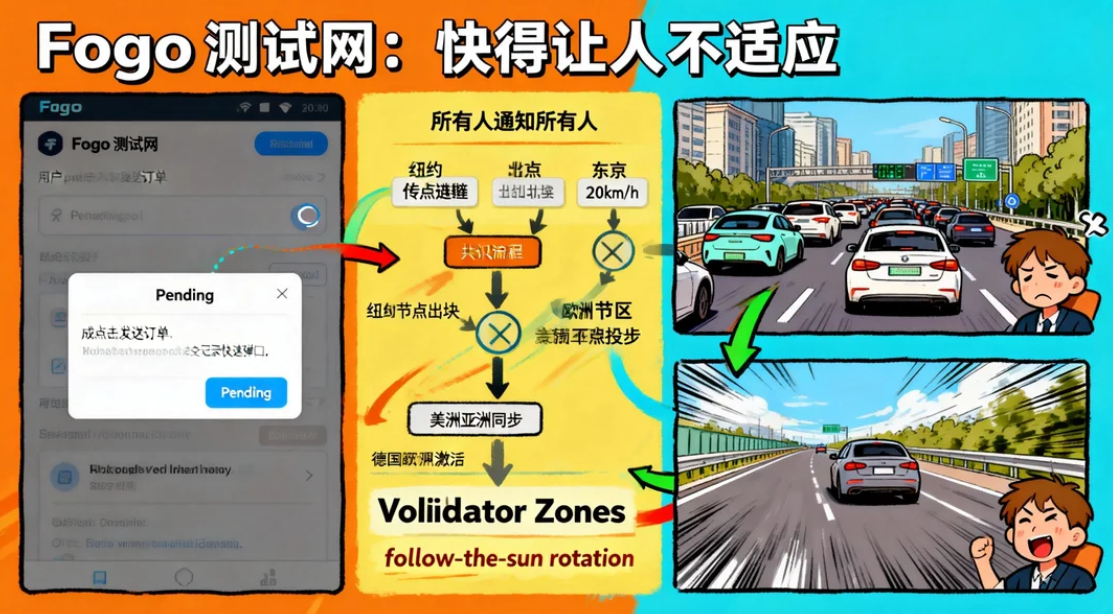
Last week I spent three days on the Fogo testnet, placing over 500 simulated orders. When I clicked send for the first time, I even thought the front end had frozen—because that familiar, anxiety-inducing 'Pending' spinning animation didn't appear at all. By the time I realized, the transaction records were already displayed on the screen. At that moment, I was dazed: it wasn't that it was too fast, but that we had been too slow before. So slow that we treated a wait of a few hundred milliseconds as the 'norm for blockchain.'
It feels like you’re used to crawling on Beijing's Third Ring Road during rush hour, averaging a speed of 20 kilometers per hour, and still having to watch out for electric scooters cutting in beside you. Suddenly one day, you find yourself thrown onto an empty German autobahn with no speed limit, flooring the accelerator, and the speedometer needle is pushing 200, with only the sound of the wind outside, the road conditions so smooth that it makes you question life. But you start to feel uneasy: where are the other cars? Where are the service areas? If you get a flat tire, how long will it take for help to arrive?
This is my first impression of Fogo: so fast it feels uncomfortable, so fast that one forgets to ask 'what's the cost?'.
Technical deep dive: How does Fogo achieve 40ms?
I read through Fogo's white paper twice. To be honest, I started with bias—another Solana fork, right? But when I got to the part about Validator Zones, I was taken aback.
This thing is a bit interesting.
The consensus of traditional chains is 'everyone notifies everyone': if I produce a block on my node in New York, the node in Tokyo must receive the message, vote, wait for others to vote, and then confirm. Just the trans-oceanic handshake takes three or four rounds. Running across half the globe in a fiber optic line takes 100 milliseconds, and a consensus round requires four or five handshakes. Even if your computer is a supercomputer, you have to wait for that guy in Singapore to wake up before you can work.
Fogo's logic is quite crude: it doesn't let everyone work, only those who are close can work.
They divide validators into different 'Zones', activating only one Zone per round. For example, this round the European Zone is working, while nodes in the Americas and Asia only synchronize, not voting or producing blocks. They call this 'follow-the-sun rotation'—wherever the sun shines, that's where the consensus is.
You might ask: Isn't this centralization?
Yes, and no. From a single moment's perspective, it is indeed determined by a few people. But from a daily perspective, the weights are rotating. More importantly, this thing breaks the lock of physical laws on consensus speed. In the past, you had to wait for the farthest person for 24 hours; now, you only need to wait for the nearest group of people.
For example: from 'global video conferencing with everyone raising hands to vote' to 'those awake make decisions'.
Another thing that caught my eye is the implementation form of the Firedancer client. Fogo uses 'Frankendancer'—Agave's stability combined with Firedancer's tile architecture. Each module runs independently on a CPU core, Net receives packets, QUIC unpacks, Verify verifies signatures, Bank executes... data does not go through the kernel, does not copy memory, but passes pointers between cores.
Translated into human language: Other chains handle transactions like waiting in line for a stamp; one person finishes all the work before the next batch can start. Fogo is doing assembly line work, with each workstation only doing one thing simultaneously, without interference.
What about the cost?
Yes, and not small. The Validator Zones mechanism essentially sacrifices the instantaneous performance of 'decentralization' in the 'security-decentralization-performance' impossible triangle for endgame speed. The white paper states very clearly: only nodes in active Zones can participate in consensus; other nodes only synchronize. This means that in a given hour, global consensus is determined by a few hundred nodes in one region—this indeed leaves a time window for regulation and physical attacks.
This is not a technical bug; it's a design trade-off.
I pulled up Fogo's node distribution data, and after looking, I felt a chill down my spine—three data centers in Tokyo, New York, and London account for 80% of the network's block rights. This means if the Tokyo Electric Power Company experiences a blackout, or if Amazon's Tokyo region goes offline, Fogo's block rights will have to rely on New York and London to hold up. Cross-continental delay of 55 milliseconds will cause the block time to jump from 40ms to around 95ms. The chain won't stop, it will just slow down.
Fogo's solution is dual fiber optics + dual power supply + 72 hours of diesel reserves + 15 minutes hydrogen fuel cell startup protocol, spending $470,000 a year on AWS insurance. Is this money well spent? Quant funds think it’s worth it—they are willing to pay $5 million for 1 millisecond. $470,000 for 3.5 milliseconds of reliability is not seen as a cost but as a ticket to entry.
Current ecosystem status: No matter how fast, one fears ghost towns.
But I have to say something unpleasant.
No matter how fast Fogo is, can it be faster than the mouse in the user's hand? Can it be faster than the speed at which developers migrate?
I opened its ecosystem page, scrolled through three screens, and apart from the familiar names Ambient Finance and Pyth, most were 'Coming Soon'. To be honest, this is not just Fogo's problem; it's a common ailment of all new public chains. During the cold start phase, no matter how fast the chain runs, without applications, it’s just a highway with only a few test vehicles idling.
Speed is to make applications run more smoothly, not for you to race alone.
I placed a relatively large order—around 50,000 U—on the native DEX Valiant, and it directly broke through the price difference between the first and fifth buy orders. This kind of slippage is not due to congestion but due to a lack of counterparties. This leads to a classic death loop: market makers are unwilling to provide depth due to the lack of retail investors, and retail investors are hesitant to enter with large funds due to the lack of depth.
Fogo resembles a newly completed super skyscraper, with astonishingly fast elevators, plenty of air conditioning, and a security system armed to the teeth. But when you push open the doors, it's all empty inside, with only a few equally confused airdrop hunters wandering the halls.
Looking at the migration costs again. Developers from Solana do find it easy to transfer—SVM compatible, with minimal code changes. I checked several Fogo ecosystem projects on Github, and wow, much of the logic is directly forked from Solana projects, and with a few configuration changes, they can run. This kind of 'borrowed methodology' may be looked down upon by purists, but it is indeed efficient.
But what about the users? The little amount of U in my wallet requires transaction fees to cross over, has to learn the logic of the new chain, and needs to reauthorize contracts. You tell me 'the experience is better'? But I already have a mature operation flow on Solana; why should I come here and be a pioneer?
Let's do a horizontal comparison:
Solana: The ecosystem is mature, with a large user base and millions of daily active addresses, but the network is unstable and has a history of outages. The major outages in 2023 directly shattered institutional confidence. Fogo is structurally more resilient than it, but the ecosystem is a disadvantage of latecomers.
Ethereum L2: OP, Arb, although slower (final confirmation from a few seconds to tens of seconds), have Ethereum's security consensus and liquidity overflow. Fogo lacks this 'rich daddy' endorsement.
Aptos/Sui: Newcomers in the Move ecosystem, with similarly aggressive technology (parallel execution, Block-STM), and an equally blank ecosystem. Fogo has a developer base for SVM, but the Move ecosystem has the halo of Meta's faith, making it easier to recruit.
Where is Fogo's differentiation? I think it’s not purely technical but rather the combination of 'SVM compatibility + physical consensus optimization'. It doesn’t want to re-educate developers; it just wants existing ones to run more smoothly. This strategy is quite smart, but it also means it will be difficult to gain narrative premium at the level of 'paradigm shift'—after all, you are not creating from scratch; you are just optimizing.
Community observation: The carnival of airdrop mercenaries
I spent a week in Fogo's Discord, and the smell of 'airdrop mercenaries' is stronger than that of technical discussions. People asking 'when will the token be issued' are ten times more than those asking 'how to use this protocol'. Those asking 'how much can I earn from locking funds' are twenty times more than those asking 'how does this Zone operate'.
Can this community enthusiasm survive a bear market? I raise a question mark.
It’s not that airdrop hunters aren’t important—they are the fuel for cold starts; without them, there won’t even be trading volume on the chain. But the problem is, these people are nomadic, moving where the resources are. Once the airdrop ends or another chain offers more generous incentives, they’ll turn and leave.
Who really stays? Developers attracted by technology, long-term holders who believe in the direction, builders willing to build houses on this chain. I counted the active developer IDs in Fogo’s developer channel; there are no more than 30 who speak daily. This number is less than one-tenth of Solana's ecosystem.
But from another perspective, this also means there are significant early opportunities. If Fogo can truly take off, developers and users entering now are the original shareholders.
Token economics: The sincerity and traps of 2% inflation
Let the data speak.
The inflation rate after Fogo's mainnet went live is fixed at 2%, all allocated to validators and stakers. This ratio is considered restrained in the industry—early Solana inflation was 8%, later dropping to 4-5%; Aptos and Sui have more complex inflation models, but all started at over 5%. What does 2% mean? It means early players won't suffer too much dilution from inflation, and validator incentives mainly rely on transaction fees, not money printing.
Token distribution is not detailed, but from the information revealed in the white paper, the release rights of the ecosystem incentive portion (about 15.25%) are fully controlled by the foundation. This is like a giant faucet; how much it turns on depends entirely on the project's mood. If the foundation wants to pump, it can slow down the release; if it wants to stimulate the ecosystem, it can increase incentives. This flexibility is good, but it also means 'trust'—you have to trust they won’t act recklessly.
I looked at the unlocking table, and in March, 120 million tokens belong to early contributors. At the current price of 0.021, the selling pressure is about $2.4 million. This number is not large—Fogo's daily trading volume is around 15 million, so 2.4 million is just an hour or two of volume. But the problem is, this is just the first batch. There will be team unlocks, institutional unlocks, and ecosystem incentive unlocks after this. Once the faucet is turned on, whether it can catch the flow depends on real demand.
What about TVL? It has just started, at less than 100 million USD. Compared to Solana's peak of several hundred billion, the gap is several orders of magnitude. But it’s normal to think about it—during the cold start phase, who dares to put in large sums? Liquidity fragmentation, ecosystem scarcity, contract risks, any one of these can wipe out funds.
Value judgment: Bet on it becoming a pioneer or a martyr?
Is the current valuation a bubble or a golden pit?
If you look at FDV (fully diluted valuation), Fogo is around 800-1 billion USD (based on total supply of 10 billion and the current price of 0.021). Compared to Solana's current FDV (about 50 billion), it's indeed cheap. But Solana has an ecosystem, users, and a brand; what does Fogo have? A 40ms technical demo and a bunch of airdrop hunters.
But if you look at its technical route and team background—coming from Jump, experienced in high-frequency trading, understanding delay sensitivity—I think the market's pricing of its 'cold start risk' is quite reasonable. It’s not one of those projects that claims millions of TPS upon launch; it knows what problems it needs to solve and what the costs are.
So what position does it hold?
It is not an 'Ethereum killer'—Ethereum has been killed eight hundred times and is still alive. It is more like 'Solana's Pro Max': same ecosystem, more stable, faster, and more in tune with physical laws. Where's the ceiling? It depends on how many developers it can steal from Solana and how much mercenary funding it can retain.
What’s my operational strategy?
Participate in the testnet with a small position to experience the product. If the ecosystem can operate after the mainnet launch and TVL exceeds 500 million, I will move some of my positions from the Sol ecosystem here. But I won't go all in. In Web3, being technically advanced does not guarantee ecosystem success—the stories of VHS and Betamax, I've seen too many times. Betamax had better quality, but VHS won because it had more content, was cheaper, and had flexible licensing.
What Fogo needs to do now is not to prove how fast it is but to prove that it can help developers and users make money. Speed is just a means, not the end.
Finally, let me say one thing:
Fogo让我看到,区块链终于开始承认“地球是圆的”,并为此重新设计协议,而不是假装所有人都在同一个机房。这个时代的残酷真相是:光速就是天花板,但你得先够到天花板,才有资格谈突破。
40ms is not magic; it’s a physical compromise. Are you willing to entrust your assets to three data centers for the sake of speed?
I left a 5% position as a tribute to this 'technical idealism'. Winning means young models, losing means going to work.
@Fogo Official #fogo $FOGO