There's a behavior pattern that's become so normalized we've stopped noticing how strange it actually is.
Someone opens an AI chatbot, asks it a complex question — about their health, their legal rights, their finances — gets a confident, well-structured, grammatically perfect answer, and acts on it. No second opinion. No source check. No verification of any kind. Just trust, extended automatically, to a system that was designed to sound convincing regardless of whether it's accurate.
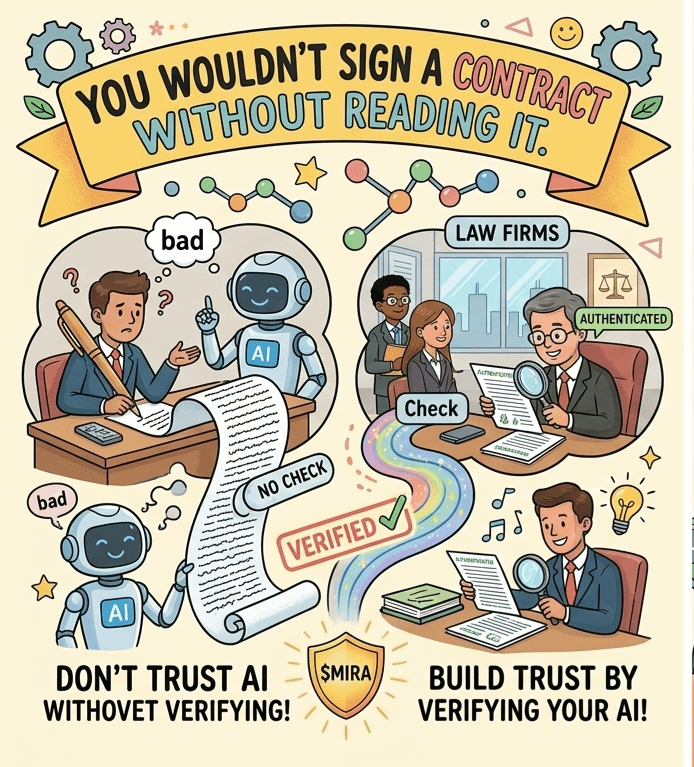
We'd never do this with a human professional. You wouldn't take a stranger's legal advice without checking their credentials. You wouldn't follow a medical recommendation without asking where it comes from. You wouldn't sign a contract without reading what it actually says. But with AI, somehow, the confidence of the delivery has become a substitute for the credibility of the content.
This isn't a user problem. It's an infrastructure problem. And @mira_network is the project that's treating it like one.
What Mira understood early — and what most of the AI industry is still dancing around — is that you cannot solve a trust problem by making AI sound more trustworthy. Better tone, smoother phrasing, more authoritative formatting — none of that changes the underlying reality that the model generating your answer has no accountability mechanism attached to it. It can be wrong. It can hallucinate. It can confabulate sources that don't exist and present them with the same confidence as facts it actually has correct. And currently, there is no system in place that catches this before it reaches you.
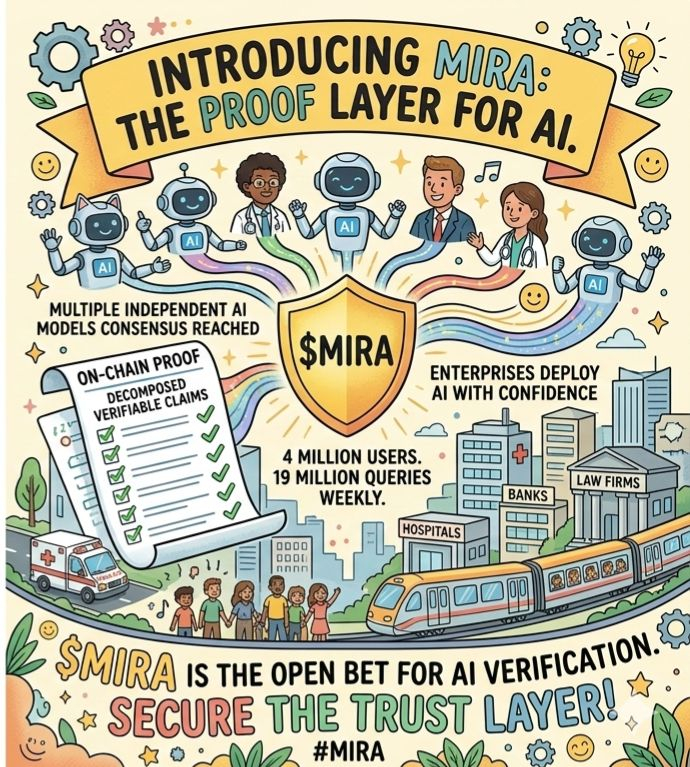
Mira's solution is elegant in the way the best infrastructure solutions always are — it doesn't try to make any single AI model perfect. It builds a system where multiple independent AI models check each other.
Here's how it actually works. When a query comes into the Mira network, the response doesn't just get generated and handed back. It gets decomposed into individual verifiable claims. Each of those claims gets independently evaluated by multiple validator nodes — running different models, trained on different data, with different architectures — and consensus is reached across those independent evaluations. The result is a cryptographically certified output that carries a verifiable proof of how many independent validators agreed, what they agreed on, and what confidence level the consensus reached. That proof lives on-chain. It's permanent. It's auditable. And it can't be retroactively changed by anyone.
This is what changes the accountability equation for AI entirely.
Right now, if an AI gives you bad medical information and you act on it, there's no trail. No record of what was said, what was checked, or whether any verification happened at all. With Mira's infrastructure in place, every verified output carries a chain of custody. Enterprises deploying AI in regulated industries — healthcare, legal, financial services — can point to that on-chain record and demonstrate, provably, that their AI outputs went through an independent verification process before reaching end users.
That's not just a nice feature. In an era of tightening AI regulation globally, that's becoming a compliance requirement.
The scale Mira has already achieved makes this more than theoretical. 4 million users. 19 million queries processed weekly. 3 billion tokens verified every single day. Real applications — Klok, Learnrite, Astro, Creato — are already running production workloads on top of Mira's verification rails. This is not a project waiting for adoption. This is a project that found product-market fit and is now scaling into it.
$MIRA sits at the center of the economic model that makes all of this sustainable. Validators don't participate out of goodwill — they stake $MIRA, earn rewards for honest consensus, and face real economic penalties for dishonest behavior. This creates a self-reinforcing loop: the more valuable the network becomes, the more validators want to participate honestly, because the cost of getting caught cheating scales with the size of their stake. Security grows with usage. Trust becomes structural rather than assumed.
Backing from Bitkraft, Framework Ventures, Accel, Mechanism Capital, and Folius Ventures tells you that serious institutional capital looked at this model carefully and decided it was the right bet. These aren't funds that chase narratives. They fund infrastructure that solves real problems at scale.
Here's the thing about trust layers. They're invisible until they're not. Nobody thought about HTTPS until e-commerce needed it. Nobody thought about SSL certificates until online banking required them. The verification layer for AI is going to follow the same pattern — ignored by most people right now, completely indispensable in three to five years when AI is embedded in every high-stakes decision workflow on the planet.
@mira_network is building that layer today. With working technology. At real scale. With a token model that creates genuine, usage-driven demand as the network grows.
The question isn't whether AI verification infrastructure gets built. It's who builds it, who owns it, and whether it's open to everyone or locked behind a corporate paywall.
$MIRA is the open bet. And the window to understand it before the mainstream does is still open — but it won't stay that way forever.
Do your own research. Take the time to understand the technology. But don't mistake the current quiet for a lack of momentum.
#Mira #MIRA $MIRA @Mira - Trust Layer of AI