
Recently, I revisited @Fabric Foundation . At first, I also used a very simple framework to understand it: AI + Robotics + Crypto. Most people see it this way too.
But when reading the white paper and foundational documents, I always felt something was a bit off. If it's just about machine networks, then there seem to be some aspects that are difficult to explain. Later, I tried to look at these contents from a different perspective and found that it seemed to become a bit interesting.
Fabric may not just be about robotics; it seems more like an attempt to solve a very strange problem: how to turn actions in the real world into a computable resource. This problem is much more interesting than robotics.
From a historical perspective, what we have been doing all along is turning resources into computable resources.
Initially, land was managed through measurement and property rights. Later, the Industrial Revolution broke labor down into computable time and efficiency. Then the Internet turned information into a resource that could be copied and spread. Finally, blockchain turned value into a programmable resource.
 But there is one thing that has never been well computed: behavior. Information can be copied, value can be accounted for, but how are behaviors recorded and verified?
Looking at Fabric from this perspective, it is trying to do something very interesting. It wants to turn real actions into a protocol resource.
The logic is probably: Action → Datafication → Verifiable → Settled
If this attempt can succeed, then tasks in the real world can be scheduled over the network like computer tasks, somewhat resembling the concept of the Internet of Actions.
Here we need to talk about a core mechanism in Fabric, Proof of Robotic Work, which looks like mining at first glance, but upon closer inspection, it is not.
Proof of Work is proof that computation has occurred, Proof of Stake is proof that capital bears risk. PORW is more like proving that a certain action in the real world actually took place.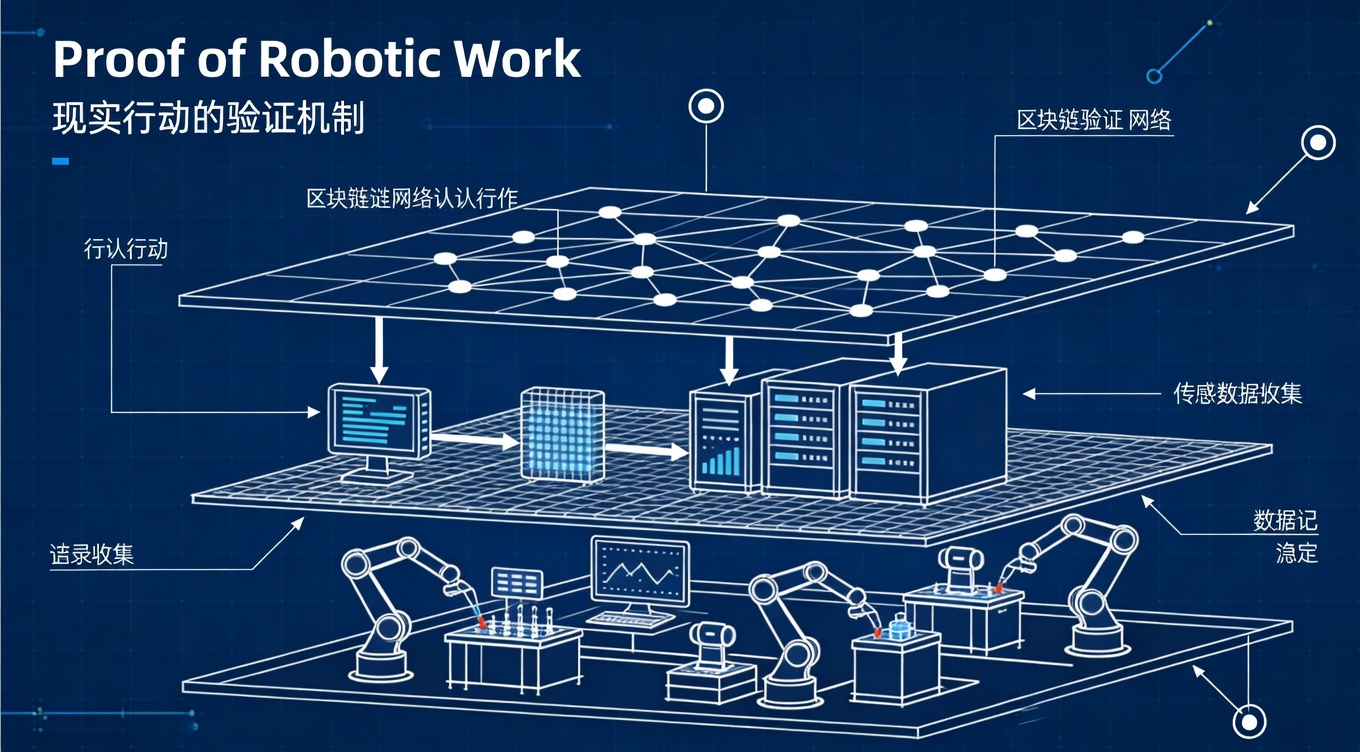
But is this thing reliable? Sensors can be faked, data can be forged, who can confirm its authenticity? I can simply write a script to broadcast that the room has been cleaned every hour; how does the system know if it's true or false, unless the vacuum robot is equipped with tamper-proof hardware fingerprints.
Looking closely at the robot network itself, you'll find that it actually has a combination of three capabilities: computation/perception/execution. In other words, it is a computer node that can perform tasks in the real world. If we look at the Fabric network this way, it seems to be scheduling the execution capabilities of the real world. What does that resemble? Cloud computing scheduling CPU?
The current combination of AI + automated devices + blockchain provides a possibility for this structure. It allows robots to autonomously accept tasks, execute tasks, and obtain rewards, which brings us closer to what is called the Machine Economy.
Well~ the prerequisites seem to be met, but the real world is more complex; sensor errors, equipment failures, and environmental changes can all affect it. So the real technical challenge is not the robots, but how to compress the uncertainties of the real world into verifiable data.
If this structure really holds, then many real-world services might gradually turn into open network services.
Of course, it could all be wrong. The real world is too complex, a thousand times messier than the computer world, but at least this direction is worth keeping an eye on. What if one day actions can actually flow in the network?