LFor most of human history, trust has been built with simple tools records, receipts, and shared rules that everyone can check. When someone completes a job, there is usually proof: a signed document, a transaction record, or a log showing what happened. As machines begin to do more work in the real world, that same basic idea becomes surprisingly important.
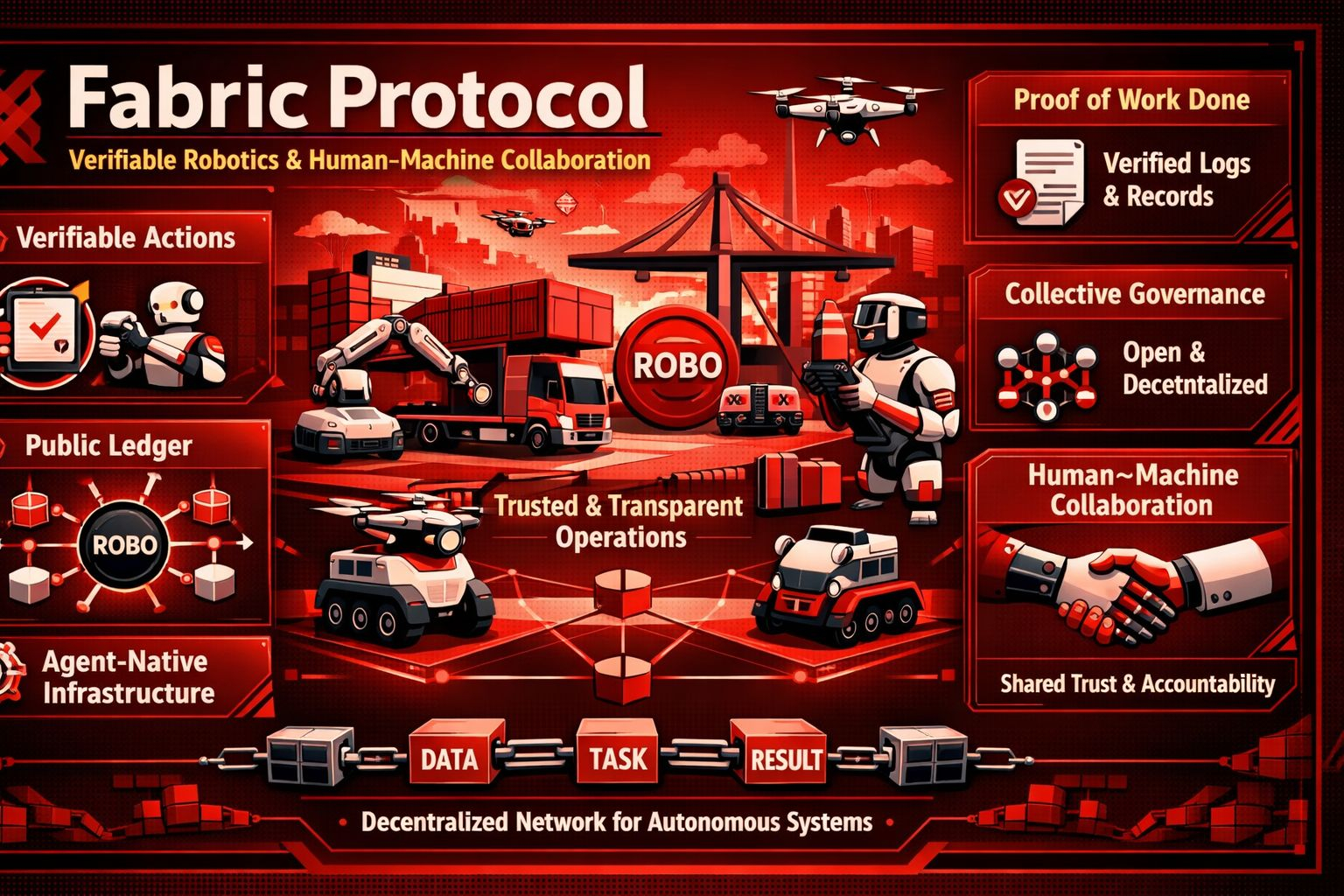
Fabric Protocol is built around this concept. Instead of focusing only on making robots more intelligent, it focuses on making their actions verifiable and transparent. In simple terms, Fabric Protocol is an open network that allows robots, software agents, and organizations to record and prove what they do through a public ledger.
One way to understand it is to imagine a large port where hundreds of ships arrive every day. Each ship carries goods, and every movement loading, unloading, inspections is recorded so everyone involved can trust the process. Fabric Protocol works in a similar way for robots and autonomous systems. It creates a shared infrastructure where the actions of machines can be logged, verified, and coordinated in a transparent environment.
The network is supported by the non-profit Fabric Foundation, which focuses on building an open framework where developers, researchers, and organizations can collaborate. Instead of a single company controlling the system, Fabric aims to create a space where rules, data, and computation can be managed collectively.
A key idea behind Fabric Protocol is verifiable computing. This means that when a robot performs a task or runs a computation, there is a way to prove that the result is correct. In environments where machines are making decisions or interacting with people, that kind of proof becomes valuable. It helps create accountability and reduces the need to blindly trust the machine or its operator.
Another important concept is what Fabric calls agent-native infrastructure. Most digital systems today are designed mainly for human users. Fabric explores the idea of infrastructure built specifically for autonomous agents systems that can operate, communicate, and coordinate with each other while still being governed by clear rules that humans can oversee.
The protocol also uses a public ledger to coordinate information about data, computation, and governance. This ledger acts as a shared record where activities and decisions can be documented in a transparent way. Instead of different systems keeping isolated logs, Fabric brings them into a common environment where they can be verified and referenced.
In recent months, the Fabric ecosystem has started expanding its public presence. The project has released more documentation explaining how its infrastructure works and has opened participation opportunities within the network. At the same time, the ecosystem’s token, ROBO, has begun appearing across major crypto platforms, bringing more attention to the protocol’s long-term goal of coordinating autonomous systems through open infrastructure.
What makes Fabric interesting is that it approaches robotics from the perspective of coordination and accountability, rather than just automation. Many discussions about robots focus on intelligence and performance, but the real challenge often comes later: how do different machines, companies, and communities trust each other’s systems? Fabric attempts to answer that by giving everyone access to the same verifiable records.
If the idea succeeds, it could create a shared foundation where humans and machines can work together more confidently, because actions are no longer hidden inside private systems but recorded in a way that others can verify.
In the end, Fabric Protocol is less about building smarter robots and more about building the trust infrastructure that allows humans and machines to collaborate responsibly.
@Fabric Foundation #ROBO $ROBO