I spent a good part of my Sunday diving into @Fabric Foundation and, honestly, I came out the other side a bit impressed. Which surprised me because normally when I see "AI + crypto" my eyes glaze over. There is so much vaporware out there.
But here is what surprised me. We are all watching these humanoid robots from Figure, Unitree, Tesla. They are improving in an unsettling way. But they are all trapped in their own bubbles.
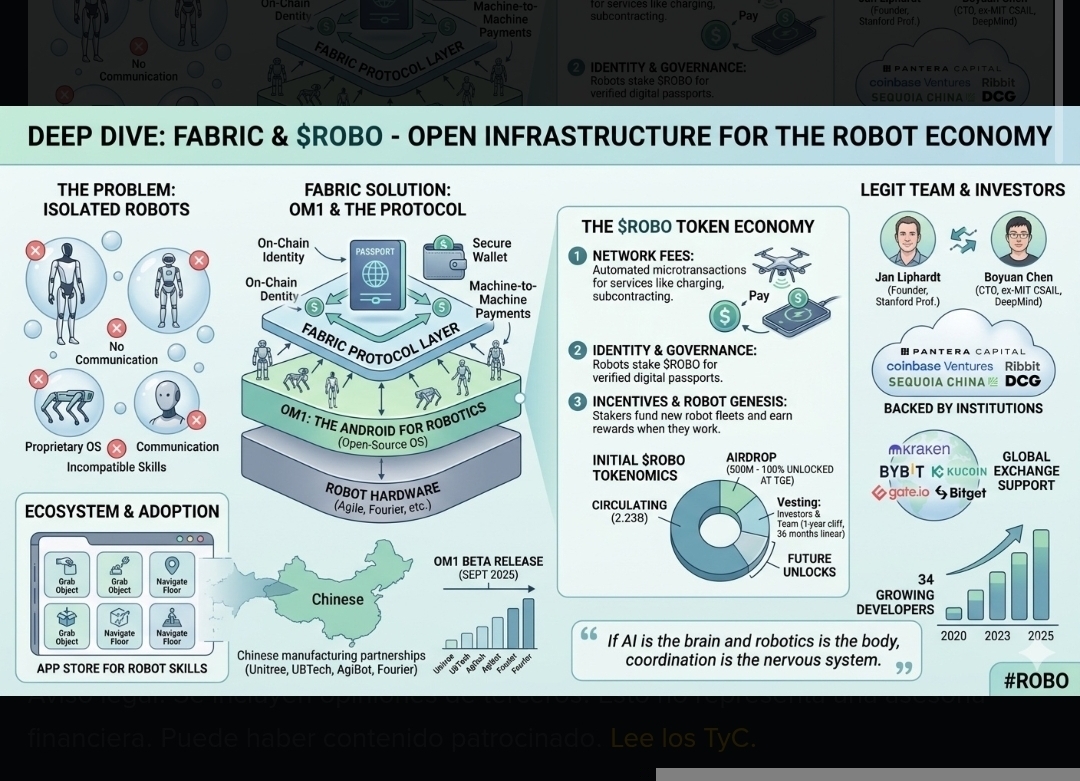
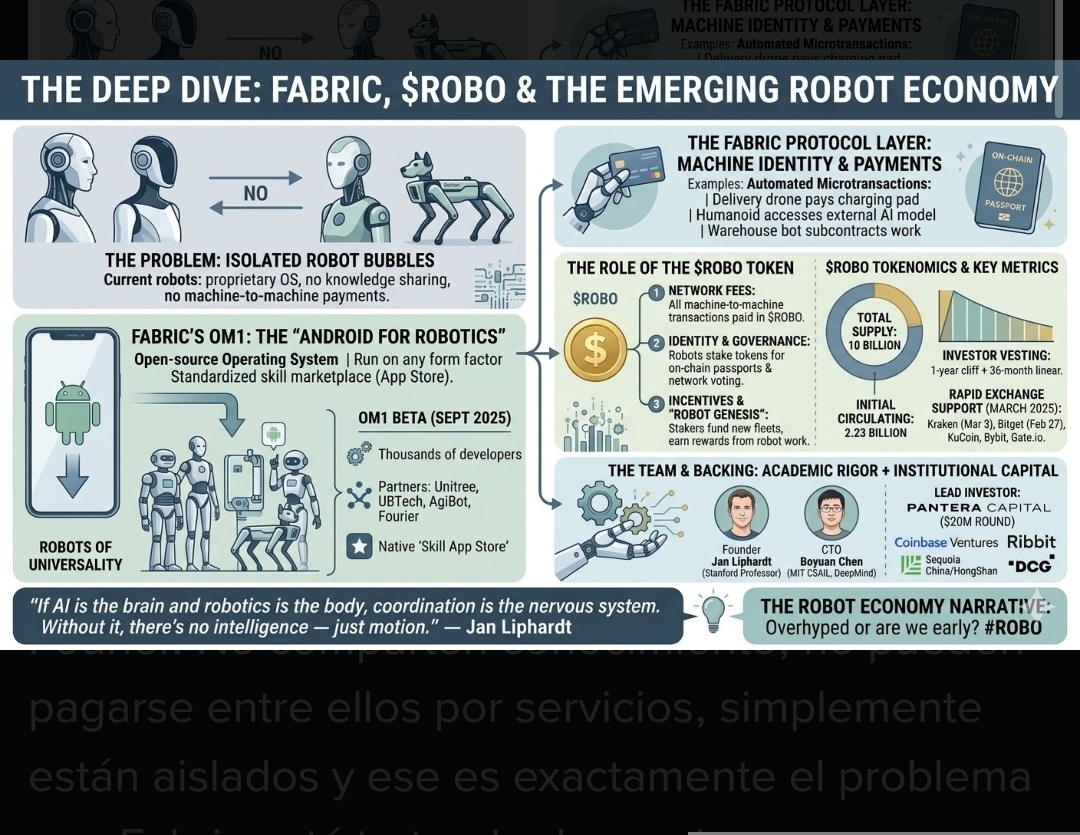
A Unitree robot cannot communicate with a Fourier robot. They do not share knowledge, they cannot pay each other for services, they are simply isolated and that is exactly the problem that Fabric is trying to solve.
Think of it this way. Before smartphones, every phone manufacturer had its own operating system, its own apps; nothing worked together. Then Android came along, and suddenly developers could build once and run anywhere.
That’s what OpenMind (the team behind Fabric) is building with OM1; they literally call it 'Android for robotics.' It’s an open-source operating system that works on any robot, whether it’s a humanoid, a four-legged dog bot, or a robotic arm.
A developer in Tokyo can build a 'grab object' skill, and a robot in São Paulo can download and use it instantly. That’s powerful.
But here’s where the crypto part really makes sense. The OM1 system handles the brain of the robot. But robots also need an identity, a wallet, a way to transact. That’s the FABRIC protocol layer.
It gives each machine a passport on the chain, allows them to verify each other, and here's the kicker, it enables machine-to-machine payments using $ROBO.
I kept thinking, 'Okay, but why do robots need to pay each other?' Then I read about real-world scenarios. A delivery drone lands at a charging base; it needs to pay for energy. A warehouse robot overloads and outsources work to another bot.
A humanoid needs access to a specialized AI model hosted by someone else. In all these cases, you need automated settlement. Humans can't just stand there swiping credit cards for every microtransaction between machines.
The $ROBO token has three main functions from what I’ve gathered. First, network fees for any transactions between machines are paid in ROBO. Second, identity and governance; robots stake tokens to get their verifiable digital passport and participate in network decisions. Third, incentives; people who stake ROBO can help fund new fleets of robots through something called 'Robot Genesis' and earn rewards when those robots work.
The team behind this is also legit, which matters to me. Founder Jan Liphardt is a Stanford professor who’s been researching at the intersection of AI, biology, and decentralized systems for years.
CTO Boyuan Chen came from MIT CSAIL and Google DeepMind. And the investors? Pantera Capital led a $20 million round, with Coinbase Ventures, Ribbit, Sequoia China (now HongShan), and DCG involved. These aren’t random angels; these are institutions that did some solid due diligence.
Speaking of which, the exchange support has been incredible. Kraken listed $ROBO on March 3rd. Bitget listed it on February 27th, right when trading opened.
It's also on KuCoin, Bybit, Gate.io, basically everywhere major. That kind of multi-exchange launch is unusual for a new project; usually, you get one and then wait months for the others.
The tokenomics is worth understanding too. The total supply is 10 billion, with about 2.23 billion in circulation initially. There’s a community airdrop of 5% that’s 100% unlocked at TGE, and the rest will be released over time, with investors having a 1-year lock-up and then 36 months linear. That means the sell pressure should be manageable if adoption ramps up.
Now, I’m not saying this is guaranteed moon material. The thesis of the robotic economy hinges on real-world robots being deployed at scale, which is still early days. Plus, over 80% of the supply is initially locked, so future unlocks could stir up volatility. But the team has been transparent about the release schedule.
What I find most interesting is the philosophical angle. Jan Liphardt said something in an interview that stuck with me: 'If AI is the brain and robotics is the body, coordination is the nervous system. Without it, there’s no intelligence, just movement.'
That’s not just marketing fluff; it’s really true. We’re building all these smart machines but forgetting to give them a way to communicate with each other and exchange value.
The OM1 beta dropped in September 2025 and it's already got thousands of devs testing it out. They're teaming up with Chinese manufacturers like Unitree, UBTech, AgiBot, Fourier—real hardware companies sending real robots—and just launched an app store for robotic skills, which feels like the kind of ecosystem play that could blow up if it gains traction.
Look, I’m not going crazy and throwing my whole portfolio into this. But I did put a little skin in the game to stay interested while I watch how this unfolds. The vision of an open infrastructure for a machine economy is compelling. Whether it actually executes is another question.
What does everyone think? Is the robotic economy narrative overhyped or are we just early? #ROBO $ROBO @Fabric Foundation