
The uncle has been in the pharmaceutical industry for a long time and understands one principle: developing a special drug is certainly impressive, but if it is possible to establish a standardized "drug screening platform" that allows everyone to quickly assemble molecules and verify activity, that is the real dimensionality reduction strike.
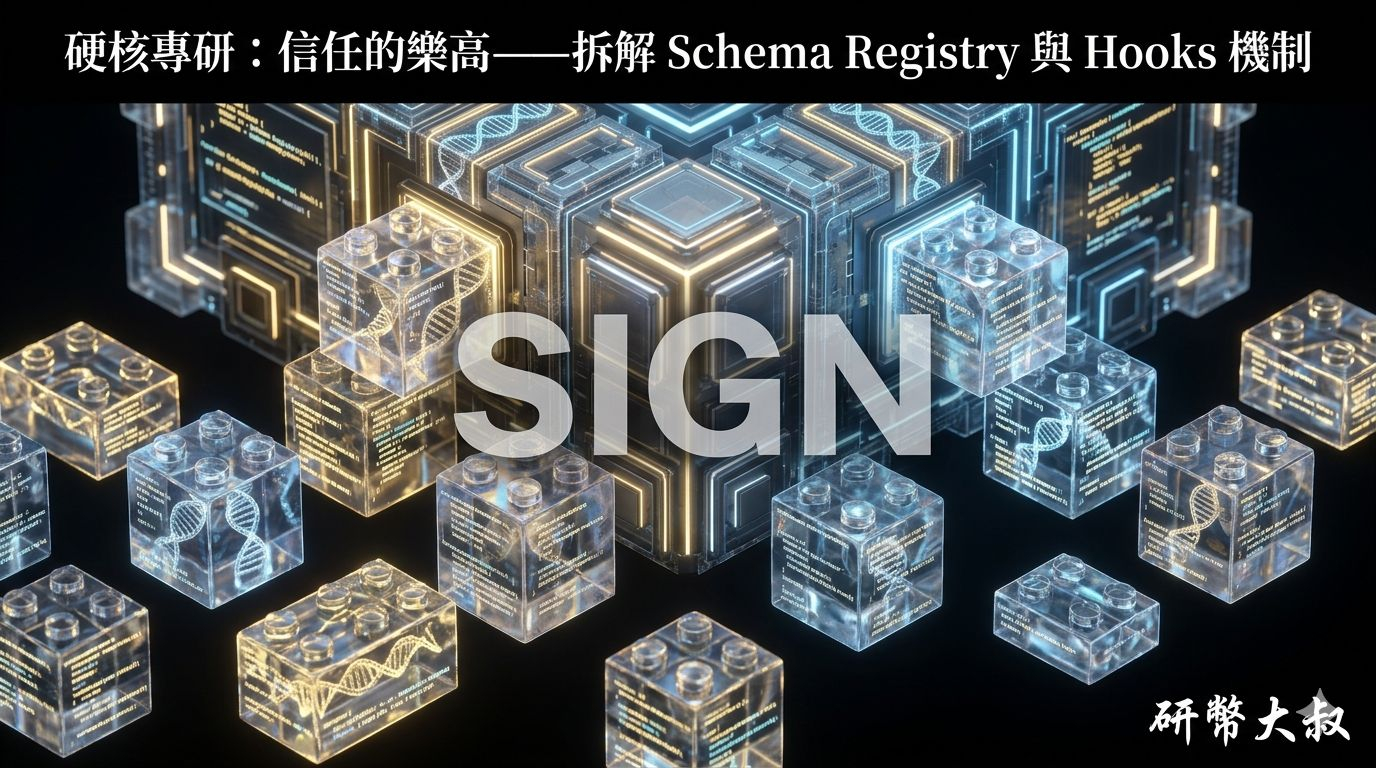
What Sign Protocol does in Web3 is essentially this set of logic. It does not force you to accept a specific trust model; instead, it gives you a box of Lego blocks named "trust" to piece together the evidence chain that best meets your needs. The core of this set of blocks is the Schema Registry and Hooks.
Schema Registry: The universal syntax of the digital world
In traditional networks, the most painful aspect of verifying information is 'inconsistent formats.' Your electronic signature is completely incompatible with my identification format. Sign Protocol's Schema Registry solves this problem.
In simple terms, Schema is like a standardized container. It defines what fields should be included in the data (e.g., name, expiration date, certificate number), how to encode them, and how verifiers should interpret them. This makes all attestations into machine-verifiable structured data.
For the uncle, this is like a standardized compound library in drug research. When all molecular formulas are described using the same terminologies, cross-chain 'automated retrieval' and 'logical docking' become possible. This is also why Sign Protocol dares to call itself a full-chain attestation protocol, because it standardizes the syntax at the most fundamental level.
Schema Hooks: The automatic executor of trust
If Schema is the skeleton, then Hooks are the soul of this system.
When writing code or designing contracts, what we fear the most is being 'rigid.' Sign Protocol introduces a Hooks mechanism that allows developers to insert a piece of custom logic when creating or revoking attestations.
What is it useful for? Here are a few hardcore application scenarios that the uncle thinks are very impressive:
* Whitelisting: You can set it so that only specific whitelisted addresses can issue attestations. This is like permission management in a laboratory, ensuring that only professionals can input data.
* Automatic Fee Collection: Fees are automatically deducted when an attestation is created, providing a sustainable economic incentive for digital infrastructure.
* Logical linkage: When an attestation is revoked, the system automatically triggers a chain reaction on the blockchain, such as revoking someone's access rights.
This is like the enzyme in a biochemical reaction; it determines the conditions under which the reaction occurs, how fast it happens, and when it stops. This flexibility allows Sign Protocol to seamlessly connect with the ever-changing legal and compliance needs of the real world.
Conclusion: Don't trust us, trust the code
When the uncle was reviewing the EthSign development documentation, he saw a phrase that deeply resonated: 'Don't trust us – trust the code.'
The power of Sign Protocol lies in its ability to make data transparent through Schema and automate execution through Hooks. There is no longer a need for a centralized 'Big Brother' to tell you whether a document is genuine; instead, trust is broken down into pluggable, combinable Lego pieces.
This narrative of 'modular trust' is precisely what gives it the technical confidence to support national-level digital sovereignty. When technology is no longer a black box but a set of transparent and efficient standard tools, the true wave of Web3 applications can officially begin.
Tomorrow, the uncle will temporarily leave the microscope and adopt the perspective of a reverse investor to take a look at the tokenomics of $SIGN , discussing how this 'trust tax' is collected and who it goes to.
