
spent way too long on chart like BITCOIN and SIREN then moved on to this one last night and honestly i almost moved past it 😂
the OtterSec case study in the Sign docs. audit results as on-chain attestations. the finding gets signed. the attestation goes on-chain. anyone can verify the audit happened without calling OtterSec, without trusting a PDF, without hoping the website is still up in three years.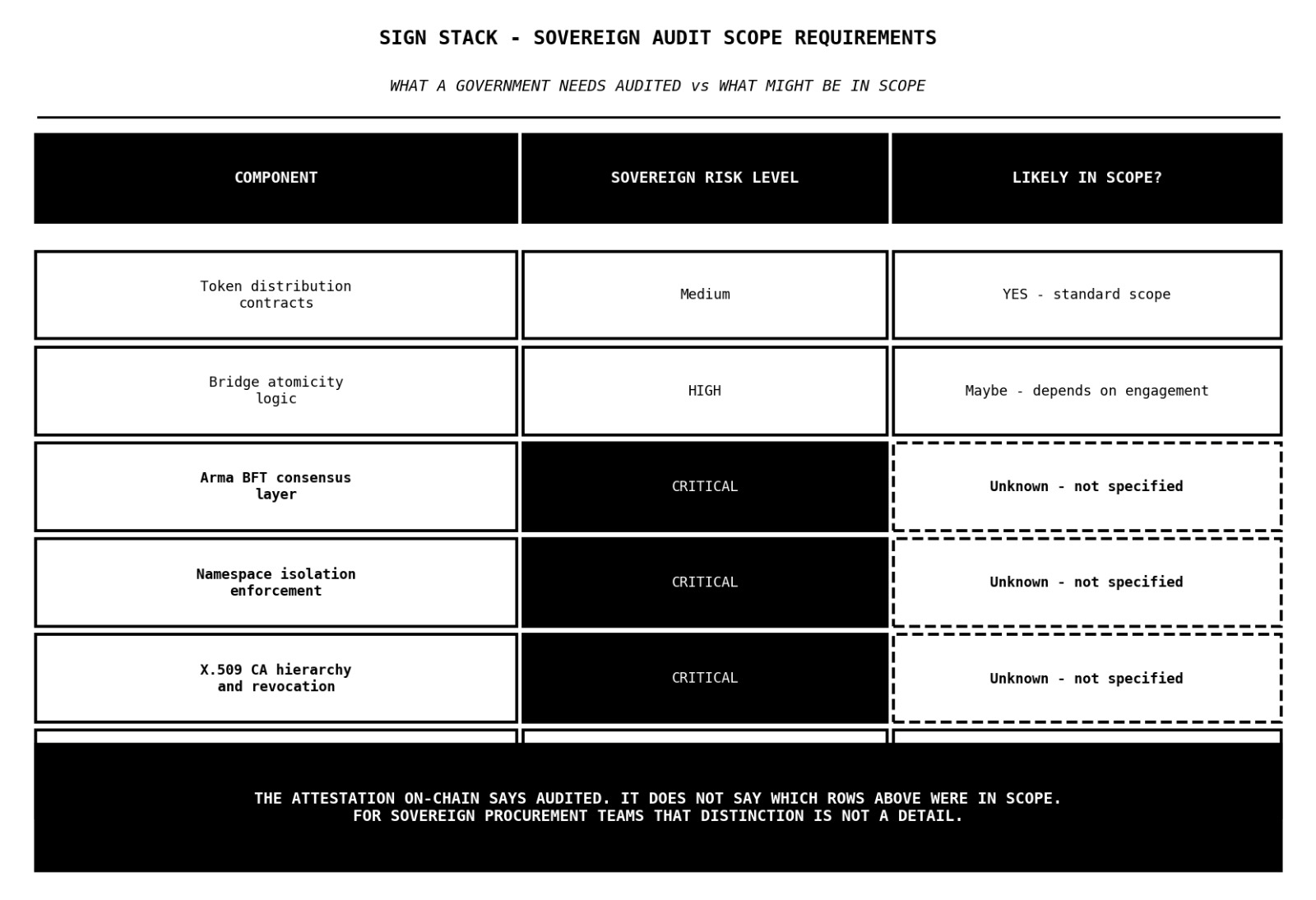
And i genuinely like this.
no really. the problem it solves is real. audit reports disappear. companies get acquired. websites go down. PDFs get quietly replaced. on-chain attestation means the record exists independently of whether the auditing firm still exists. thats a meaningful improvement over how audit verification works today.
kept re-reading the case study trying to find the scope definition
couldnt find it.
here is the thing about audits that anyone who has sat through a serious security review knows - scope is everything. an audit of module A tells you nothing about module B. a smart contract audit covering token distribution logic tells you nothing about the bridge. a penetration test scoped to the API layer tells you nothing about the consensus mechanism.
the attestation records that OtterSec audited something. signed it. date stamped it.
actually no - let me be more precise. the attestation records that an audit occurred and the result was whatever the attester declared. the scope of that audit - what was included, what was explicitly excluded, what was out of scope by agreement - none of that is in the attestation.
And for a developer checking a repo this probably doesnt matter much. audit happened, result was clean, ship it.
But for a sovereign government evaluating whether to deploy national CBDC infrastructure on a stack with an on-chain audit attestation - the scope question is the entire question. did they audit the Arma BFT consensus layer..... the namespace partitioning logic
the certificate authority hierarchy
the bridge atomicity
or
did they audit the token distribution contracts and call it done.
the on-chain attestation looks identical either way.
a government procurement team with no blockchain background sees an on-chain attestation from a credible security firm and reads that as full-stack verification. the attestation contains no information to correct that assumption. scope lives in a PDF somewhere
maybe
i keep coming back to this
the immutability of the attestation is the feature. but immutability of an incomplete record is not the same thing as immutability of a complete one. what got frozen on-chain might be a partial picture that looks like a full on.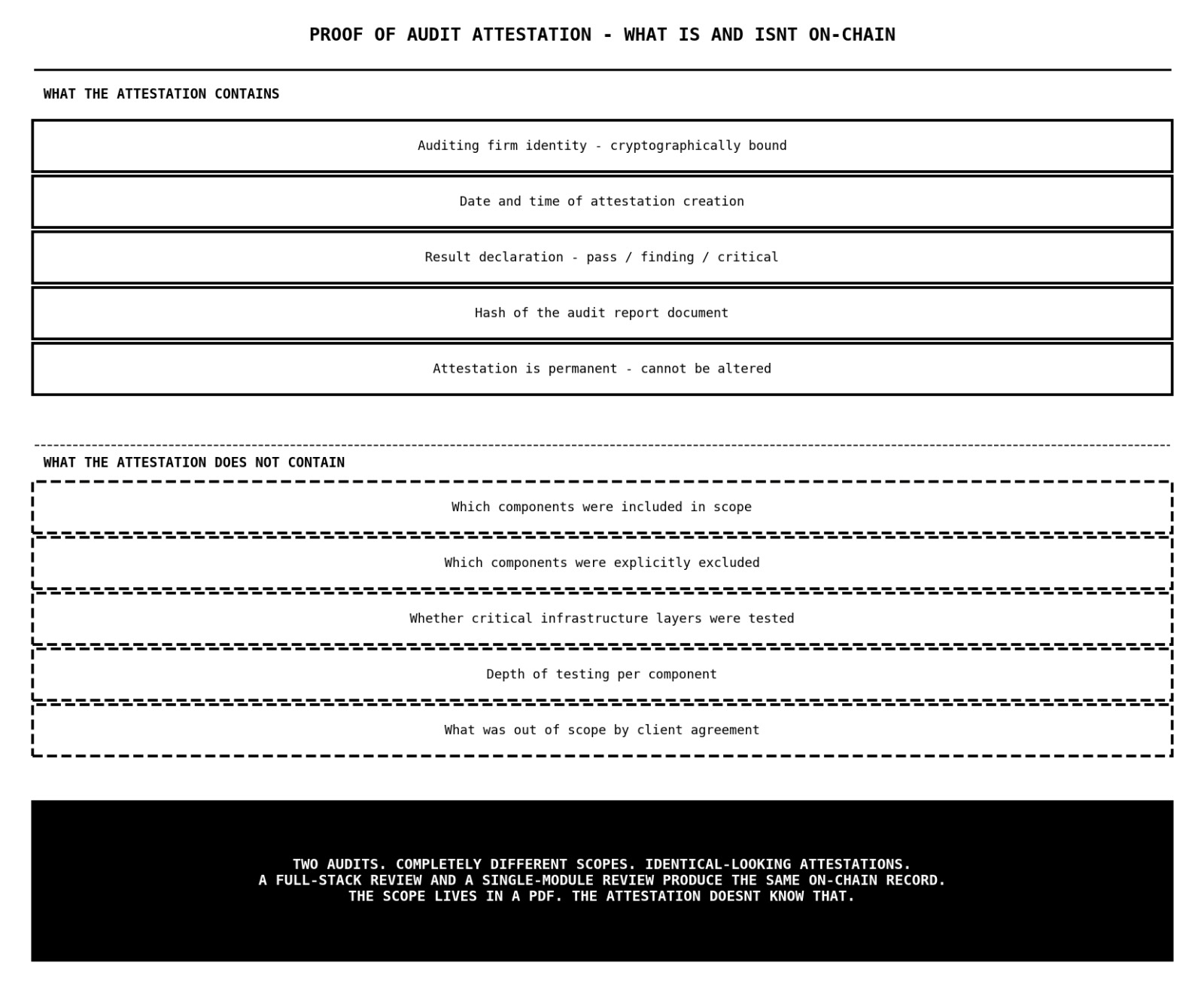
IDK if on-chain audit attestations make security verification more trustworthy for sovereign deployments or just make a scoped finding look like a comprehensive clearance to anyone who doesnt know to ask what the scope was?? 🤔
#SignDigitalSovereignInfra @SignOfficial $SIGN
