
My Honestly observation.
I keep watching @Pixels and trying to figure out if Stacked's AI can actually manage token distribution rates well enough to prevent the supply-demand imbalance that kills every reward system or if that's an optimization problem that gets harder the more valuable the tokens become.
What I'm watching isn't whether managing distribution matters. It does. What I'm watching is whether it's possible to maintain the balance between distributing enough to keep players engaged and not distributing so much that supply outpaces demand.
The distribution rate problem in reward systems.
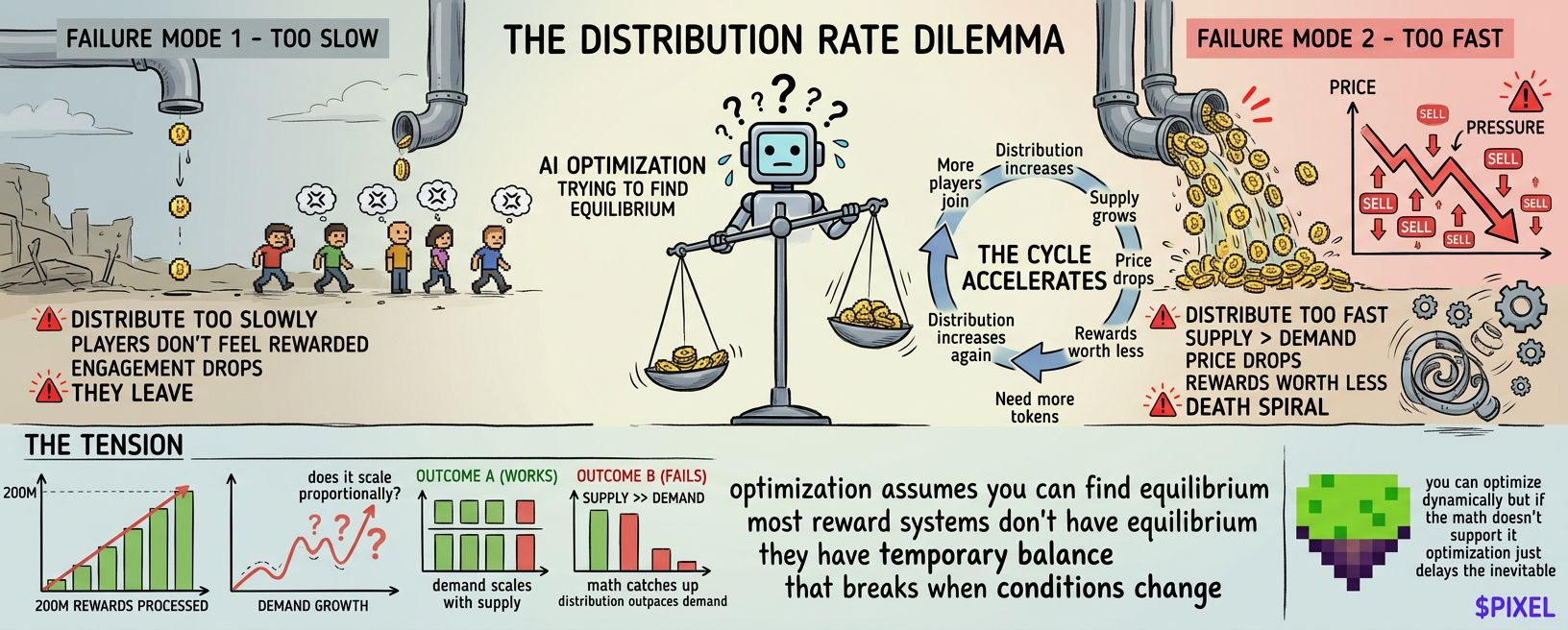
Not the theoretical optimization. The reality where you're choosing between two failure modes. Distribute too slowly and players don't feel rewarded. Distribute too fast and token supply grows faster than demand. Price drops. Players leave anyway.
Every play-to-earn hits one of those walls.
Pixels says Stacked's AI economist optimizes distribution rates. It watches player behavior. It adjusts reward amounts dynamically to maintain retention without flooding the market.
Right approach in theory. What I can't tell is whether it works in practice when distributing real value at scale.
The challenge is that optimization assumes you can find an equilibrium. Some distribution rate where engagement stays high and supply doesn't outpace demand. But most reward systems don't have an equilibrium. They have a temporary balance that breaks when conditions change.
More players join. Distribution increases. Supply grows. Unless demand grows proportionally, price drops. Lower price means rewards are worth less. Players need more tokens to feel rewarded. Distribution increases again. The cycle accelerates.
That's not an optimization problem. That's fundamental tension.
@Pixels processed 200 million rewards. The AI economist managed that distribution while maintaining $25 million in revenue. That suggests demand kept pace with supply in their ecosystem.
What I don't know is whether that scales when distribution expands across multiple games.
Most reward tokens work in their home ecosystem because the ecosystem generates demand. The game creates reasons to hold or use the token.
When you expand to multiple games, distribution scales linearly. Each new game distributes rewards. But demand doesn't necessarily scale linearly. Cross-game utility doesn't automatically create proportional demand.
If ten games each distribute rewards but demand doesn't grow 10x, you get supply-demand imbalance.
The AI economist can optimize distribution within each game. But it can't create demand across games. It can reduce reward rates when it detects oversupply. But reducing rates creates the first failure mode. Players feel unrewarded. They leave.
That's the trap. You optimize for balance until optimization itself becomes the problem.
Maybe Stacked's AI is sophisticated enough to manage this. Maybe it finds distribution rates that maintain engagement without oversupply. Maybe the revenue model generates enough demand to absorb increased distribution.
Maybe it can't and the math catches up. More games distributing tokens faster than cross-game utility creates demand.
I'm watching to see which one.
What I'm particularly watching is whether distribution rates stay consistent or tighten as the ecosystem expands. Consistent rates suggest demand is scaling. Tightening rates suggest the AI is managing oversupply by restricting distribution.
Both have implications for PIXEL. Consistent rates with growing distribution means supply is increasing. Sustainable only if demand grows proportionally. Tightening rates means protecting value by limiting supply. Sustainable only if players accept lower rewards.
Most reward systems can't thread that needle. They either flood the market or squeeze players until they leave.
The other challenge is that AI optimization works until it doesn't. The AI is trained on historical data. It optimizes based on what worked before.
But future conditions might not match historical patterns. More games means different player demographics. The AI's optimization might not transfer.
I'd prefer Stacked has revenue models that create structural demand for PIXEL independent of reward distribution. If the token has utility beyond being a reward, demand can grow with supply.
I'm just not convinced AI optimization alone solves the fundamental tension between keeping players engaged through rewards and preventing token oversupply.
The distribution rate question's fundamental. You can optimize dynamically. If the math doesn't support the distribution levels you need to maintain engagement, optimization just delays the inevitable.
And honestly, I trust teams that acknowledge the tension between engagement and supply more than teams that claim AI optimizes it away.
