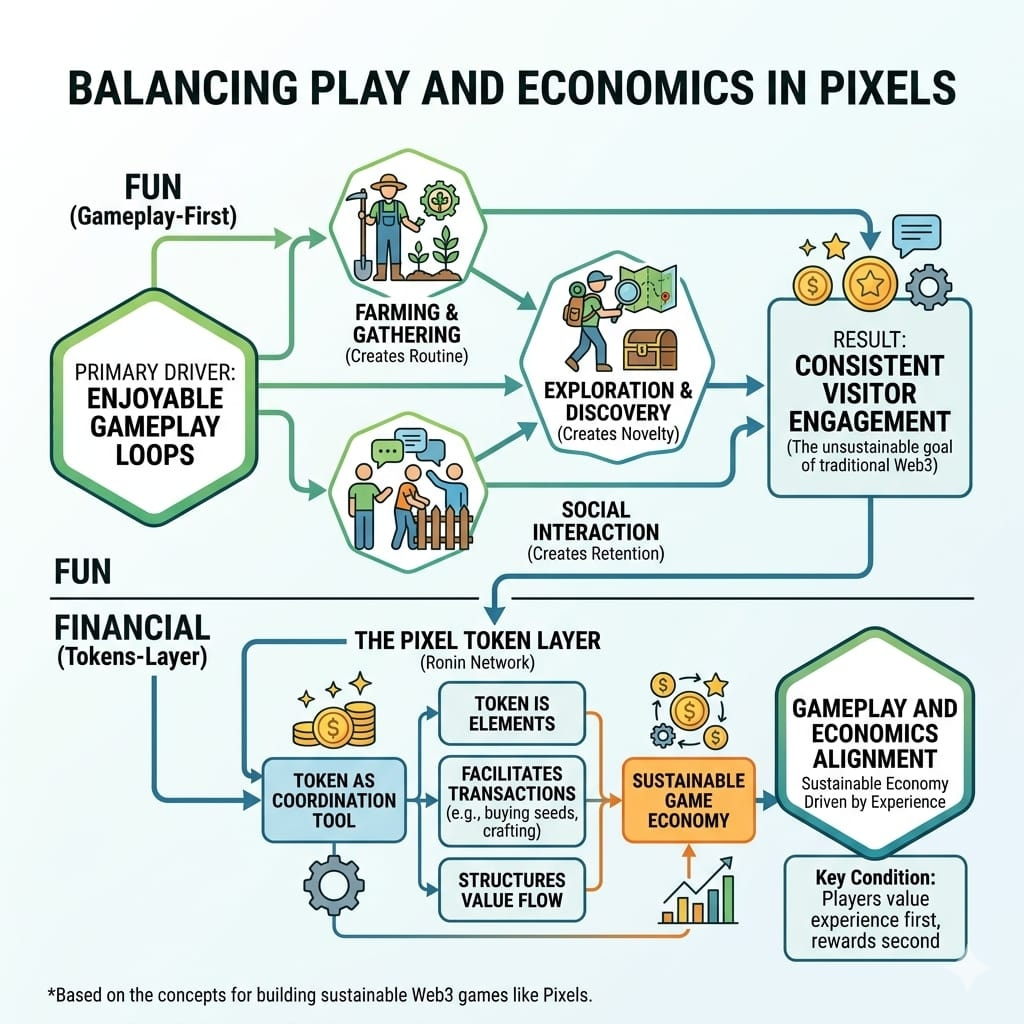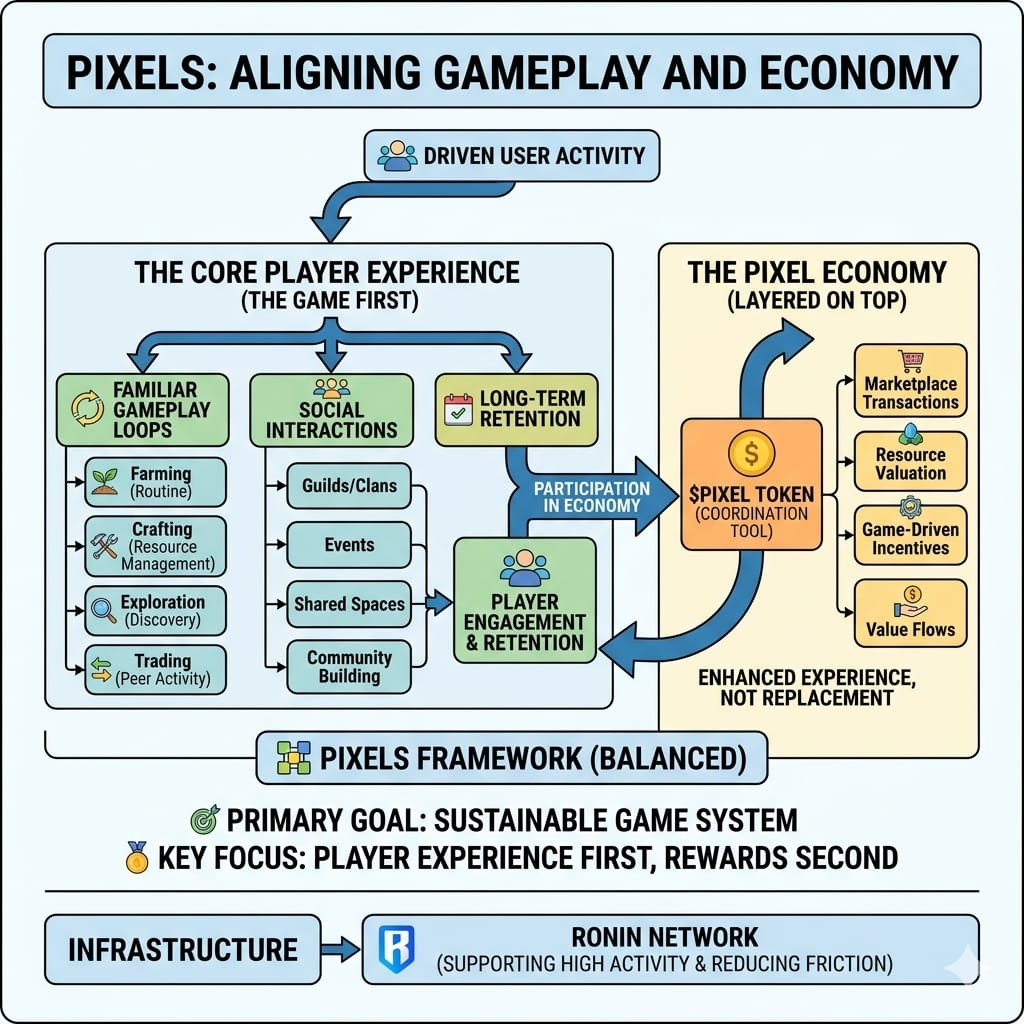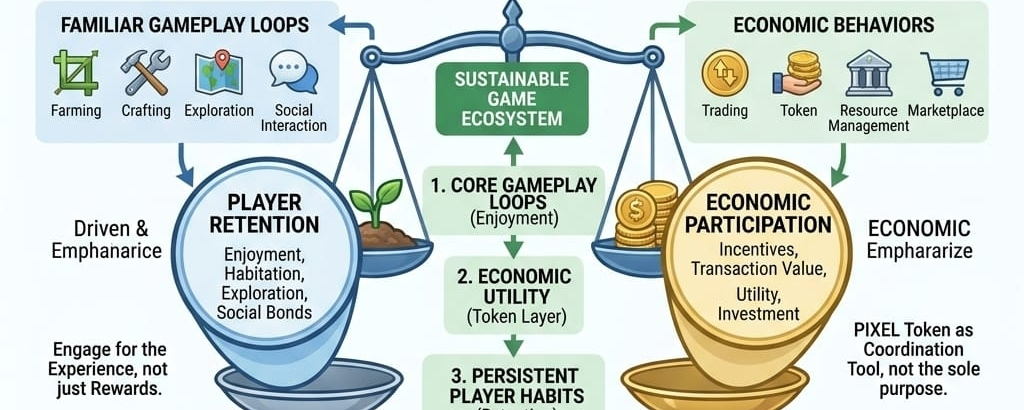
At the start, Pixels feels lightweight.
You log in, get your avatar, maybe farm on public plots, gather a few resources, and move on. There’s no pressure to own anything. No urgency to invest. You can exist entirely in the free layer of the game—using shared spaces, basic tools, and off-chain resources.
It feels accessible.
Almost intentionally casual.
And for a while, ownership doesn’t seem important at all.
Pixels lets you play without ownership—so that you feel the difference when it finally matters.
That difference doesn’t hit immediately.
It builds slowly.
You start noticing certain players operating differently. Not faster in a mechanical sense—but smoother. Their actions connect better. Their loops feel uninterrupted. They don’t wait for access. They don’t adjust around others.
They don’t adapt to the environment.
They control it.
That’s when ownership stops being abstract.
Pixels is built around a mix of shared and owned systems—public farming spaces alongside NFT-based land and assets that players can control and monetize.
And the gap between those two experiences is not loud.
It’s felt.
When you don’t own, you navigate.
You adjust to availability. You work around others. You accept inefficiencies as part of the experience. The game feels flexible—but also slightly constrained.
When you do own, that friction changes.
Not completely removed.
But redirected.
Now your decisions define the space instead of reacting to it. You choose what grows. You control how your time converts into output. The system starts responding to you instead of the other way around.
That shift is subtle—but it changes how you think.
Because ownership doesn’t just give you resources.
It gives you certainty.
And certainty is powerful in a system built on shared interaction.
This is where $PIXEL ties into the experience in a deeper way. It isn’t just used for upgrades or perks—it becomes the bridge between access and control. From land acquisition to premium features and governance, the token connects ownership to influence inside the ecosystem.
And once you understand that, your perspective shifts.
You stop asking “what can I do?”
You start asking “what do I control?”
That’s not a small change.
That’s a different way of engaging with the game entirely.
The interesting part is that Pixels doesn’t rush you into that realization.
It lets you exist without ownership long enough to normalize it.
So when you finally feel the difference, it’s not theoretical.
It’s personal.
And that’s what makes it effective.
Because instead of telling you ownership matters…
the game lets you experience why it does.
The tension, of course, is what comes next.
If ownership enhances gameplay, the system feels deeper.
If it dominates too much, the world risks splitting into those who control—and those who adjust.
Pixels is still balancing that line.
But the design choice is clear.
Ownership isn’t the starting point.
It’s the turning point.
And once you cross it, you’re not playing the same game anymore.




#JustinSunSuesWorldLibertyFinancial #KelpDAOExploitFreeze #MarketRebound #StrategyBTCPurchase