
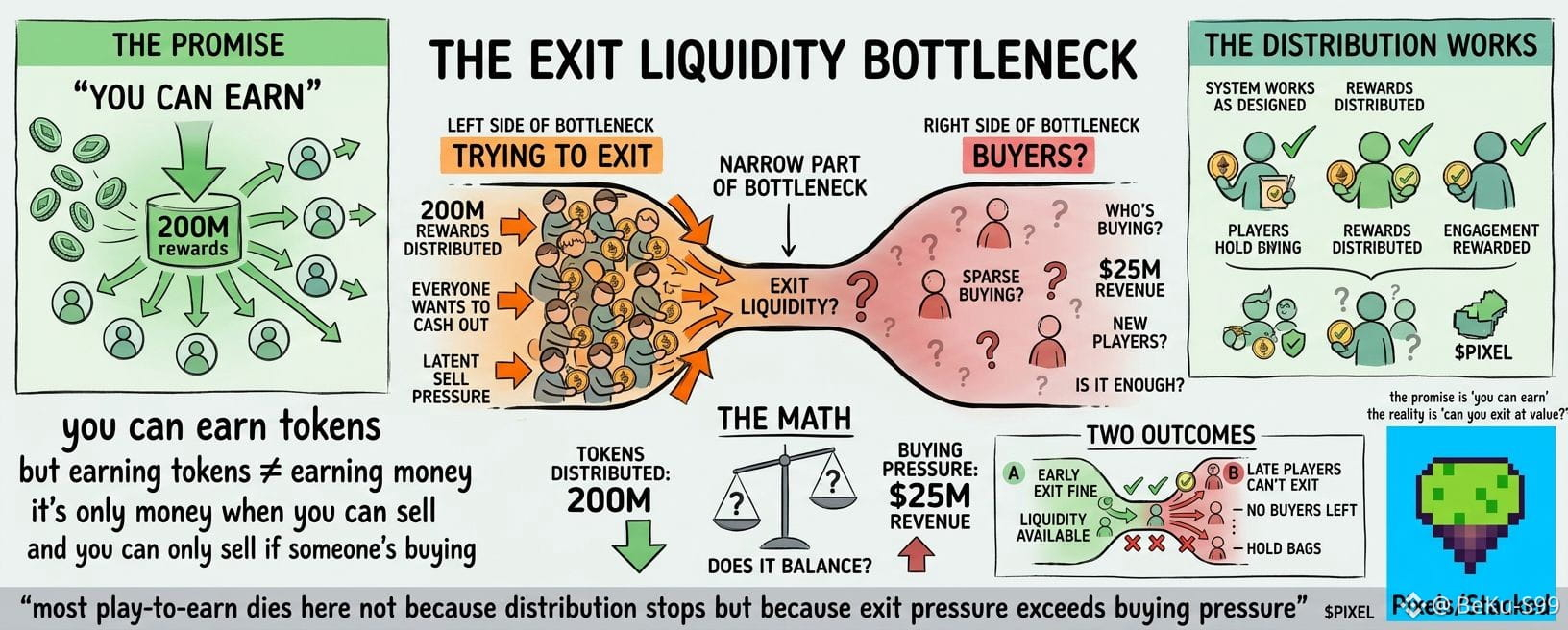
I keep watching @Pixels and trying to figure out if the promise that players can earn is meaningful when tested against the reality that earning tokens only becomes earning money if you can actually exit at reasonable value.
What I'm watching isn't whether Pixels distributes rewards. They do. What I'm watching is whether the system can absorb exit pressure when players try to convert tokens to actual money.
The exit liquidity problem in reward tokens.
Not the distribution narrative. The reality where "you can earn" is only half the equation. The other half is "you can sell what you earned." And you can only sell if there's sufficient buying pressure to absorb everyone trying to exit.
That's where most play-to-earn breaks down.
Pixels says they've distributed 200 million rewards. Players earned $PIXEL through engagement. The system works from the distribution side.
What I can't tell is whether it works from the exit side.
The challenge is that distributed tokens create latent sell pressure. Players don't earn tokens to hold them forever. They earn tokens to convert them to money. Every token distributed is a future potential sell order.
Most reward systems fail to account for cumulative exit pressure. They optimize for distribution. They create incentives that drive token earnings.
But they don't build systems that absorb the selling pressure when everyone tries to exit.
@Pixels has $25 million in revenue. That creates buying pressure. Players buy tokens to use in games.
That's better than most play-to-earn which relies entirely on new players buying tokens to fund old players exiting.
What I don't know is whether $25 million in revenue creates enough buying pressure to absorb 200 million distributed rewards when players try to exit.
The math matters. If more tokens are being distributed than being bought through revenue and new player entry, there's structural imbalance. Price drops. Rewards become worth less.
Most play-to-earn dies here. Not because distribution stops. Because exit pressure exceeds buying pressure and price collapses.
Maybe Pixels is different. Maybe revenue scales with distribution. Maybe cross-game utility creates additional demand.
Maybe it doesn't and this hits the same wall when cumulative distribution outpaces cumulative demand.
I'm watching to see which one.
What I'm particularly watching is price stability as distribution expands. If Stacked integrates more games and distribution increases but price stays stable, that suggests buying pressure is scaling. If price trends down as distribution expands, that suggests exit pressure is overwhelming buying pressure.
The stakes for players depend on exit liquidity. The promise is "you can earn." The reality for most players is "you can earn but you might not be able to exit at meaningful value."
Early players exit fine. There's always buying pressure when a system is new. New players entering. Speculators buying.
Late players face deteriorating exit conditions. More tokens distributed. More people trying to exit. Less new player growth. Weakening buying pressure.
That's the pattern in every reward system. Early participants capture value. Late participants hold bags.
Most crypto gaming teams don't talk about exit liquidity. They talk about how many rewards they distribute. How many players they have.
They don't talk about whether players can actually realize the value of what they earned.
The distinction matters because it determines whether "earning" is real or illusory. If you earn tokens but can't exit at meaningful value, you didn't really earn anything valuable.
Maybe Stacked's expanding ecosystem creates enough demand to absorb exit pressure. More games means more use cases. More reasons to buy and hold.
Maybe ecosystem expansion increases distribution faster than it increases demand. More games means more rewards flowing out. Demand doesn't keep pace.
What keeps me coming back is whether Pixels measures exit liquidity as a success metric. Most crypto gaming measures user acquisition, engagement, distribution volume. They don't measure whether players can successfully exit.
If you're not measuring exit success rates, you're not accounting for whether the promise you're making is actually deliverable.
I'd prefer reward systems that acknowledge exit liquidity as a constraint and build accordingly. Systems that limit distribution to what buying pressure can absorb.
I'm just not convinced most reward systems including Stacked can maintain exit liquidity when distribution scales to hundreds of millions of tokens.
The exit question's fundamental. You can distribute perfectly. If players can't exit at meaningful value, the distribution doesn't create real earnings.
And honestly, I trust teams that acknowledge exit pressure more than teams that focus exclusively on distribution volume.
