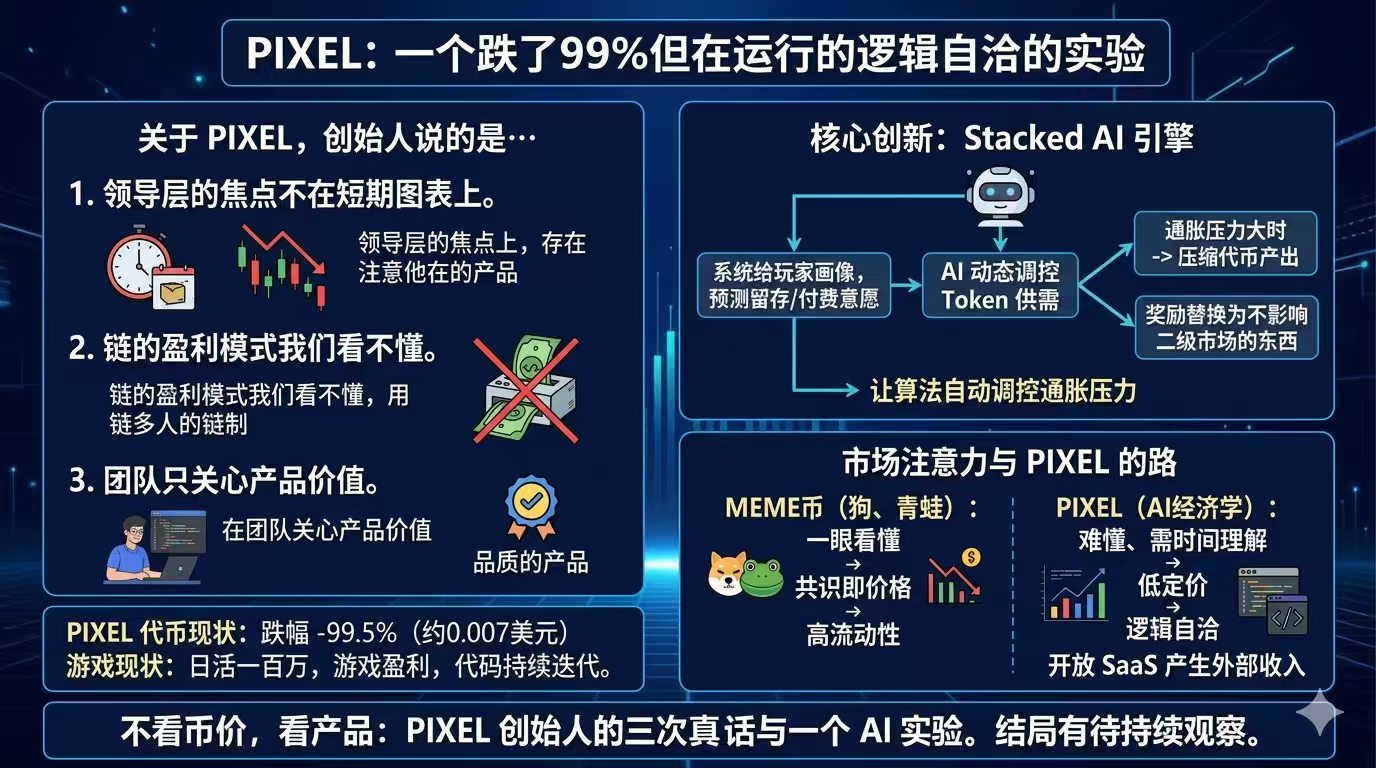
The founder of PIXEL spoke three truths. #以太坊基金会解质押4890万美元ETH
First thing, someone asked what’s going to happen with the price. He said the leadership's focus isn't on short-term charts.
Second thing, someone asked why he doesn’t launch his own chain. He said, we don’t understand the profit model of the chain.
The third thing he said in another interview was that the team only cares about product value.
In an industry where project quality is measured by the thickness of whitepapers, these words come off as almost offensive.
This project is called @Pixels , the token PIXEL, has dropped from $1.02 to $0.00474, a staggering 99.5% drop. By market standards, the back of such a candlestick typically reads 'dead'. But it’s not dead. With a million daily active users, the game is profitable, the team keeps coding, and the founder continues to speak the truth in AMAs.
This contrast deserves to be documented seriously.
I took some time to understand what it's doing. Pixels developed an AI engine called Stacked to regulate the supply and demand of in-game tokens. The way it works: the system profiles each player, predicts retention and willingness to pay, and then dynamically allocates tokens or item rewards. When inflation pressure rises, the AI automatically compresses token output, replacing rewards with items that won't impact the secondary market.
Traditional chain game inflation control relies on manual parameter tweaks by planners, which is essentially just guesswork. Here, they've switched it up and let algorithms take over. The effectiveness remains to be seen, but the approach itself is quite uncommon.
Now, back to those three truths.
'Not looking at short-term charts' is considered heretical in the crypto world. In this industry, the time unit is days, hours, minutes. If a founder dares to say they don't look, they are either lying or genuinely focusing their attention elsewhere. Considering what they're doing—developing an AI engine, offering SaaS services, maintaining a million daily active users—I haven't found any evidence of lying at least for now.
It's even rarer to hear 'I don't understand the profit model of the chain.' In a bull market, launching a chain is the quickest way to mint money. Trading volume, Gas fees, ecosystem projects—each one is narrative fuel. If a project with a decent user base chooses not to go down this path, claiming 'I don't understand,' those three words in a frenzy period translate to actively giving up a shortcut to boost valuation.
This leads to another observation: 'Being able to understand' is liquidity in itself.
Why is MEME rising? Because it's instantly understandable. A dog, a frog, a joke. The entry barrier is zero, and consensus equals price.
Why is PIXEL dropping? Because very few people understand what it's doing. AI regulating token economics requires comprehension to believe, and understanding takes time.
The market gave MEME high liquidity and PIXEL a low price point. This isn't about right or wrong; it's the way the market allocates attention.
But there's a noteworthy phenomenon: Pixels has opened its Stacked system for use by other chain game projects, starting to generate external revenue. A tool created for self-rescue is turning into a sellable business. This pivot interests me more than its token price.
Objectively speaking, PIXEL's price is still quite low, currently around $0.007. A large number of tokens are still locked, and future unlocks will bring new selling pressure. Its long-term value depends on whether this AI engine can continue to evolve and if the user base continues to grow. None of this is certain.
This article isn't a conclusion; it's a record. A project that has dropped 99% but is still operational, a founder who spoke three truths, and an experiment that's been ignored by the market yet logically coherent. I don't know how it will end. Precisely because I don't know, this case is worth ongoing observation.