
There’s something subtle about systems that feel open at first.
When you enter them, everything seems fair. You can move freely, participate without restriction, and progress at your own pace. There are no obvious walls, no hard limitations, nothing that clearly tells you that you can’t go further. It feels smooth, almost welcoming.
But over time, that perception begins to shift.
You’re not blocked. You’re just slightly slower than you expected. Not enough to frustrate you immediately, but enough to make you feel like something is off. You complete the same actions as others, follow the same loops, and still find yourself just a step behind an invisible rhythm.
This kind of experience isn’t unique to games. It’s something that shows up in markets as well.
Two traders can observe the same setup at the same moment. One enters cleanly and captures the move, while the other hesitates for a fraction of a second and watches the opportunity disappear. The difference, in that moment, rarely comes down to knowledge or even skill. It comes down to positioning and the ability to act without delay.
That same pattern quietly exists inside Pixels.
At first glance, Pixels feels like a relaxed GameFi environment. The loop is simple and almost calming. You farm, collect, wait, and repeat. There’s no urgency pushing you forward, no pressure forcing optimization. You can engage casually and still feel like you’re making progress.
And that’s exactly what makes it easy to overlook what’s really happening beneath the surface.
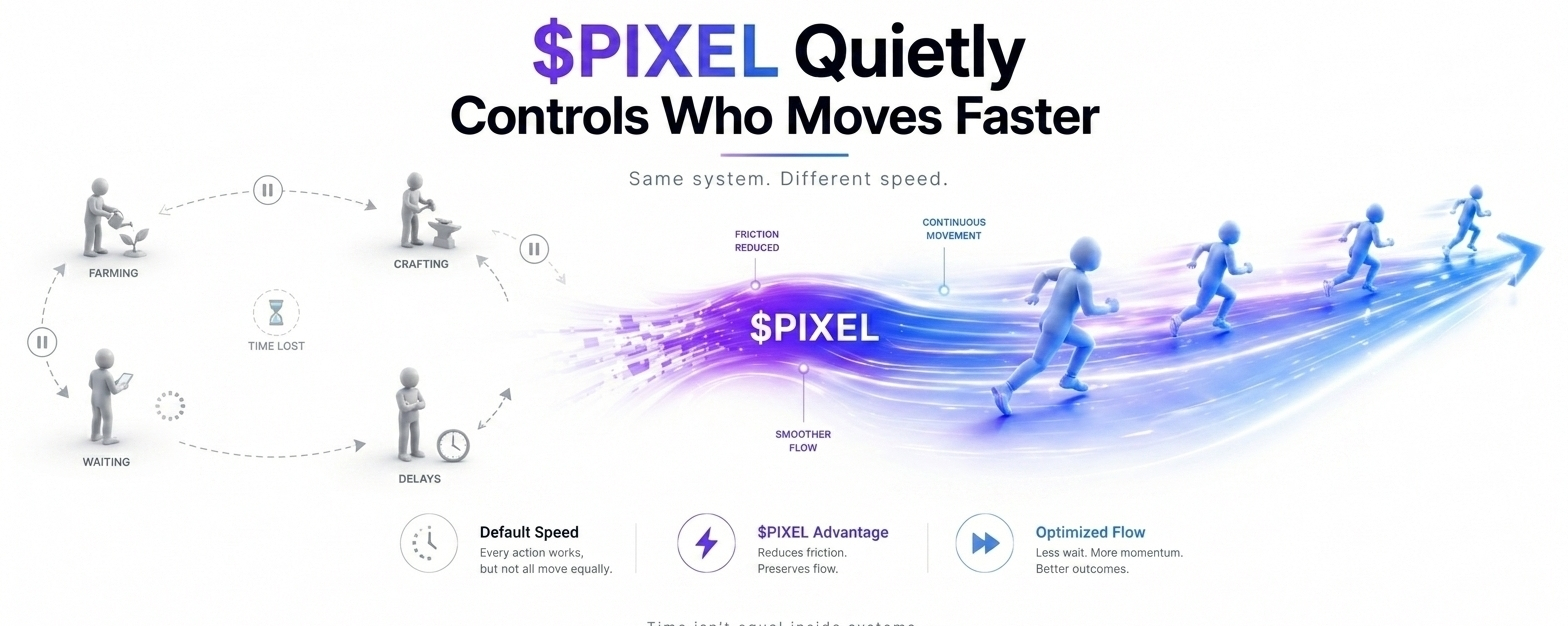
If you spend enough time inside the system, not just playing but observing, a different behavior starts to emerge. Players are not actually focused on maximizing rewards in the way you might expect. Instead, they begin to focus on how smoothly they can move through the system.
The real objective becomes flow.
People naturally start trying to reduce interruptions. They look for ways to avoid waiting, to minimize pauses, and to keep their cycles running without disruption. The goal shifts from simply producing more to maintaining continuity.
This is where $PIXEL starts to take on a different meaning.
It doesn’t act like a typical reward token that aggressively pushes itself into every part of the experience. It doesn’t constantly demand attention or force usage. Instead, it operates quietly, almost invisibly, influencing something much more subtle.
It shapes how friction behaves.
You can ignore it and still participate in the system. Nothing stops you from progressing. But by doing so, you are experiencing the system at its default speed. That default speed is functional and fair, but it is not optimized.
The difference between default and optimized isn’t dramatic at first. It shows up in small ways. Slight delays, minor interruptions, tiny breaks in your flow. Each of these moments feels insignificant on its own.
But systems are built on repetition.
When those small inefficiencies repeat over and over again, they stop being small. They begin to define your entire experience. Some players start moving through the system almost continuously, with minimal interruption. Others remain caught in a loop where progress is constantly paused, even if only briefly.
Over time, this creates separation.
Not because one group is working harder or producing more, but because one group is losing less time. That difference, while subtle, compounds into something meaningful.
This kind of structure is not unfamiliar. In blockchain systems, for example, transactions are not blocked, but they are not treated equally either. When demand increases, speed becomes something that can be influenced. Those who are positioned better move faster through the system.
Pixels reflects a similar idea, but in a much softer and less visible way.
There is no explicit moment where the system tells you that you need $PIXEL. Instead, the realization develops gradually. You begin to notice where time is being lost. You start adjusting your behavior. Eventually, you look for ways to eliminate inefficiencies altogether.
That’s where demand begins to form.
Not through a single decision, but through a series of small, repeated choices. A player decides to skip a delay, then to speed up another process, and then to smooth out another part of their loop. Each decision feels minor, but together they reshape how the system is experienced.
Over time, the system reveals what it truly values.
It doesn’t directly reward output. It rewards how efficiently that output is produced. Two players can reach similar results, but one does it with fewer interruptions and less wasted time. That player gradually gains an advantage, not by doing more, but by moving more cleanly.
Time becomes the real resource.
$PIXEL simply exists alongside it, quietly influencing how it is used.
What makes this design particularly interesting is how subtle it is. The system doesn’t feel unfair. Access remains open, and participation is available to everyone. But not everyone operates under the same conditions, even if it appears that way on the surface.
This creates a hidden layer within the system.
It is not a visible hierarchy, but it functions like one. Some players operate close to an optimal state, where their flow remains uninterrupted. Others continue within the default loop, where small inefficiencies persist.
That difference is easy to ignore in the beginning, but it becomes harder to overlook as it compounds over time.
From a broader perspective, this shifts how the token should be understood.
$PIXEL is not just a reward mechanism, and it is not simply a currency within the game. It behaves more like a tool for positioning. It allows players to move closer to the system’s ideal operating state, where time loss is minimized and flow is preserved.
In most systems, positioning is what ultimately determines outcomes.
Whether in markets, infrastructure, or game economies, those who operate with less friction tend to move further over time.
The long-term impact of this design depends on how it evolves. If the gap between default and optimized becomes too visible, it could create tension. If it remains subtle, it may continue shaping behavior quietly, without resistance.
At the moment, it exists somewhere in between.
Easy to overlook at first, but difficult to ignore once you begin to notice it.
Most people approach tokens by asking what they can gain from them. But in systems like this, the more important question might be what they allow you to avoid.
Because sometimes, value is not created by adding more.
Sometimes, it comes from removing what slows you down.
And that is where Pixel becomes truly interesting.
