

A few weeks ago, I hit a wall trying to set up a simple automated trading setup. I wanted something that could handle basic strategies, pull real market data, and actually move funds without me babysitting every step. Traditional finance? Forget it. Banks and brokers still treat you like a suspect—endless KYC loops, API approvals that take days, and zero visibility into what’s happening behind their walls. I was refreshing dashboards, second-guessing every delay, and feeling that same old low-level frustration I’d had years back when a buddy sent me cash that vanished into banking limbo for three days.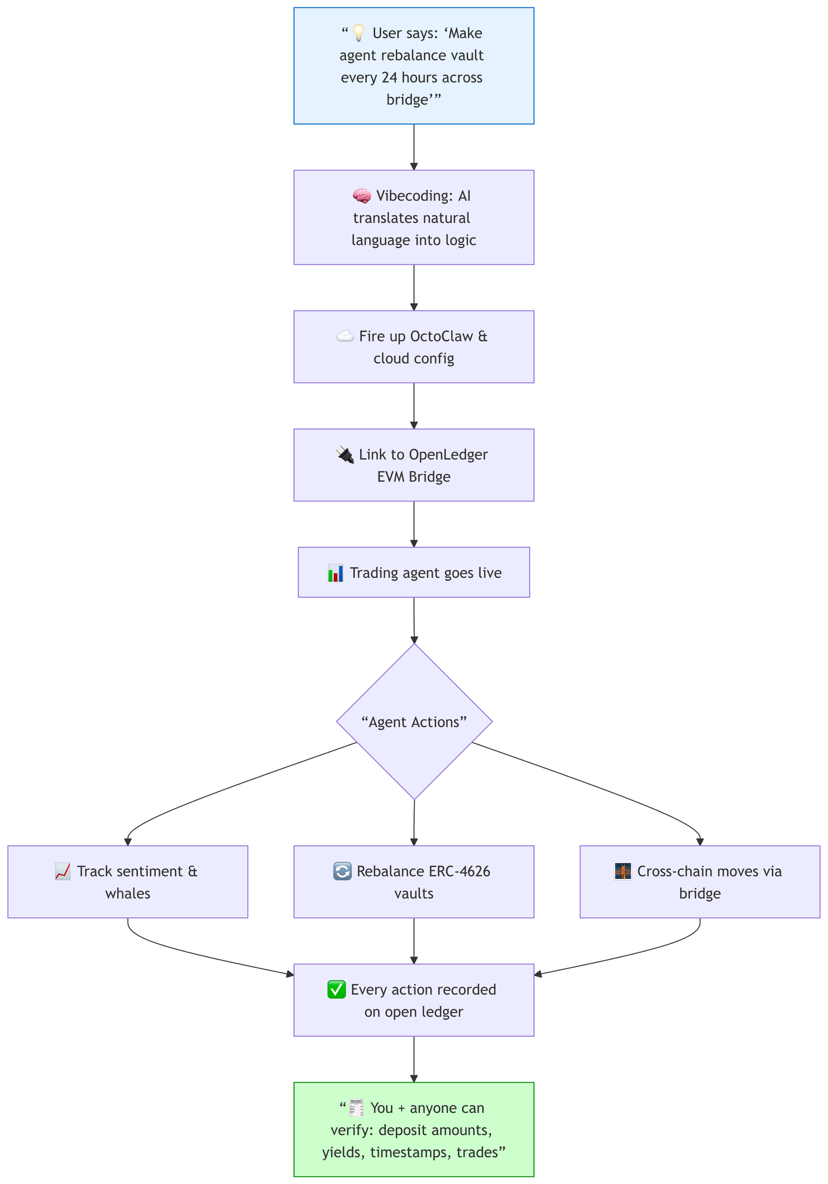
That’s when I decided to try something different. I’d been hearing about OpenLedger’s new OctoClaw launch, so I downloaded it, fired up the cloud config, and started piecing together a real trading agent. No corporate gatekeepers. No waiting for someone else’s approval. Within an hour I had it running—integrated an ERC-4626 vault for yield strategies, linked it straight to the OpenLedger EVM Bridge for cross-chain moves, and used straight vibecoding (just chatting natural instructions to the AI) to make the whole thing click. It wasn’t perfect at first; I had to tweak the cloud config twice and debug one bridge call. But every single step was visible on the open ledger. No black box. No “trust us.”
That experience flipped my whole thinking on money and tech. An open ledger isn’t some abstract blockchain nerd thing—it’s the only system I’ve ever used that actually treats you like an adult who deserves to see the full picture. You send a transaction, it lands on the public record in seconds, and anyone (including you) can verify it forever. No more “pending” purgatory. No more wondering if the middleman skimmed a fee or rerouted your funds.
What surprised me most was how naturally the AI side of it fit. OpenLedger isn’t just another chain; it’s built from the ground up for this exact blend of AI agents and real economics. OctoClaw lets the agent analyze sentiment, track whales, and execute trades in real time—stuff that used to require a team of devs and a fat enterprise contract. I watched my test trades settle on-chain with full ERC-4626 transparency: deposit amounts, yields, everything timestamped and immutable. And because it’s all on an EVM-compatible open ledger, the vibecoding felt effortless—I literally described what I wanted (“make the agent rebalance this vault every 24 hours across the bridge”) and the AI handled the rest. No sterile code reviews. Just results you could audit yourself.
Look at the numbers if you want proof it’s not hype. OpenLedger raised $8 million from Polychain and Borderless early on, ran a testnet with over a million users, and now has real traction with agents like OctoClaw already live and executing on-chain workflows. That’s not vaporware—that’s infrastructure people are actually using to move real economic value.
The deeper I got, the more it hit me: this is what financial dignity actually looks like. In the old world, your trading activity disappears into a bank’s private database. Here, every move is part of a shared, verifiable story. A grandmother in one country gets remittance proof the same second a donor in another sees it. An AI agent executes a strategy and you can point to the exact block that shows it happened exactly as intended. No more “the system was down” excuses. No more hidden fees quietly eroding your edge. Just math, transparency, and your own copy of the truth.
I’m not saying open ledgers fix everything. Gas fees, learning curves, and regulatory noise are still real. But they solve the core problem I’ve always hated: the feeling that your money—and now your AI-powered decisions—belong to someone else. OctoClaw on OpenLedger made that abstract idea concrete for me. I configured the cloud, vibecoded the bridge integration, set the trading agent loose on ERC-4626 vaults, and for the first time felt like I was participating in the economy instead of just showing up to it.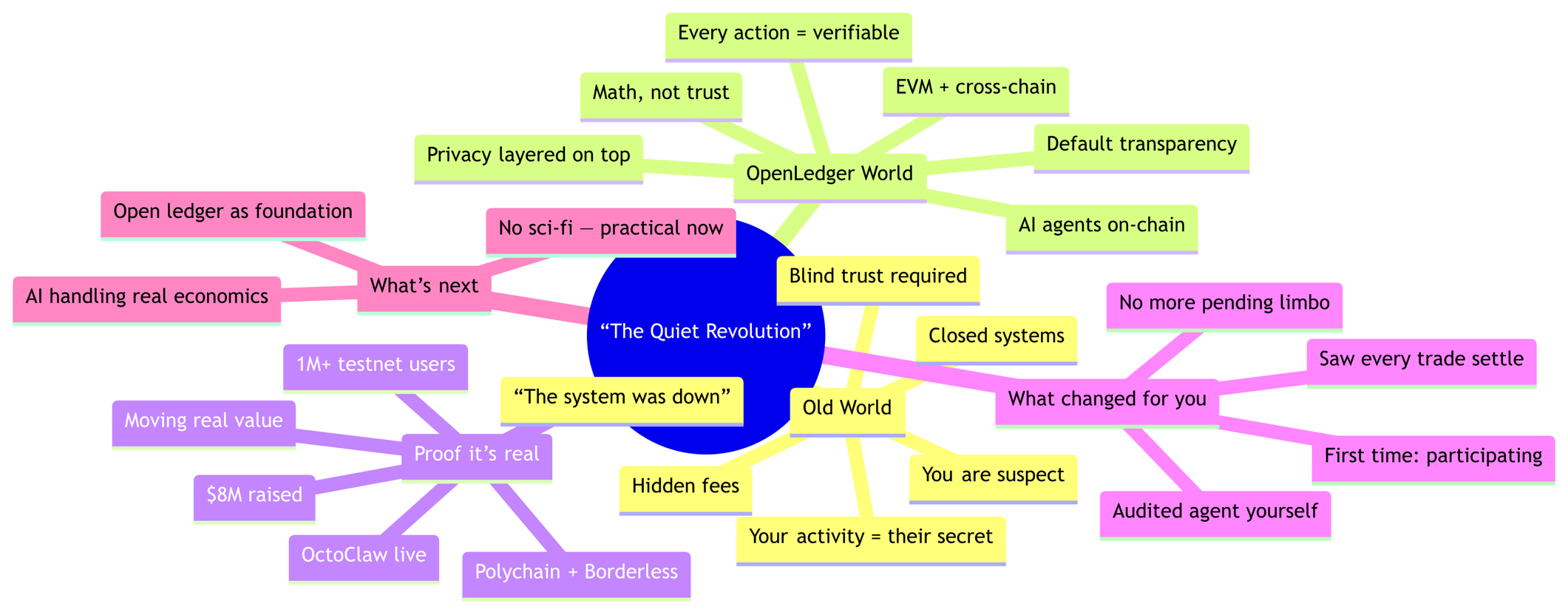
That’s the quiet revolution. We’ve spent years building closed systems that demand blind trust. Open ledgers flip it: default transparency, with privacy layered on top when you need it. And when AI agents start handling real economic work on top of that foundation? That’s not sci-fi. That’s the practical next step for anyone tired of opaque finance.
What about you—have you tried handing real economic tasks to an AI agent on a public ledger yet, or are you still stuck refreshing bank apps?
