
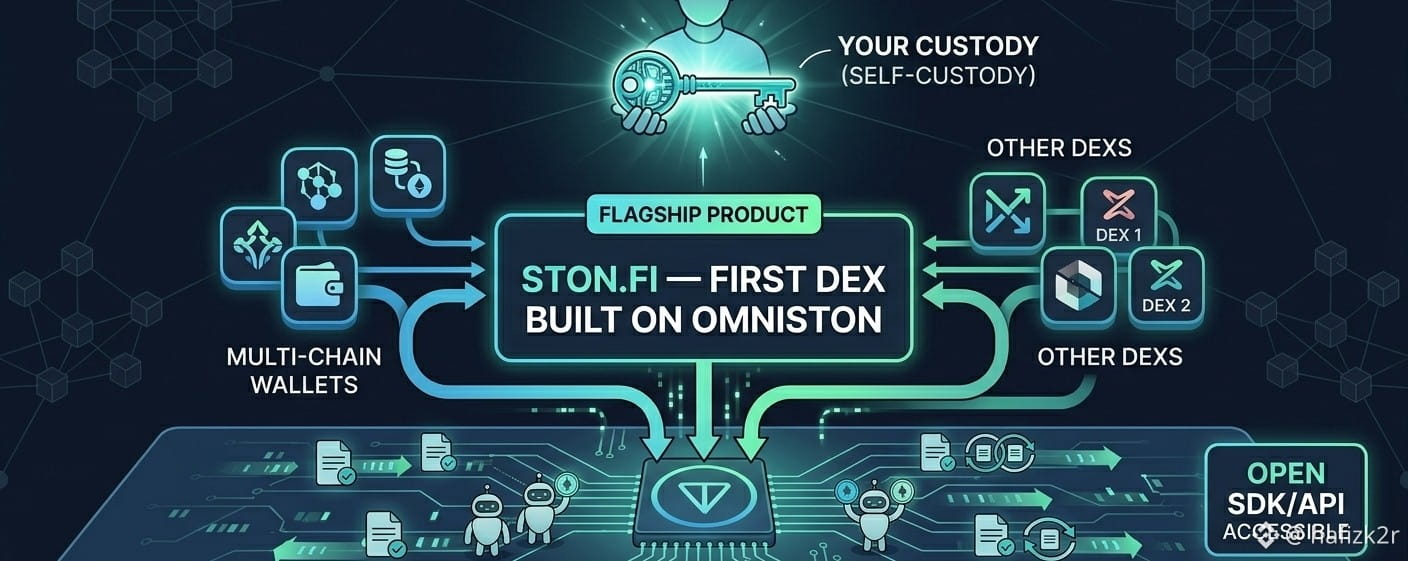
When a groundbreaking new technology hits decentralized finance (DeFi), it is easy to focus entirely on the first app that uses it. For example, when looking at Omniston, which is the revolutionary cross-chain protocol that allows users to swap crypto between different blockchains without using risky bridges, it is natural to immediately look at STON.fi.
But STON.fi is actually just the tip of the iceberg. To understand the true power of this new architecture, it helps to understand exactly where STON.fi fits into the equation, and how an entire ecosystem of developers can build on top of it.
The Blueprint: STON.fi as the Pioneer
A common point of confusion is the relationship between the tech and the platform. To put it simply: **STON.fi Dev built Omniston, and STON.fi is the very first product built on top of it.
Think of Omniston as a powerful new engine, and STON.fi as the first sports car built to showcase what that engine can do. STON.fi acts as the highly visible, user-friendly interface where traders can easily click "Swap" to execute native cross-chain transactions. Underneath that simple dashboard, however, Omniston is doing the heavy lifting coordinating independent liquidity providers (Resolvers) and cryptographic smart contracts (HTLCs) to ensure your funds stay perfectly safe.
Because STON.fi is open about its layout, it serves as a live, real-world proof of concept showing the global DeFi community that vaultless cross-chain trading isn't just a theoretical idea but it works in practice.
Open for Everyone: What Integrators Can Build
Omniston was never intended to be a closed sandbox exclusive to one platform. It is an open, permissionless execution layer. This means any developer, startup, or existing crypto project can hook into Omniston’s infrastructure via its **SDK or API** to completely skip the headache of building secure cross-chain tech from scratch.
Because Omniston sits quietly in the background underneath products, here is a look at what other integrators can build on top of it:
Multi-Chain Crypto Wallets: Mobile and desktop wallets can integrate Omniston directly into their native interface. This allows everyday users to swap assets from entirely different blockchains (like moving stablecoins between TON and EVM networks) without ever leaving the safety of their wallet app.
DeFi Aggregators: Trading platforms that hunt for the best swap rates across the internet can route their orders through Omniston. Because Omniston features a marketplace where professional Resolvers actively compete on price quotes, aggregators can tap into deep, highly competitive liquidity on demand.
Non-Custodial Exchanges (DEXs):
Other decentralized exchanges can leverage the protocol to instantly offer cross-chain features to their users. They get to offer "all-or-nothing" security guarantees (where a user either gets their exact quoted tokens or a full refund) without needing to hold massive, dangerous vaults of user capital.
Building a Stronger, Fragmented Web3
Right now, the blockchain world is highly fragmented; assets on the TON network are structurally isolated from assets on EVM networks.
By creating an open infrastructure protocol, STON.fi Dev isn't just building a standalone trading platform. They are handing a toolkit to the entire Web3 community. As more wallets, dApps, and exchanges integrate Omniston into their backends, the entire ecosystem inches closer to a future where blockchains talk to each other seamlessly, all while keeping user custody firmly in
the hands of the users.
Check the official blog at https://blog.ston.fi/omniston-explained-how-cross-chain-swaps-on-ton-work-without-a-bridge/
Or
Ston.fi