
Nokia (NOK): The AI-RAN comeback, is this a real reversal or just hype?
Let's get straight to the point
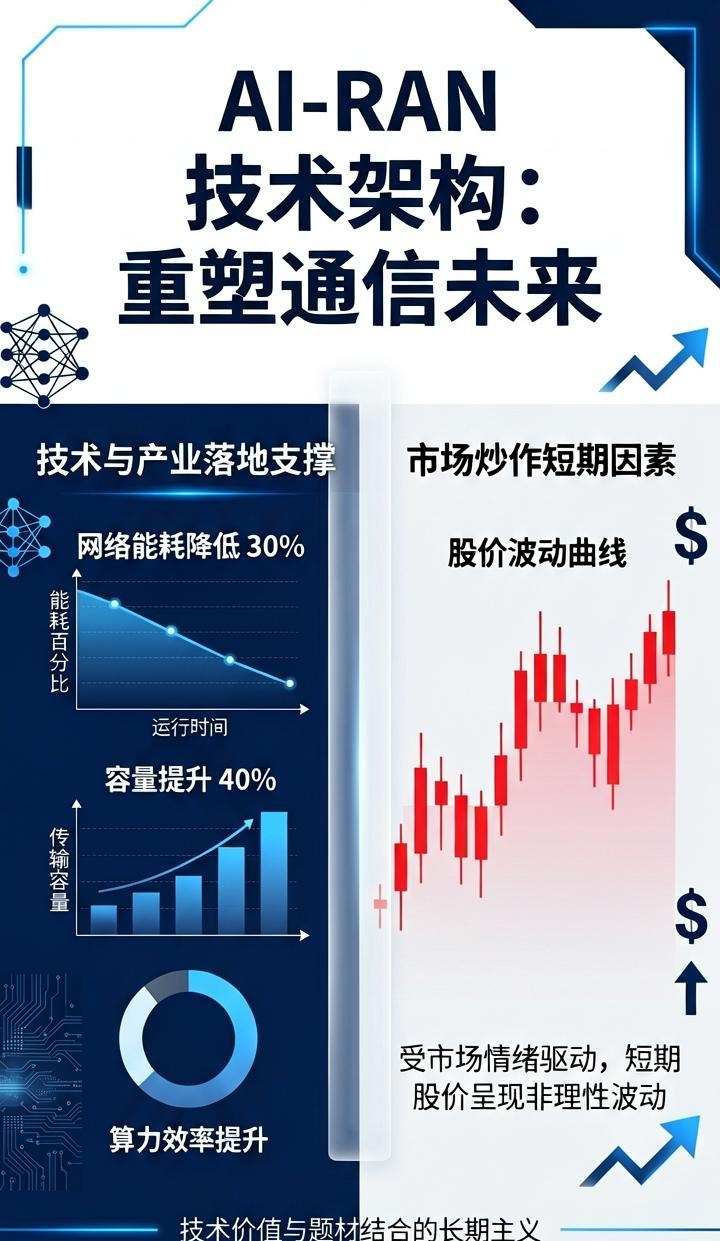
Nokia's recent surge isn't just pump and dump. Nvidia dropped a cool $1 billion for a stake, Q1 AI-related sales shot up by 49%, and their optical network division is riding the wave of data center interconnect demand—these are solid numbers backed by real orders. But here’s the catch: AI currently only makes up 8% of Nokia's total sales, and the traditional telecom biz is still the heavyweight and a drag. The market is pricing Nokia as an AI infrastructure play, but at its core, it’s still a telecom equipment company just pivoting towards AI.
Currently around $13.5, is it worth chasing? I'll analyze, you decide.
1. NVIDIA's $1 billion stake: This isn't just about the money.
On October 29, 2025, NVIDIA announced a $1 billion investment in newly issued Nokia shares at $6.01 per share, gaining 2.9% ownership. On the day the news broke, Nokia's stock price in Helsinki surged more than 20%, marking the largest single-day increase since 2000 — the last time such a spike happened was when Nokia announced capturing one-third of the global mobile market.
But this isn't just a financial investment:
NVIDIA isn't investing in Nokia's financials; it's backing the AI-RAN (AI-driven Radio Access Network) space. The collaboration includes:
AI-native 5G-Advanced and 6G networks: Nokia is deeply integrating 5G/6G RAN software with NVIDIA's AI architecture, transforming the network from a 'dumb pipeline' to 'smart infrastructure.'
Data center network interconnect: Nokia's optical switching and data center communication products will be included in NVIDIA's own AI infrastructure design.
AI-RAN field testing: T-Mobile US is involved in managing and testing the AI-RAN technology framework, expected to launch in 2026.
6G ahead: Nokia's CEO Justin Hotarde has made it clear — 'This isn't just an upgrade from 5G to 6G; it's a fundamental redesign of the network.'
Why is NVIDIA investing in Nokia?
AI inference requires GPU clusters, but these clusters need high-speed network interconnects. NVIDIA's own NVLink and InfiniBand handle interconnects within servers and racks, but high-speed connections across data centers and wide area networks still require RAN technologies from telecom equipment vendors like Nokia and Ericsson. By bringing Nokia into its AI infrastructure ecosystem, NVIDIA has effectively planted a flag in the AI network layer.
McKinsey predicts that by 2030, capital expenditure on data center infrastructure will exceed $1.7 trillion — largely driven by AI. Nokia is vying for a piece of that pie.
2. The stock price has risen 141%, where does it stand now?
As of June 11, 2026, NOK's stock price is about $13.40 to $13.85, having pulled back from a high. From the beginning of the year to May 26, it's had a cumulative increase of 141.45%, and last week due to a surge in demand for data center optical communication equipment, it spiked 9.1% in a single day, marking the highest closing price since 2009.
Current valuation data:
Indicators Value Total Market Cap around $74.9 billion Price-to-Book (P/B) 3.09x Price-to-Earnings (TTM) around 81x Earnings Per Share (TTM) $0.165 12-Month Expected P/E around 36x (around 17x at the beginning of the year)
The core of the valuation controversy lies here: The market is re-pricing Nokia from a 'traditional telecom stock' to an 'AI infrastructure stock,' so the 12-month expected P/E has risen from 17x to 36x. However, the AI business currently only accounts for 8% of total sales. Supporters say this is pricing in future growth early, while opponents argue this is selling future stories at present value.
The statement from BNP Paribas analysts is the most accurate — 'Investors are starting to believe that Nokia may be hiding a 'mini Arista' and 'mini Ciena.' But he also emphasized: 'The traditional Nokia hasn't disappeared.'
3. AI business performance: Is the 49% growth real?
This is the most critical question in analyzing Nokia.
**AI-related sales grew 49% in Q1**: This is a real number, but the base isn't large. The AI business mainly includes data center optical networking equipment, cloud service provider networking solutions, and AI-RAN software. The 49% growth is year-on-year data, indicating demand is accelerating.
Acquisition of Infinera to strengthen optical networking: After completing the acquisition of Infinera in early 2024, Nokia will rank among the largest optical network equipment suppliers globally. AI data center clusters require super high-speed optical interconnects, and Infinera's technology perfectly fills this demand. This is the most tangible asset in Nokia's 'AI transformation.'
In April, the cloud business unit's performance guidance was raised: Management proactively raised the full-year guidance for the cloud customer business unit in April, indicating that corporate demand is stronger than initially expected.
But there's also a cold reality: Core mobile network business accounts for over half of total sales, but profit margins are lower than AI-related businesses. Telecom operators are cutting capital expenditures, and the U.S. market has lost key contracts — these issues won't be solved by just shouting AI slogans. AI business is incremental, but the legacy telecom business is holding it back.
4. July earnings report preview: Key verification points.
Nokia is set to release its Q2 earnings report in late July 2026. This will be the first 'report card' following the stock price surge and is the most important checkpoint for verifying the AI narrative.
Key indicators to watch:
AI/cloud business revenue share: Currently 8%, is there potential for increase? Wall Street hopes to see the ratio expand.
Cloud business unit revenue growth: Guidance has been raised; will Q2 actual growth exceed expectations?
Q2 overall profit margins: Can traditional telecom business profit margins hold steady, or is AI business expansion squeezing overall profitability?
AI-RAN order progress: Are there any new telecom operator customers signing contracts?
Management's update on full-year guidance: Will there be another upward revision of cloud business or AI business guidance?
Historical pattern: Nokia's Q2 earnings reports are typically released in late July. If AI business data continues to exceed expectations, the stock price may see a second wave of momentum in Q3; if AI business growth slows sequentially, the market may reassess the reasonableness of the 36x P/E.
5. Target price of $20: Is it achievable?
Currently, Wall Street's average target price for Nokia is still about 25% lower than the current price, with less than half of analysts giving a 'buy' rating. This is a warning signal — institutions are not fully bullish.
Reasons for bullishness on $20:
Demand for interconnect in AI data centers is exploding, and optical networking is seeing sustained high growth.
NVIDIA's endorsement is akin to giving Nokia's AI transformation a stamp of approval.
6G commercialization is expected between 2028-2030, giving Nokia a first-mover advantage.
If the AI business share increases from 8% to over 20%, overall valuation could be re-rated.
Currently over a 50% valuation discount compared to Ciena, there is room for recovery.
Reasons for skepticism about $20:
P/E has reached 80x (TTM), with TTM EPS of only $0.165 — valuation is highly dependent on future performance growth.
Traditional telecom business growth is limited, 5G construction is maturing, and operators' capital expenditures are under pressure overall.
AI business accounts for only 8%; can the 'AI stock' premium be sustained?
Institutions are not fully bullish yet; average target price is below current price.
Sondre Solvoll Bakketun, manager of the Skagen Vekst fund, has publicly stated, 'I have significantly reduced my position in Nokia over the past few months,' believing the current price risk-reward is no longer attractive.
My judgment: $20 isn't impossible, but the path is very narrow — AI business must continue to increase its share, cloud business guidance needs to be raised, and Q2 earnings must exceed expectations; all three are indispensable. If any one falls short, support around $13.5 could break.
6. Horizontal comparison of three telecom equipment vendors.
Dimension Nokia (NOK) Ericsson (ERIC) Samsung Electronics (005930) AI Business Growth Q1 +49% Limited Semiconductor Business Explosion NVIDIA Collaboration ✅ AI-RAN $1 billion ❌ ❌ Optical Network Layout Acquisition of Infinera Weak Display/Semiconductor Horizontal 5G Market Share Approximately 25% Globally Approximately 25% Limited Current P/E (TTM) ~81x Relatively Low ~10x (semiconductors drag down) Year-to-Date Increase +141% Limited +Significant Increase Target Price vs Current Price Wall Street is bearish by 25% Unclear Unclear
Ericsson and Nokia are in similar situations, but Ericsson lacks NVIDIA's AI-RAN collaboration and doesn't have Infinera's optical network layout. For now, Nokia is the only player in the 'AI telecom infrastructure' niche backed by a top-tier AI company.
7. Risk warning: Where are the biggest pitfalls?
1. Valuation bubble risk: A stock price increase of 141% over the year, with a P/E skyrocketing to 80x; if Q2 earnings show a slowdown in AI business growth, a correction could be severe. Amanda Lyons, head of research at Energy Group Capital, stated bluntly: 'The easiest phase of valuation re-rating has already passed.'
2. AI capital expenditure cycle risk: History has shown multiple times that after capital expenditure bubbles burst, related stocks can undergo significant corrections. Nokia's AI business benefits from tech giants' AI infrastructure investments, but will these investments be cyclical?
3. Legacy business drag: Mobile network business accounts for over half of total revenue, but profit margins are low and growth is weak. The AI business is a highlight, but the fundamentals of the core business show limited improvement.
4. Increasing competition: Ciena is a purer AI beneficiary in the optical networking field, but Nokia still has over a 50% valuation discount compared to Ciena. If the market believes Ciena is purer and more direct, its premium could suppress NOK.
5. Uncertainty in NVIDIA's collaboration progress: The $1 billion stake is a strategic commitment, but commercializing AI-RAN will take time. T-Mobile's testing is this year, not right now.
8. My judgment.
Nokia #NOKUSDT isn't junk, but $13.5 isn't a spot you buy casually.
The true value of this stock lies in its transformation from a traditional telecom equipment vendor to a key player in AI infrastructure. NVIDIA's endorsement is credible, and the 49% growth in AI business indicates rising demand. However, AI business currently only accounts for 8%, while traditional telecom business remains dominant, and an 80x P/E requires future performance to consistently exceed expectations.
Three operational strategies:
Conservative: Wait for the July Q2 earnings report to confirm that AI business growth hasn't slowed before re-entering. Missing this wave of gains is not regrettable; stepping on a landmine is what you should worry about.
Balanced: Current position can hold a small amount, but set a stop-loss — if Q2 earnings fall short of expectations or AI-RAN testing progress doesn't meet expectations, exit promptly.
Aggressive: Investors with strong conviction and confidence in the AI-RAN space can hold, target $20, but need to continually track changes in AI business share in Q2/Q3 earnings.
Honestly: Wall Street's average target price is 25% lower than the current price, and less than half of analysts are giving a 'buy' — this isn't a strong bullish signal. If I were a fundamentals player, I'd wait for the earnings report to decide. But if you've got a cost basis below $13.5, it's not too late to exit now.