

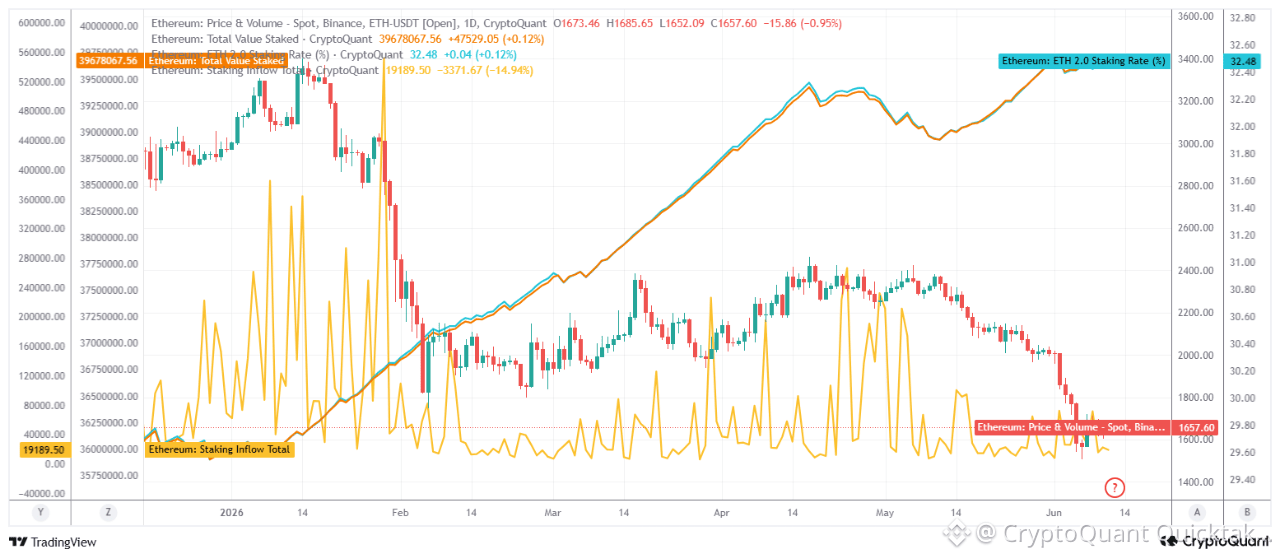
The chart shows that the amount of staked ETH continues to increase despite the recent price decline. While ETH fell from around $3,400 to the $1,650 region, total staked ETH rose from roughly 36 million to over 39.7 million ETH. This suggests that many investors prefer locking up their ETH rather than selling it.
The fastest price reactions are usually seen on Binance, where most whale and institutional activity takes place. That is why I primarily follow Binance price data.
As a result, Ethereum’s long term liquid supply continues to tighten. While this alone does not guarantee higher prices, it remains a structurally bullish factor.
Staking activity has also remained relatively stable, with no major inflow or withdrawal waves recently. If investors expected significantly lower prices ahead, a decline in the staking ratio would likely be visible. Instead, the staking ratio remains near record highs at around 32.5%, meaning nearly one third of the circulating ETH supply is locked.
A shrinking liquid supply can amplify future price recoveries if demand returns. However, price action still shows lower highs and lower lows, meaning the short term trend remains bearish and a confirmed bottom has not yet formed.
A notable divergence has developed: staked ETH keeps rising while price keeps falling. Such divergences rarely last forever. Either price eventually catches up with the ongoing accumulation and recovers, or macroeconomic pressure persists and keeps ETH under pressure for longer.
My view is that ETH may be approaching a bottoming phase. Although the short-term trend remains weak, long-term investor behavior does not support a strongly bearish outlook. The steady rise in staked ETH suggests that on-chain selling pressure is not increasing.
Based solely on this data, the probability of consolidation and a gradual recovery appears slightly higher than the probability of an accelerated sell off in the coming weeks.
Written by PelinayPA