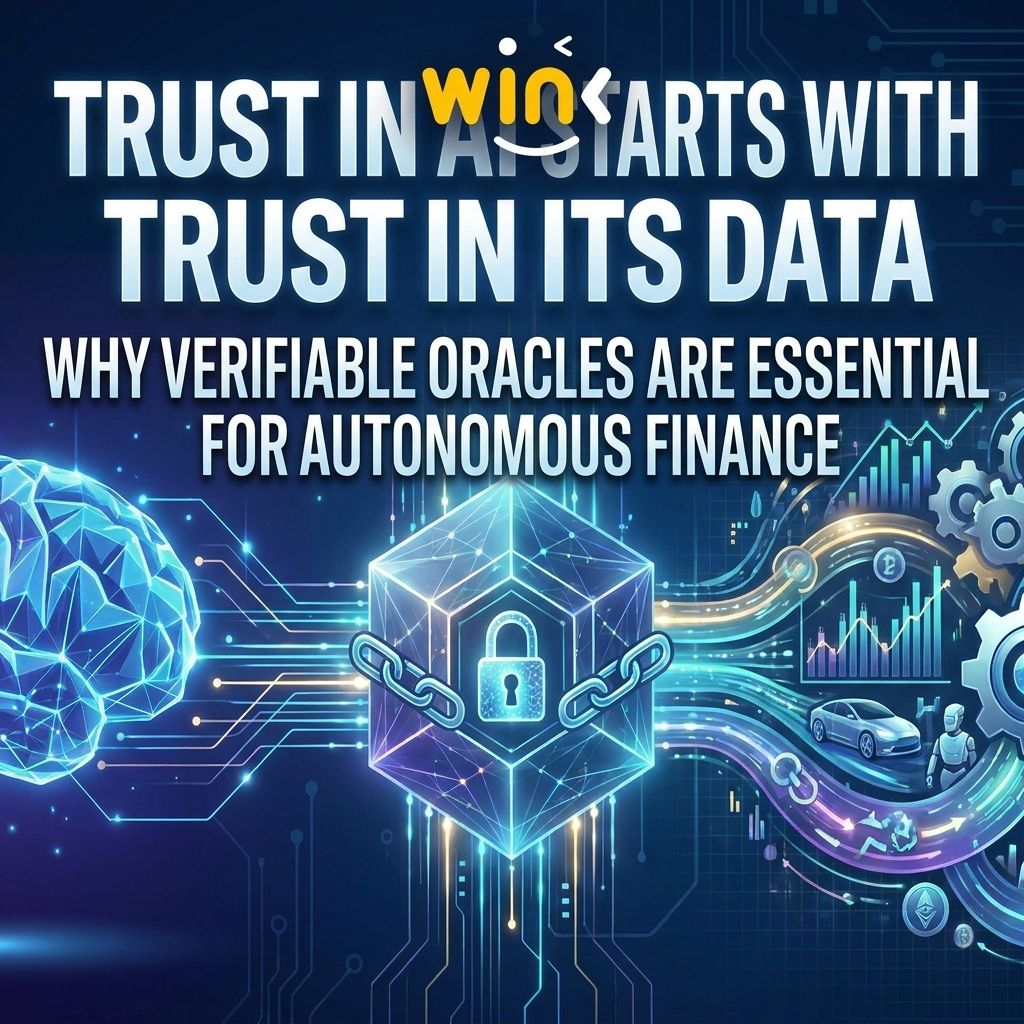
Artificial intelligence is rapidly becoming a key component of the digital economy. From managing investment portfolios to executing payments and interacting with decentralized applications, AI agents are beginning to make financial decisions with little or no human intervention.
But an important question remains:
If an AI agent can move your money, yet you cannot verify where its data comes from, would you trust it?
The answer highlights one of the biggest challenges facing the next generation of Web3 infrastructure: trustworthy data.
🔹 ① AI IS ONLY AS RELIABLE AS THE DATA IT RECEIVES
No matter how advanced an AI model becomes, its decisions depend entirely on the quality of its inputs.
If the underlying data is:
Inaccurate,
Delayed,
Manipulated,
Incomplete, or
Unverifiable,
then even the most sophisticated AI can produce incorrect or potentially harmful outcomes.
In financial applications, unreliable data can lead to poor investment decisions, incorrect asset pricing, or unintended execution of smart contracts.
🔹 ② BLOCKCHAIN ORACLES CREATE TRUSTED DATA PIPELINES
Smart contracts and AI agents cannot independently verify real-world information.
This is where decentralized oracle networks become indispensable.
Oracle infrastructure provides verified external data such as:
Cryptocurrency prices.
Interest rates.
Stablecoin reserves.
Market indices.
Sports and event outcomes.
Cross-chain information.
Real-world asset data.
By delivering transparent and tamper-resistant information on-chain, oracles become the trusted bridge between artificial intelligence and decentralized finance.
🔹 ③ VERIFIABILITY IS THE FOUNDATION OF AUTONOMOUS FINANCE
As AI agents begin managing wallets, executing trades, allocating liquidity, and interacting with decentralized protocols, every decision must be supported by verifiable information.
Key requirements include:
Transparent data sources.
Cryptographically verifiable updates.
Decentralized validation.
Real-time availability.
Resistance to manipulation.
Without these safeguards, users would have little confidence that autonomous systems are acting on accurate information.
🔹 ④ THE FUTURE OF AI AND WEB3 DEPENDS ON TRUSTWORTHY INFRASTRUCTURE
The convergence of artificial intelligence and blockchain has the potential to transform global finance. Autonomous agents may soon negotiate contracts, optimize portfolios, process payments, and interact across decentralized ecosystems without constant human oversight.
However, intelligence alone is not enough. The success of AI-powered finance depends on the integrity of the data that drives every decision. Reliable oracle networks provide the transparency and verification needed to ensure that AI operates on trustworthy information rather than assumptions or manipulated inputs.
As Web3 evolves toward an autonomous economy, the most valuable infrastructure will not simply enable AI to act—it will enable users to verify why those actions were taken. In the age of intelligent agents, trust begins with verifiable data.
@justinsuntron
#TRONEcoStar
@Justin Sun孙宇晨 @WINkLink_Official